Science magazines make us feel small in the best way. A planet hangs in the dark, stars scatter across the page and a single question pulls you in. This science and space magazine cover template turns your photo into a ringed planet floating in a star field, under a bold COSMOS masthead. It’s a natural fit for science teachers, astronomy clubs, planetariums, STEM clubs, science fair projects and students writing reports about space.
A Ringed Planet in a Field of Stars
The cover is US Letter, 8.5 x 11 inches, portrait, set against a deep navy-black sky:
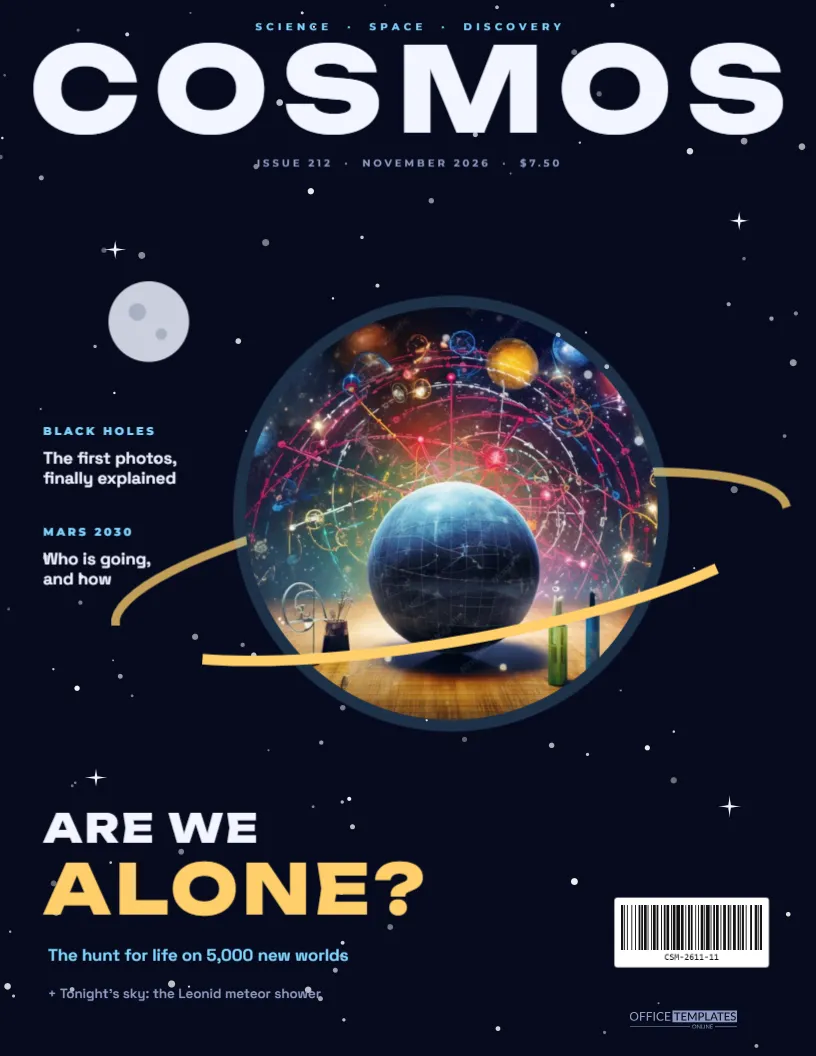
- A star field of more than a hundred tiny stars in varying brightness, with four larger four-pointed sparkle stars near the corners, all grouped as one object.
- The masthead, COSMOS, is set in wide, heavy white Unbounded capitals, with “SCIENCE · SPACE · DISCOVERY” in cyan above and the issue, date and price below.
- The planet: your photo fills a large circle with a soft cyan atmosphere glow. A golden ring tilts around it, with its back arc behind the planet and its front arc crossing below the planet’s centre, just like Saturn’s rings.
- A small grey moon with a few craters floats to the upper left.
- Cover lines in the left margin: “BLACK HOLES: The first photos, finally explained” and “MARS 2030: Who is going, and how”, with cyan kickers.
- The big question at the bottom: “ARE WE” in white and “ALONE?” in large gold letters, with “The hunt for life on 5,000 new worlds” and a note about tonight’s meteor shower.
- Bottom right: the barcode label and a small logo.
Fact-Check Your Cover Lines
Space is a subject where wonderful myths spread quickly. If your cover is for a class or a club, it’s a great chance to model good science writing. Here are a few common claims and how to phrase them accurately:
| Popular claim | More accurate cover line |
|---|---|
| “The Great Wall of China is visible from space” | “What astronauts can (and can’t) see from orbit” |
| “There’s no gravity in space” | “Why astronauts float: the truth about free fall” |
| “The dark side of the Moon never gets sunlight” | “The far side of the Moon, explained” |
| “Black holes suck everything in” | “How black holes really behave” |
| “Mars is red because it’s hot” | “Why Mars is rusty red” |
A cover line can be exciting and still true. Teachers can use this table as a quick lesson in writing headlines that don’t mislead.
Building Your Own Planet Cover
- Make your planet. Choose the circle, then Replace Image. A photo of a planet, the Moon or Earth fills the circle perfectly. So does a student’s face, for a “Scientist of the Month” cover.
- Rename the magazine. Double-click “COSMOS” to use your club’s or class’s name, such as “ORBIT”, “STARGAZER” or “ROOM 12 SCIENCE”.
- Write your cover lines. Replace the two stories in the left margin and the big question at the bottom with your topics.
- Recolour the ring. The front and back ring arcs are separate shapes; recolour both in the same shade, or delete them for a ringless planet.
- Adjust the star field. It’s one group, so move, resize or delete it all at once.
Classroom and Club Ideas
- Research project cover: each student makes a cover about a planet, with three cover lines summarising their research.
- Science fair display: print the cover large as the title board for a space-themed project.
- Astronomy club newsletter: use the cover lines to announce this month’s observing night and sky events.
- Planetarium or museum programme: a cover for a show or exhibition guide.
- Space-themed birthday: put the birthday child in the planet with the headline “Our Star Turns 7!”
Printing a Dark Cover
The deep-space background uses a lot of ink, so for class sets consider printing at a copy shop, or save ink with the PNG on screens and interactive whiteboards. For a single display copy, gloss photo paper makes the stars sparkle and the gold ring glow. Download the PDF for printing and a PNG for presentations and newsletters.
A Night-Sky Calendar for Club Covers
Astronomy clubs often theme each month’s newsletter around what’s visible in the sky. Some regular highlights to build a cover around (dates shift a little each year, so check a current sky almanac):
- January: the Quadrantid meteor shower and bright winter constellations like Orion.
- April: the Lyrid meteors and good views of galaxies in Leo and Virgo.
- August: the Perseids, one of the year’s most popular meteor showers.
- October: the Orionids and International Observe the Moon Night.
- December: the Geminids, often the richest meteor shower of the year.
Swap “+ Tonight’s sky: the Leonid meteor shower” at the bottom of the cover for the month’s highlight, and use the big question headline for your feature topic.
Fonts and Colours in This Design
The masthead and headline use Unbounded, a wide, modern display font that feels at home in science and technology. Cover lines use Space Grotesk, whose slightly quirky shapes suit scientific topics. The palette is limited to deep navy, white, cyan and gold: cyan for labels and highlights, and gold for the planet’s ring and the key word “ALONE?”. If you recolour, keep a single warm accent against the cool sky and the cover will stay striking.
Space Cover FAQs
Where can I find planet photos I’m allowed to use?
Space agencies such as NASA publish many images that are generally free to use for educational purposes. Check each image’s usage guidelines and credit the source inside your magazine.
Can I make the planet smaller?
Yes, but resize the ring arcs and glow circle along with the photo so they still line up.
Can I change the background colour?
Try a deep purple or a dark teal for a nebula feel. Keep it dark so the stars and gold text stay visible.
Is the moon editable?
The moon is made of simple circles, so you can move it, recolour it or delete it.
Explore the Universe
Turn a photo into a planet, ask a big question and fill the page with stars. Whether it’s a class project or a club newsletter, this cover invites everyone to look up.