Sixty seconds is a surprisingly long time when you are balancing a cookie on your forehead. Minute to win it games take simple household items, give players a minute and let the laughter do the rest. This template collects twelve Christmas challenges on one colourful page and adds a scoreboard on the second, so you can run the whole event from two sheets of paper.
Opening the Sheet: What You See
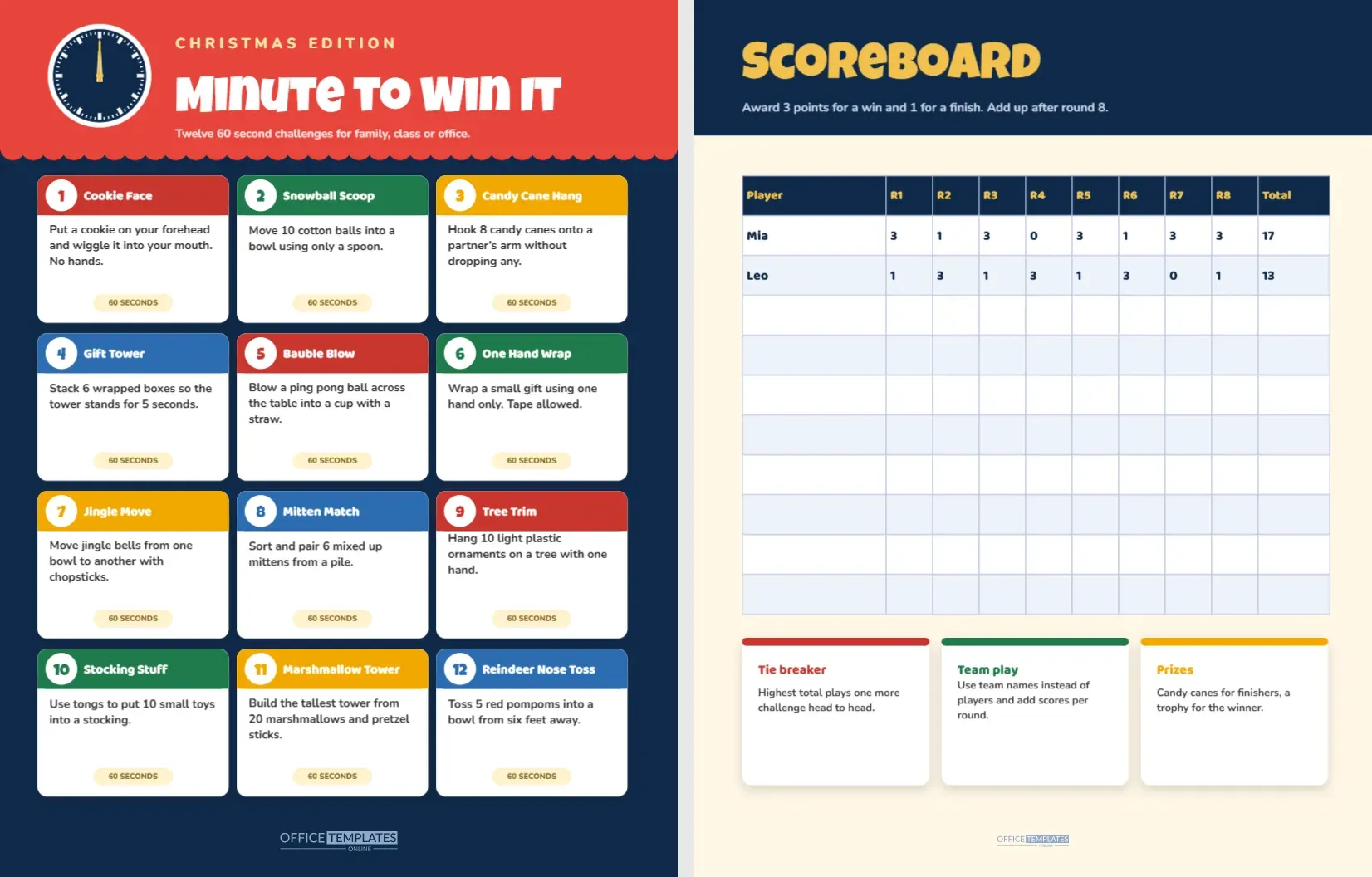
Page one has a navy background with a tomato red band across the top, its lower edge scalloped like icing. A big stopwatch with a navy face and a gold second hand sits at the left, and the title Minute to Win It stands beside it in a bold poster face. Below the band, twelve white cards sit in three columns and four rows. Each card carries a coloured header bar in red, green, gold or blue, a numbered circle, the challenge name, a plain sentence explaining the task and a pill labelled 60 SECONDS.
Step by Step: Running the Event
- Print both pages and cut out the cards, or leave the sheet whole and read the challenges from it.
- Gather the items. Most challenges need only a bowl, a spoon, some cotton balls or a few wrapped boxes.
- Choose a timer. A phone, a kitchen timer or a wall clock all work.
- Pick the first card, read the challenge aloud and hand the player the items.
- Start the timer and let the player try for sixty seconds.
- Score the round on page two and move to the next player.
The Twelve Challenges and What They Need
| No. | Challenge | Items to gather |
|---|---|---|
| 1 | Cookie Face | A flat cookie for each player |
| 2 | Snowball Scoop | Ten cotton balls, a spoon and a bowl |
| 3 | Candy Cane Hang | Eight candy canes |
| 4 | Gift Tower | Six wrapped boxes |
| 5 | Bauble Blow | A ping pong ball, a straw and a cup |
| 6 | One Hand Wrap | A small gift, paper and tape |
| 7 | Jingle Move | Jingle bells, chopsticks and two bowls |
| 8 | Mitten Match | Six pairs of mittens |
| 9 | Tree Trim | A small tree and ten light ornaments |
| 10 | Stocking Stuff | Tongs, a stocking and ten small toys |
| 11 | Marshmallow Tower | Twenty marshmallows and pretzel sticks |
| 12 | Reindeer Nose Toss | Five red pompoms and a bowl |
The Scoreboard Page
Page two has a navy header with the word Scoreboard in gold and a table with ten columns: Player, eight round columns marked R1 to R8 and a Total. The sample rows show how it works. Mia scores 3, 1, 3, 0, 3, 1, 3 and 3 for a total of 17, and Leo scores 1, 3, 1, 3, 1, 3, 0 and 1 for a total of 13. Eight blank rows follow, and the totals are plain text, so you add them up by hand and type the result. Three small cards at the foot explain a tie breaker, team play and prizes.
Safety and Common Sense
- Keep small items such as jingle bells and pompoms away from children under four.
- Use light plastic ornaments rather than glass.
- Clear the floor of cords and rugs before running any standing challenge.
- Check for food allergies before offering cookies, candy canes or marshmallows, and choose an alternative if needed.
Adapting Challenges for Your Group
Every card is editable. Click the title or the instruction and type something different. If you are running an office party, change the stocking challenge to paper clips and a mug, or swap the marshmallow tower for a stack of sticky notes. For a classroom, shorten the time to thirty seconds and shift the counts down. Keep the instructions to one or two sentences. Players should understand the rules in five seconds, since the clock starts as soon as they begin.
Scoring Ideas Beyond Three Points
The sheet suggests three points for a win and one for a finish, but you can use any system you like. A simple option is one point for each completed challenge. For teams, use a running total on a whiteboard. For long evenings, add a bonus round worth double points and use the tie breaker card to settle any deadlock. Whatever you choose, announce the rules before the first round, because players love the game more when scoring feels clear and fair.
Setting Up the Room
Minute to win it works best with a little staging. Clear a long table, put the items for each challenge in a labelled tray and keep the timer where everyone can see it. A small lamp or a string of lights on the table adds a game show feeling. Mark a spot on the floor with tape for the player to stand on, and ask spectators to stay behind a line, since enthusiasm tends to move people closer as the seconds run out.
Keeping a Large Group Moving
With fifteen or more people, run two or three challenge stations at once and rotate groups every few minutes. Each station gets its own card and its own timekeeper. A volunteer at each table notes the scores on a sticky note and passes it to the host, who adds them to the scoreboard. This keeps energy up and avoids long waits between turns.
Keeping Time Fairly
One person should hold the timer for the whole event, and everyone should agree that the timekeeper’s word is final. Say go clearly, call out the last ten seconds and finish with a firm stop so that nobody tries to squeeze in a final move.
FAQs About the Challenge Cards
How many players can join?
Any number. One player at a time goes while others cheer, or all players can try at once if each has their own set of items.
Can I use the sheet without cutting it?
Yes. Leave it whole, pin it to the wall and call the challenge by number.
Can I add a thirteenth challenge?
Duplicate a card, drag it to a blank sheet, change the number and write your own challenge on it.
Why does the clock say twelve?
It is only a design. The stopwatch is drawn from shapes, and its hands point at twelve to suggest a fresh start.