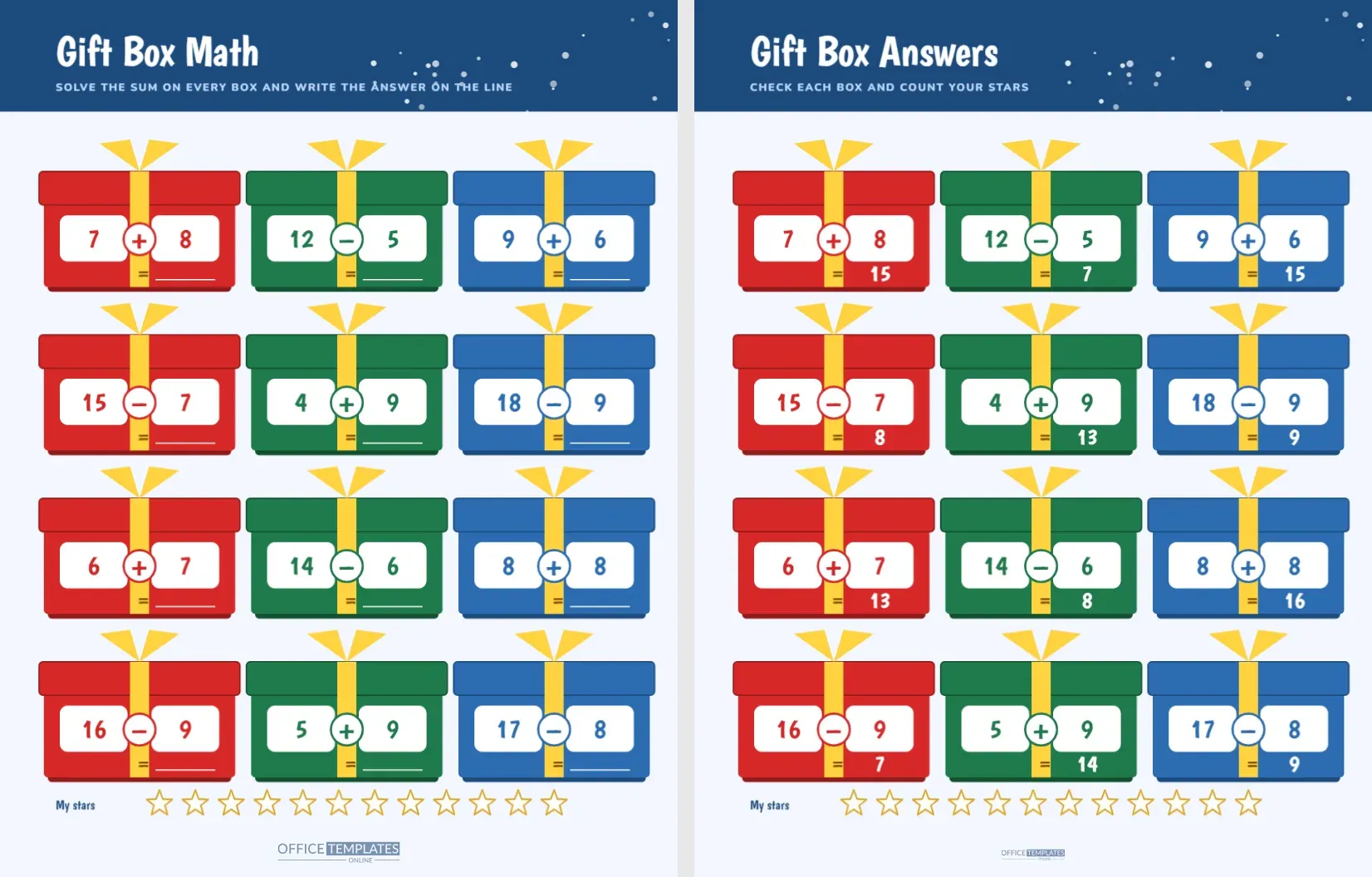
Maths practice is easier to swallow when it comes wrapped in a gift. These twelve boxes each hold one sum, and the child unwraps it by writing the answer on the line. Six sums are additions and six are subtractions, all within twenty, which is where many children in early primary school are working. Page two shows every answer.
The Twelve Sums
| Box | Sum | Answer | Skill |
|---|---|---|---|
| 1 | 7 + 8 | 15 | Adding across ten |
| 2 | 12 ? | ||
| 7 | 8 | Subtracting through ten | |
| 5 | 4 + 9 | 13 | Making ten, then adding three |
| 6 | 18 ? | ||
What a Gift Box Looks Like Here
Each box is a rectangle in red, green, blue or purple with a darker shadow at the base, a wider lid across the top and a bright yellow ribbon running down the middle. Two yellow bow loops stand on the lid. On the front of the box, two white rounded labels hold the first and the second number, and a small white circle in the centre carries a plus or a minus sign. An equals sign and a white line at the lower right show where the answer goes. The numbers are large and chunky so that they read easily from a short distance.
The Page Around the Boxes
A deep blue band across the top has the title Gift Box Math in a tall handwritten face and a line of capitals explaining that the sum on every box needs an answer on the line. Four rows of three boxes fill the middle, on a very pale blue page. Under them, a row of twelve outlined stars sits beside the words My stars, so a child can colour a star for each box solved. The logo sits at the foot of the page.
How to Use the Sheet
- Print page one and give the child a pencil.
- Read the first sum aloud together, then let the child solve it in their head or with counters.
- Write the answer on the line inside the box.
- Colour a star for each box finished.
- Check the answers against page two, or ask a grown up to mark them.
Strategies Worth Teaching
Several of the sums are chosen to practise tricks that make mental maths easier. In 7 plus 8, think of 7 plus 3 to reach ten, then add the remaining 5. In 9 plus 6, take one from the 6 to make the nine into ten, then add the other five. Doubles, such as 8 plus 8, are quick to remember, and near doubles like 6 plus 7 become easy when a child sees that they are one more than 6 plus 6. For subtraction, counting up from the smaller number often helps: 15 minus 7 is the same as how far you must go from 7 to reach 15.
The Answer Key
Page two has the same layout, with the heading Gift Box Answers and the correct answer written in each box in white, next to the equals sign. The same row of stars appears at the bottom, so a child can count how many they got right and colour that many stars. Parents who want to hand the page to a child to check their own work should print it separately and keep it out of sight until the sums are finished.
Changing the Sums in the Editor
The numbers and signs are ordinary text boxes. Click a number, type a new one and update the matching answer on page two. To change the level, make the numbers bigger for older children, or smaller, up to ten, for beginners. You can swap a plus for a minus by clicking the symbol in the white circle and typing another sign. If you want a multiplication practice sheet, replace the symbols with times signs and use the facts your child is learning. Keep the answers in step with the sums.
Keeping Maths Fun
- Race against a timer for a minute, and see how many boxes the child can finish.
- Roll two dice and make up new sums for a game of pairs.
- Use real wrapped presents for the early boxes to make the numbers feel real.
- Let the child write sums for a parent to solve, which swaps the roles.
Colour, Ink and Paper
The blue band and the coloured boxes use a fair amount of ink, so print in standard or draft mode if you are making many copies. If you prefer a lighter version, change the box colours to a pale tint in the editor and keep the numbers dark. Pencil shows clearly on the white answer lines. Use a paper of regular weight, and for repeated use, slip the page into a clear sleeve and write with a dry erase marker.
Linking the Sums to Real Presents
Numbers mean more when they belong to something real. Before starting the sheet, gather a small pile of wrapped presents or toy blocks and count them. Seven presents and eight more makes fifteen: let the child put the groups together and count them out loud. Then take away five from twelve and watch the pile shrink. After the concrete practice, the abstract sum on the page becomes a memory of something the child has done with their own hands, which is the most reliable way to build number sense.
Celebrating Progress With the Star Row
The row of twelve stars at the foot of the page is a simple reward system. Colour a star for each sum finished, and a second colour for each answer that was right the first time. Children like seeing the row fill up. If a child finds the sheet hard, set a smaller goal, such as colouring six stars today and six tomorrow. Keep the tone cheerful, and treat a wrong answer as a clue to try again instead of a mistake to hide.
Parent Questions About the Sums
Is the maths right for my child’s age?
Sums within twenty are typical for ages six to eight. Younger children can use counters, and older children can try the sums as a quick speed test.
Can I print only the boxes without answers?
Yes. Print page one for the child, and keep page two for yourself.
Can I add more boxes?
Duplicate a box in the editor, change its numbers and add the matching answer to the key. Keep the spacing even so that the boxes do not overlap.