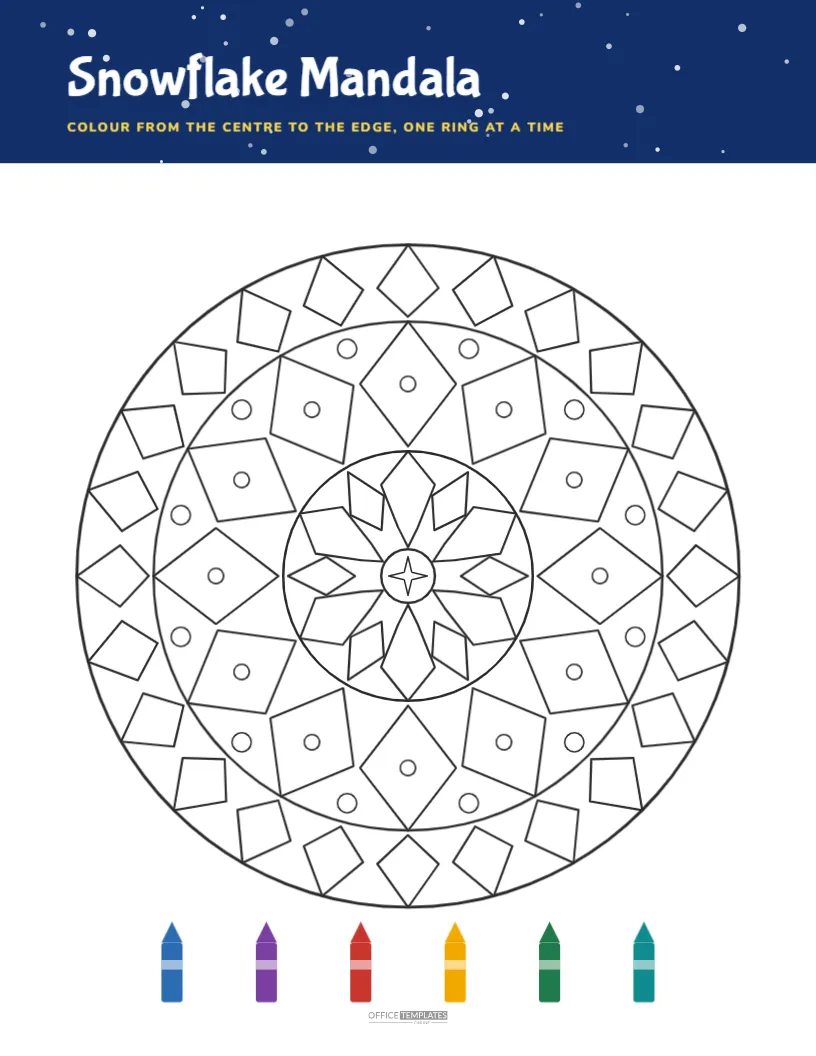
Not every child wants a tree and a Santa to colour. Older children and adults often prefer a pattern that rewards patience: a circle of repeating shapes that grows outward from a small centre. This snowflake mandala is built from four rings of petals and diamonds, each one a small colouring task of its own, and the whole design fits on one letter page under a deep blue winter band.
Reading a Mandala From the Middle Outward
| Ring | Shapes in it | Colouring tip |
|---|---|---|
| Centre | A small circle holding a four pointed star | Use the brightest colour for the heart of the design |
| Inner ring | Twelve elongated petals in two sets of six | Alternate two colours around the circle |
| Middle ring | Twelve diamond petals with small circles | Colour the circles in a contrasting shade |
| Outer ring | Twenty four small diamonds along the edge | Repeat a pattern of three colours |
What Makes It Look Like a Snowflake
A real snowflake has six arms. The design leans on that number: the centre is built from six arms with branching petals, the second ring has twelve shapes, which is two for each arm, and the outer ring has twenty four, which is four for each arm. The result is a pattern with six fold symmetry. If you hold the page up and turn it by a sixth of a turn, it looks the same. Children often notice this and enjoy turning the page around to check.
Seeing the Whole Mandala
A dark navy band with scattered white snow dots stretches across the top. The title Snowflake Mandala sits in white, with a gold line of capitals advising the colourist to work from the centre to the edge, one ring at a time. The mandala itself is nearly seven inches across and drawn in dark lines with a thin weight, which suits fine pencils and gel pens. At the bottom, six crayons in blue, purple, red, gold, green and teal show a palette that works well with the navy band.
Choosing a Colour Plan
- Pick two or three main colours and a neutral, such as white or silver.
- Colour the centre first, then work outward ring by ring.
- Repeat each colour at regular intervals so that the pattern keeps its rhythm.
- Use a lighter shade at the edge so the design fades like frost.
- Finish with fine details, such as dots, lines and shading inside the larger petals.
Colour Schemes That Work
- Icy blues: three shades of blue and a silver gel pen.
- Warm sunset: red, orange and gold with a deep purple edge.
- Jewel tones: emerald, ruby and sapphire alternating around the rings.
- Pastel winter: pale pink, lilac and mint on a cream background.
- One colour only: a single shade used in light, medium and dark strokes.
A Calm Activity With Real Benefits
Mandala colouring is a favourite relaxation tool for older children and teens. The repeating pattern gives the mind something simple to follow, which lowers worry and noise. Teachers use mandalas for quiet time, and families use them in the busy days before Christmas when everybody needs a break. A finished mandala makes a fine gift for a grandparent or a teacher, framed with a mount and a short note.
How the Pattern Was Drawn
The design was generated from a handful of base shapes, a diamond, a petal and a circle, rotated around the centre by equal angles. Each ring uses its own shape and its own spacing, so the whole pattern aligns perfectly. Every shape is a separate vector object with an outline and no fill, which means you can select a single petal and recolour it in the editor, delete it or ungroup it. A selection box drawn around a whole ring lets you move or resize that ring as a unit.
Customising the Mandala in the Editor
To preview a colour scheme before you print, fill the shapes with colour in the editor. Click a diamond, choose a fill and repeat for the others, or select a whole ring and apply one fill at a time. You can also change the outline colour from black to a deep navy for a softer look, or thicken the lines for a younger colourist. If you would like a smaller mandala for a bookmark or a card, scale the whole design and keep the line weight consistent.
Print and Paper Choices for Fine Detail
Fine pencils and gel pens need a smooth paper, so choose a heavier matt stock if you can. Marker ink bleeds through thin paper, and a sheet of scrap paper under the page prevents stains. A laser printer gives the sharpest lines, but an inkjet at high quality is fine. If you want a larger version, print on A3 or enlarge the page at a copy shop. The lines hold their sharpness at any size because they are vector shapes.
Colouring Group Ideas
- Family evening: print several copies and colour together with a playlist of carols.
- Study break: use one as a five minute reset between homework tasks.
- Gift tags: colour a copy, cut out circles and punch a hole for gift tags.
- Window decoration: trace the finished mandala onto tissue paper and stick it on a window.
Choosing Tools for Fine Work
Sharp coloured pencils give the cleanest edges in the small diamonds at the rim, while fine liners are better for the dots in the middle ring. Gel pens add sparkle on the navy band if you print the page with a white title area. Keep a pencil sharpener nearby, since dull points are the main reason mandala shapes look messy. A ruler is not needed, because the shapes already guide the hand.
Colourist Questions
How long does it take?
Most people spend thirty to sixty minutes, depending on how much shading they add.
Is it too hard for younger children?
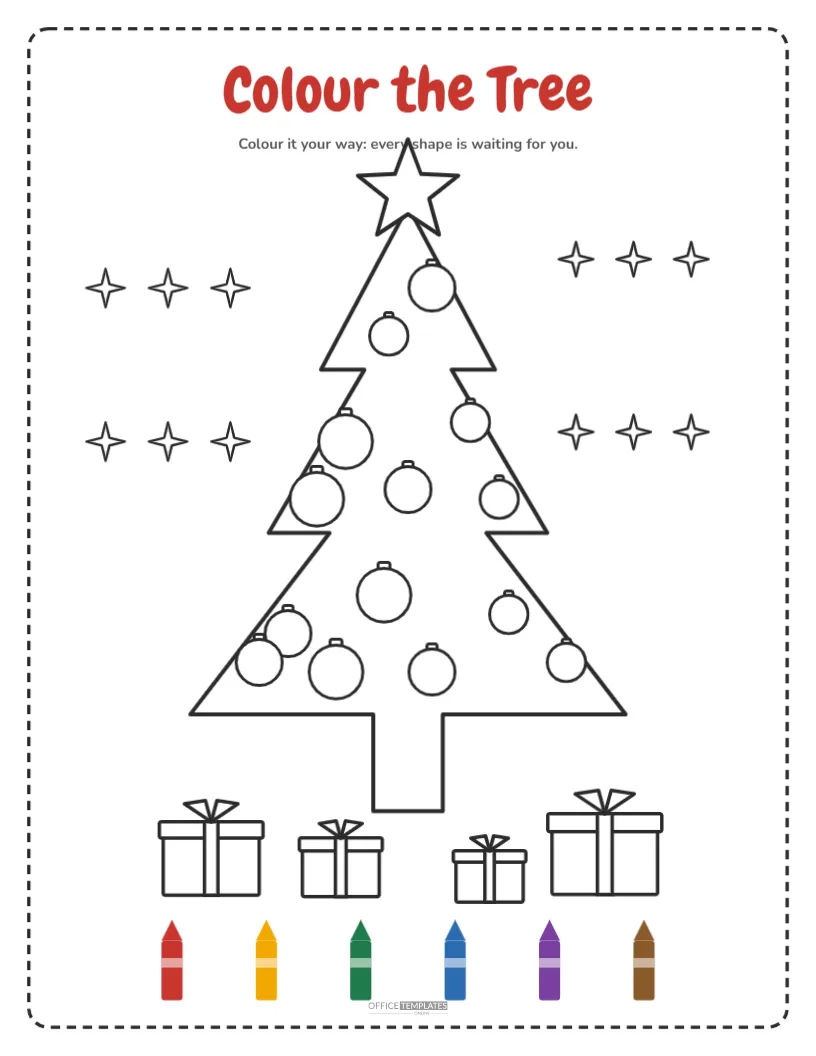
Children under seven may find the small shapes frustrating. The Christmas tree colouring page in this collection has larger spaces and is a better choice for them.
Can I print it in colour?
The page is designed for colouring, so a black outline on white paper works best. The navy band prints in colour but can be removed for a plain version.