Two pictures, one tiny set of changes and a pencil. Spot the difference is a puzzle that works for almost every age, because it asks nothing more than careful looking. This Christmas version puts two matching night scenes on one page, one above the other, and hides ten changes in the lower picture. Page two circles every answer and lists them in plain words.
Welcome to the Scene
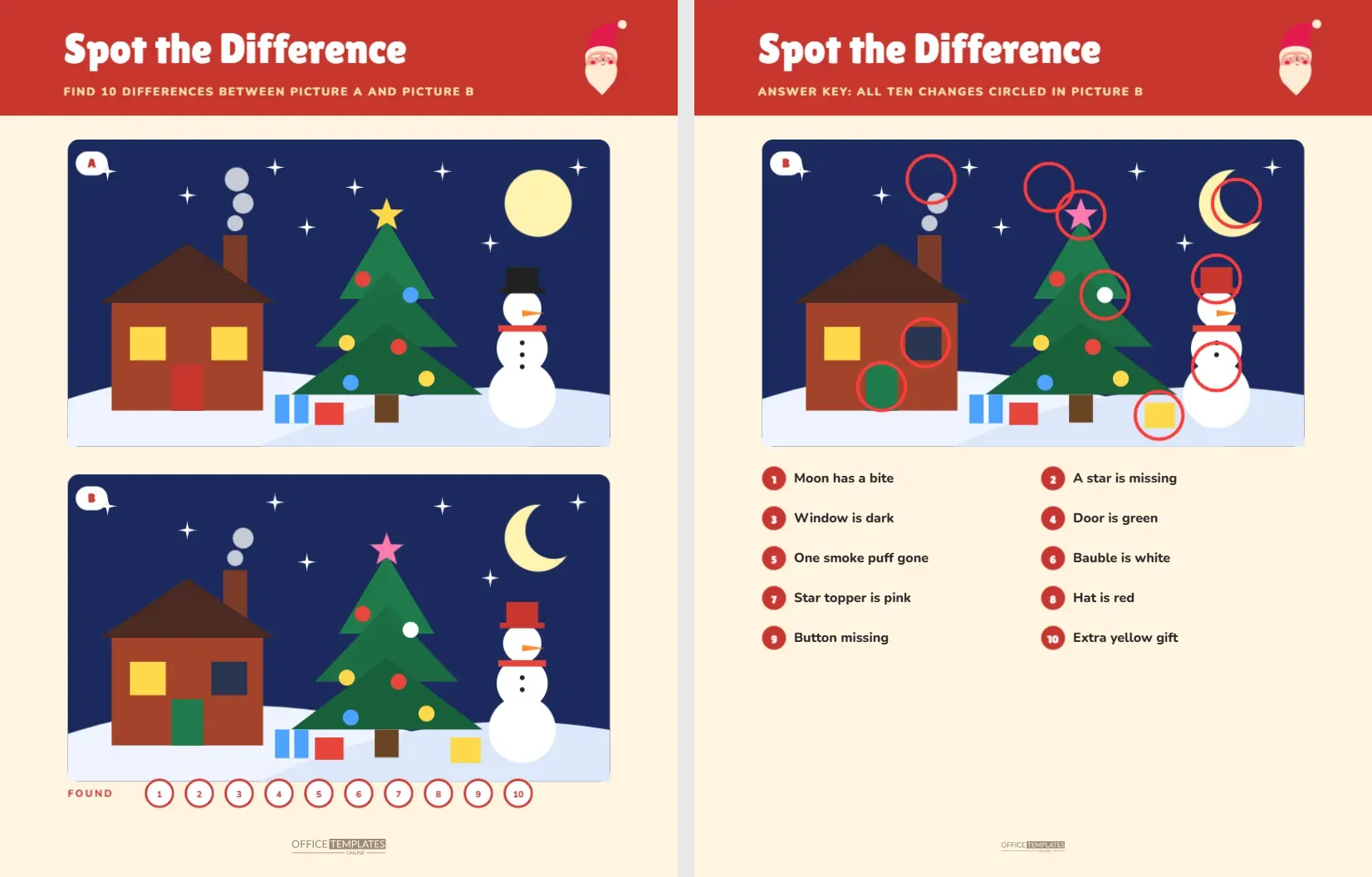
Each picture is a rounded rectangle of deep midnight blue. A pale full moon hangs in the upper right, small white stars twinkle across the sky and a pair of snowy hills roll across the bottom. On the left stands a brick coloured house with a brown roof, a chimney, two yellow windows and a red door. In the middle grows a three tier Christmas tree decked with coloured baubles and a golden star, with small wrapped gifts at its foot. A snowman in a black hat and red scarf waits on the right. Picture A and Picture B are tagged with small white labels in the top corner.
The Ten Differences in Picture B
| No. | Where to look | What changed |
|---|---|---|
| 1 | The moon | Full in A, a crescent in B |
| 2 | The sky | One star is missing in B |
| 3 | The house, right window | Lit yellow in A, dark in B |
| 4 | The door | Red in A, green in B |
| 5 | The chimney smoke | Three puffs in A, two in B |
| 6 | The tree baubles | One blue bauble is white in B |
| 7 | The star on the tree | Yellow in A, pink in B |
| 8 | The snowman’s hat | Black in A, red in B |
| 9 | The snowman’s buttons | Three in A, two in B |
| 10 | Beside the tree | A yellow gift appears in B |
Finding Differences Like a Detective
- Divide each picture into quarters in your mind and compare one quarter at a time.
- Compare colours first, since colour changes are the easiest to see.
- Count repeated objects, such as stars, puffs of smoke and buttons.
- Look at the edges and corners, where people often forget to check.
- Check the size and position of each object, not only its colour.
- Tick a number in the FOUND row every time you spot a difference.
The Counter at the Foot of the Page
Below picture B, a row of ten empty circles is labelled FOUND. Each circle holds a number from 1 to 10 in red. When a child finds a difference, they circle it in the picture and tick the next number. It gives young solvers a feeling of progress and tells the adult exactly how many remain. On the answer page this row is replaced by a list.
Answer Page With Circles and Legend
Page two shows picture B once, large, with a red circle around every change, numbered to match the list underneath. The list uses short plain phrases such as Moon has a bite, Door is green and Extra yellow gift. Parents can use it to give hints without ruining the puzzle. For example, say that there is one difference in the sky and one near the tree, then let the child hunt.
How the Differences Were Made
The scene is drawn from simple shapes in a function that runs twice, once for picture A and once for picture B. The second run switches ten settings, such as a colour, a count or a missing shape, so the two scenes match except for those changes. Because every shape is an editable vector, you can recolour the sky, replace the house colour or move the snowman before printing. If you change a detail in picture A, make the same change in picture B, or the number of differences will change.
Skills Children Practise
- Visual discrimination, the ability to tell small differences between similar images.
- Attention to detail and patience.
- Vocabulary, as children describe colours, counts and positions.
- Systematic searching, a basic scientific skill.
- Confidence, because every found difference is a small win.
Variations for Parties and Classrooms
Print one copy for every pair of children and see which pair finds all ten first. Project the page on a screen and let the class call out answers, with the teacher circling each one. Put the two pictures on opposite walls and let children walk between them, calling out what they notice. For older groups, create a new version by moving three shapes in picture B and asking guests to find only your changes. A prize for the most careful eye, such as a candy cane or a sticker, finishes the game nicely.
Editing and Making Your Own Version
Select any object in the scene to change its colour or size. To add a new difference, change a single feature in picture B only: a different colour for a window, a missing bauble, a smaller star. Keep the differences fair by avoiding changes so tiny they are invisible at normal print size. Update the answer page and the legend to match. If you remove a difference, remember to change the number of circles in the FOUND row, or the counter will not match.
Printing the Night Scenes
Dark backgrounds use more ink, but the scenes are only two rectangles and they print clearly. Use a sharp resolution, and consider printing on matt paper to avoid reflections. If you want to reduce ink, change the sky colour to a mid blue in both pictures. Children can circle differences with a coloured pencil or a washable marker.
Spot the Difference Questions
Are there really only ten differences?
Yes. The scenes match in every other detail, so a child who finds a difference that is not on the list may have misread a shape.
Can the puzzle be used on a tablet?
You can open the file in the editor on a tablet and zoom in, though printing is more comfortable for small hands.
What age is it for?
Children from about five can enjoy it with help, and older children and adults can use it as a quick brain exercise.