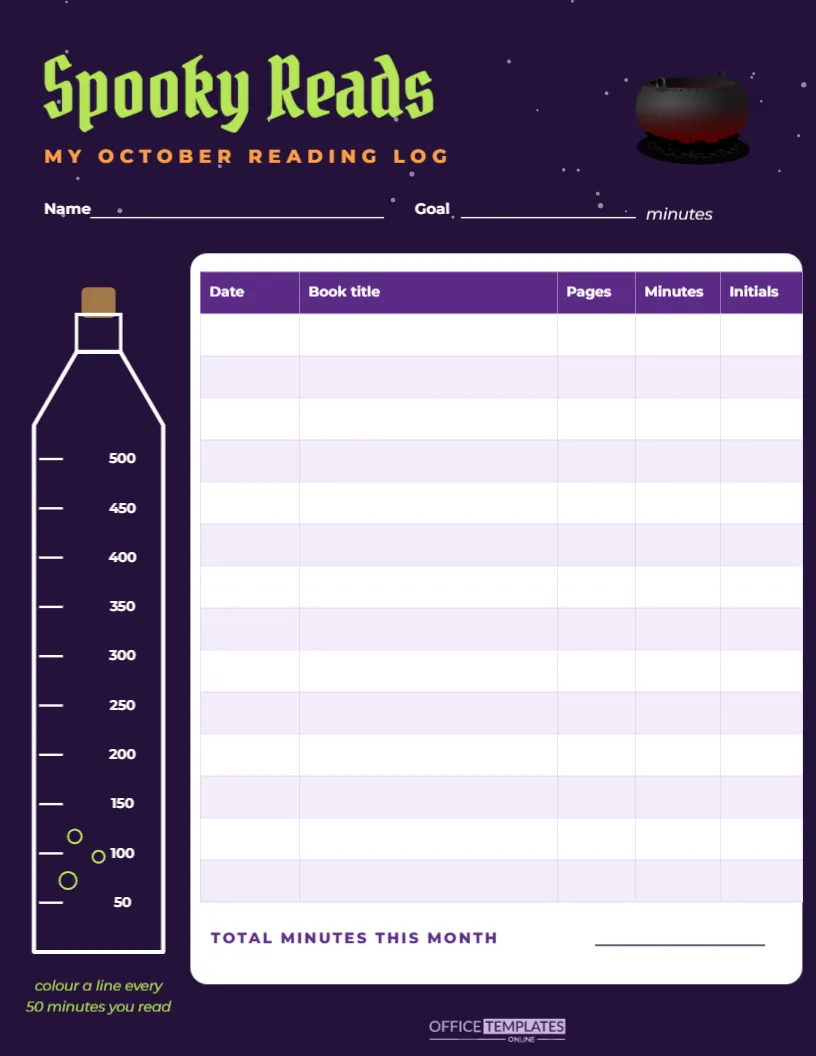
October is the perfect month to curl up with a slightly spooky book. Ghost stories, mysteries, witches, haunted houses, and friendly monsters: there is a whole shelf of Halloween reading waiting for young readers. This Reading Log turns the month into a challenge. Children record every book, every page count, and every minute, and watch a potion bottle fill up as they read.
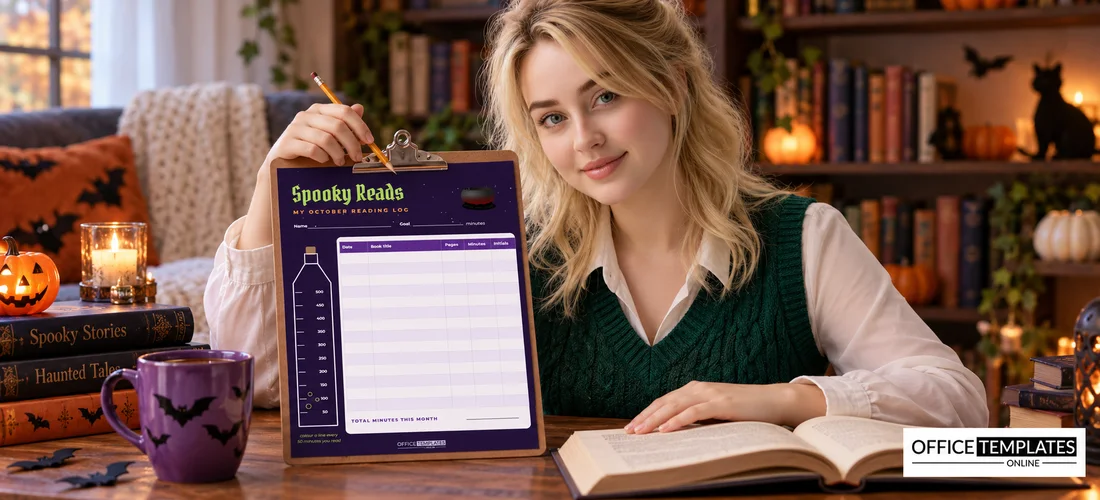
Spooky Reads at a Glance
The log is US Letter size, 8.5 x 11 inches, portrait, on a deep night-purple background speckled with tiny stars. Spooky Reads is written in bright lime green Pirata One, a gothic blackletter-style Google font, with MY OCTOBER READING LOG in orange capitals underneath. A bubbling black cauldron sits in the top-right corner. White writing lines collect the reader’s name and their minutes goal for the month.
On the left, a tall potion bottle outlined in white stands with a cork stopper. Ten tick marks run up the side, labelled 50 to 500 minutes, and a few lime bubbles float at the bottom. A small note says colour a line every 50 minutes you read. The right side is a white panel holding the reading table: Date, Book title, Pages, Minutes and Initials, with fourteen rows in alternating white and lilac. At the bottom of the panel, a line records the total minutes for the month, and the OTO logo sits in pale lilac at the foot of the page.
 Filling the Potion Bottle
The potion meter makes progress visible. Every time the total reaches another 50 minutes, the child colours up to the next line. Green makes the potion look like a bubbling brew, but purple, orange or rainbow stripes work just as well. If your child’s goal is lower, change the numbers on the bottle: double-click each label and type 25, 50, 75 and so on. If the goal is higher, change them to 100, 200, 300 and up to 1,000.
Editing the Reading Table
The log is built with the editor’s Table object, so you can adapt it easily. Click a cell to type, or use the Table options to add or remove rows and columns. Common changes include:
- Adding a Rating column where children give each book one to five pumpkins.
- Replacing Initials with Parent signature or Teacher check.
- Adding more rows for strong readers who finish lots of short books.
- Pre-filling the Date column with the school days of October.
Spooky Book Ideas by Age
| Age group | What to look for | Scare level |
|---|---|---|
| Ages 3 to 5 | Picture books about friendly monsters, costumes, and pumpkins | Not scary at all |
| Ages 6 to 8 | Early chapter books about witches, ghosts, and mystery clubs | Mildly spooky |
| Ages 9 to 11 | Middle-grade ghost stories and haunted house mysteries | Shivery but fun |
| Ages 12 and up | Classic gothic tales, retold folklore and graphic novels | Properly creepy |
Ask your school or local librarian for a list; most libraries put out a Halloween display in October.
Classroom Reading Challenges
Teachers can use the log for a class-wide October reading challenge. Each student keeps their own log, and the class adds up all the minutes on a giant cauldron poster in the hallway. When the class reaches its goal, everyone earns a reward: a spooky read-aloud with the lights off and flashlights, a book swap, or a costume reading day where children dress as a book character. Logs can also feed into a library’s autumn reading programme.
Making Reading a Habit
- Set a small daily target, such as 15 or 20 minutes.
- Choose the same time each day: after school, before dinner or at bedtime.
- Let the child pick the books, even if they choose the same series again and again.
- Read aloud together for younger children and count those minutes too.
- Audiobooks count, especially for children who are building confidence.
- Celebrate when the potion bottle is full.
Talking About the Books
A reading log records time, but conversation builds real readers. Once a week, look at the log together and ask a few easy questions: Which book was the spookiest? Which character would you want on your trick-or-treat team? Did any ending surprise you? Children who talk about what they read remember more and are more likely to pick up the next book on their own. For a classroom twist, let students recommend one book from their log to a friend on a sticky note shaped like a pumpkin.
Changing Colours and Fonts
The purple background, lime title and orange subtitle are all easy to recolour. Select the background to make it black, dark green or navy, or change it to white if you want to save ink when printing a whole class set. The cauldron is an editable vector illustration you can recolour from its swatches. The potion bottle is a group of simple shapes, so you can resize it or change the outline colour. Fonts are Pirata One for the title and Montserrat for everything else, both free from Google Fonts.
Printing a Month of Logs
Download the PDF and print on plain letter paper. For a class set, a lighter background saves a lot of toner. Two-sided printing lets you add a second page for strong readers. Keep the log in the child’s book bag or reading folder so it travels between home and school.
Reading Log Questions
Do comics and graphic novels count?
Yes. Any reading counts, and graphic novels are a great way to keep reluctant readers going.
What if my child does not reach the goal?
Celebrate the progress anyway. Every coloured line on the bottle is reading that happened.
Can the log be used in other months?
Change the subtitle to My Autumn Reading Log, and it works through November.
Can siblings share one log?
Give each child their own sheet, so every reader can see their own potion bottle fill up.
Who should initial each entry?
A parent or carer usually initials home reading; teachers sometimes check logs weekly.
Write your name and your goal, pick a spooky book, and start filling that potion bottle. The best stories are waiting on the next page.