The best Halloween costumes are rarely last-minute. They start with a spark of an idea, a sketch on the back of an envelope, and a hunt through the craft drawer, and they come together over a few weekends. A costume planner keeps that process organised, so you do not end up at a costume shop at 6 PM on October 30. This worksheet gives you space for ideas, a sketch, a supply list, and a budget, all on one page.
Designed Like a Sewing Pattern
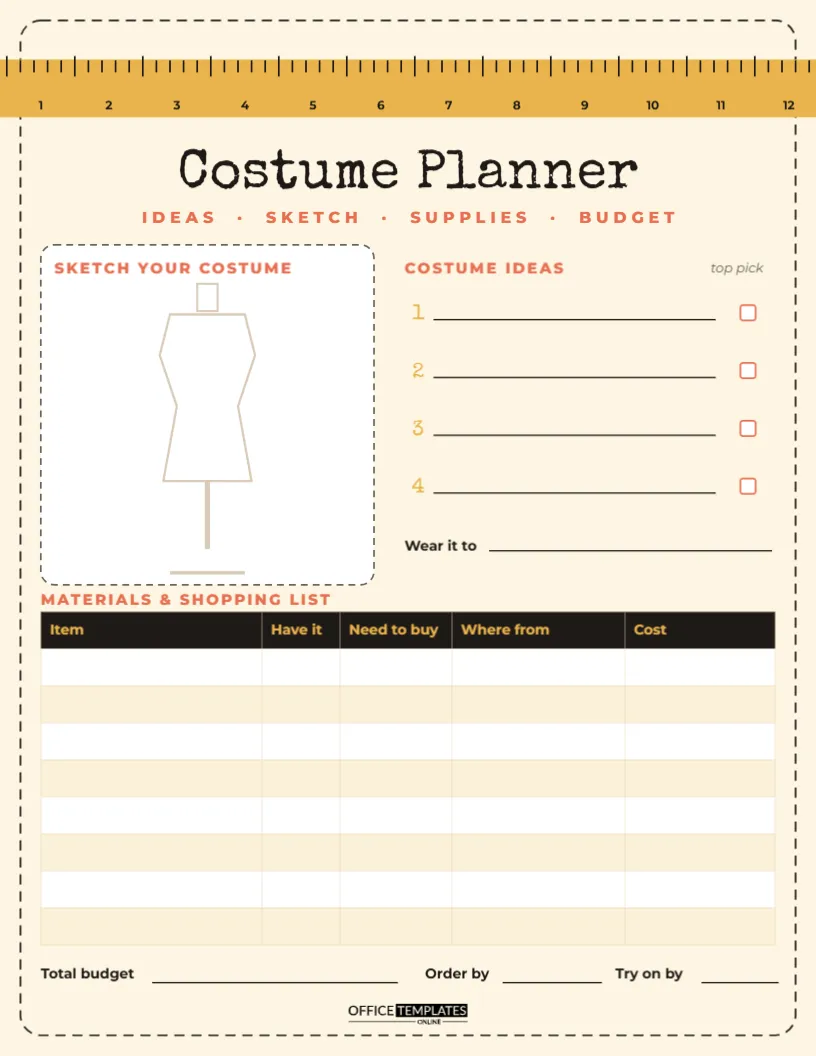
The planner is US Letter size, 8.5 x 11 inches, on a warm cream background with a dashed stitched border around the whole page, like the edge of a paper sewing pattern. Across the top runs a mustard-yellow tape measure with tick marks and numbers. Costume Planner is set in Special Elite, a typewriter-style Google font that looks like an old pattern label, with IDEAS · SKETCH · SUPPLIES · BUDGET in spaced coral capitals underneath.
The left side has a SKETCH YOUR COSTUME box with a dashed outline and a faint dress-form mannequin on a stand, ready to draw on. The right side has COSTUME IDEAS with four numbered lines and a top pick checkbox next to each, plus a Wear it to line. Underneath, a MATERIALS & SHOPPING LIST table has columns for Item, Have it, Need to buy, Where from, and Cost, with eight rows. At the bottom, lines collect the total budget, an order-by date, and a try-on-by date, with the OTO logo at the foot.
Step One: Brainstorm Freely
Write down four ideas without judging them. Think about favourite films, books, games, animals, jobs, puns and inside jokes. Some of the best costumes come from unexpected places: a smart cookie in a graduation cap covered in cookies, a night owl in pyjamas with owl ears, or a whole family dressed as a box of crayons. Once the four lines are full, tick the top pick box next to the idea that excites you most.
Step Two: Sketch the Look
The dress form in the sketch box gives you a body shape to draw on, so even non-artists can map out a costume. Sketch the main pieces, label the colours, and add notes such as felt ears, cardboard wings, or face paint whiskers. Children love this part; let them draw their own ideas, and you add the practical notes.
Step Three: List the Supplies
The table is the editor’s Table object, so you can type straight into it or print it and fill it in by hand. List every piece the costume needs, tick what you already own, and note where to buy the rest. Use the Table options to add rows for complex costumes. A typical list might look like this:
| Item | Have it | Need to buy | Where from | Cost |
|---|---|---|---|---|
| Black leggings | Yes | No | Wardrobe | 0 |
| Felt sheets | No | Yes | Craft store | 6 |
| Hot glue sticks | Yes | No | Craft drawer | 0 |
| Face paint | No | Yes | Pharmacy | 8 |
| Cardboard box | Yes | No | Recycling | 0 |
Step Four: Set a Budget and Deadlines
The bottom line asks for a total budget, an order-by date, and a try-on-by date. Setting a budget stops costume costs from quietly growing. An order-by date, about three weeks before Halloween, leaves time for online orders to arrive. A try-on-by date, at least a week before, gives you time to fix anything too tight, too long or too itchy.
Money-Saving Costume Tips
- Start with clothes you already own and build around them.
- Swap costumes with friends or cousins.
- Check charity shops for coats, hats and accessories.
- Use cardboard, paper plates and felt for props and details.
- Buy face paint instead of masks; it is cheaper and easier to see through.
- Shop post-Halloween sales for next year’s costume supplies.
Planning Group and Family Costumes
Group costumes are hugely popular, and they need extra planning. Print one planner per person, plus one for the group as a whole, and agree on the theme early. Use the Wear it to line for the events you are attending together, such as a school parade or a party, and assign who is buying shared materials. Group themes that work well include a box of crayons, a deck of cards, a superhero team, a garden of vegetables, or characters from a favourite family film.
Customising the Planner
Every label is editable. Change COSTUME IDEAS to PARTY COSTUME IDEAS, add more idea lines, or rename the table columns. The tape measure header and the dress form are grouped drawings you can recolour or remove. The mustard and coral palette can be switched to purple and green for a witchy feel, or to black and orange for classic Halloween. Fonts are Special Elite and Montserrat from Google Fonts.
Keeping the Costume Planner with Your Swatches
Download the PDF and print on letter paper. The cream background prints softly; change it to white to save ink. Keep the planner in a clear sleeve with any fabric swatches or printed inspiration pictures, so everything is in one place while you shop and sew.
Costume Planner Questions
What if my child changes their mind?
It happens! The four idea lines make it easy to switch to the second choice, and many supplies can be reused.
How do I make a costume warm enough?
Plan a base layer, such as thermal leggings and a long-sleeved top, under the costume, and choose pieces that fit over a coat on cold nights.
Is this planner for kids or adults?
Both. Children enjoy the sketch box, while adults find the budget and table useful.
Can I use it for cosplay?
Yes. Add rows to the table for complex builds and use the sketch box for reference notes.
Can I fill it in digitally?
Yes. Type in the ideas and the table in the editor, then download it as a PDF.
When should I start planning?
Early October is ideal for homemade costumes, and September for anything ordered online.
Print the planner, grab a pencil, and start brainstorming. This year’s costume is going to be the one everyone remembers.