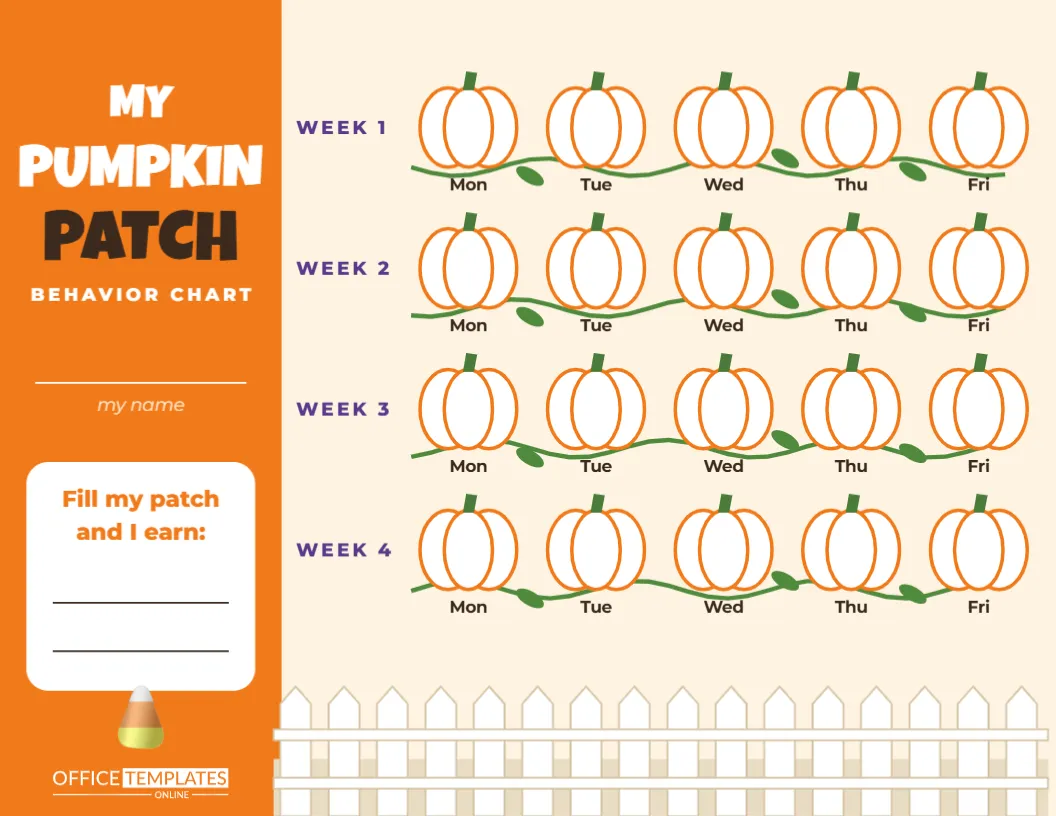
October is an exciting month for children, and sometimes that excitement spills over into bedtime battles, homework stalling, and very creative excuses. A themed behavior chart channels all that Halloween enthusiasm into something positive. Each good day earns a pumpkin, and a full patch earns a reward. This chart works at home or in the classroom, and kids love watching their patch fill up.
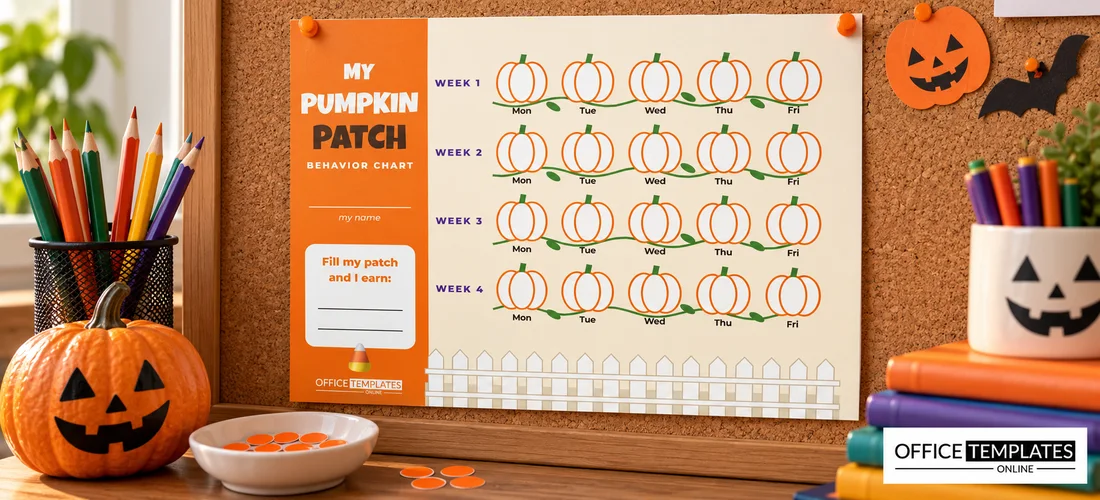
Growing a Patch, One Good Day at a Time
The chart is landscape, 11 x 8.5 inches, US Letter turned sideways. A bright orange band runs down the left side with the title stacked in chunky Luckiest Guy letters: MY, PUMPKIN, PATCH, with BEHAVIOR CHART underneath. Below the title is a line for the child’s name, then a white rounded box that reads, Fill my patch, and I earn, with two lines to write the reward. A small candy corn and the OTO logo sit at the bottom of the band.
The main area is a cream pumpkin patch with four rows labelled WEEK 1 to WEEK 4. Each row has five white-outline pumpkins with green stems, one for each school day from Monday to Friday, joined by a curling green vine with little leaves. A white picket fence runs along the bottom of the chart, closing in the patch.
Three Ways to Fill the Pumpkins
- Colouring: the child colours a pumpkin orange at the end of each good day. Simple and satisfying.
- Stickers: pumpkin, ghost or star stickers on each outline. Round stickers about 2 cm across fit well.
- Stamps: a Halloween stamp and an ink pad make it feel official.
Whatever you choose, let the child do the filling in. Putting the sticker on themselves is half the reward.
Choosing the Behaviour to Track
Behavior charts work best when they focus on one clear goal at a time. A vague goal like be good is hard for a child to understand. Pick something specific and positive, and write it at the top or tell the child clearly.
| Age | Example goal | What counts as a pumpkin |
|---|---|---|
| 3 to 5 | Getting dressed on your own | Dressed before breakfast with no more than one reminder |
| 3 to 5 | Staying in bed at bedtime | Lights out and staying in bed |
| 6 to 8 | Homework before screens | Homework finished before any tablet time |
| 6 to 8 | Kind words with siblings | A day without name-calling |
| 9 to 11 | Morning routine on time | Ready at the door by the agreed time |
| Classroom | Listening during carpet time | Following the class rules for the day |
Rewards That Actually Motivate
The reward box on the left is where you write what a full patch earns. Small, experience-based rewards often work better than toys. Popular ideas for a Halloween chart include choosing the family’s Halloween movie, an extra stop while trick-or-treating, carving the biggest pumpkin, baking spooky cookies together, a trip to a pumpkin patch or corn maze, or picking a special Halloween treat. You can also add mini rewards for each completed week, such as a sticker sheet or an extra bedtime story.
Tips from Parents and Teachers
- Start the chart on a Monday, so each row matches a week.
- Keep it somewhere visible: the fridge, the bedroom door or a classroom noticeboard.
- Praise the behaviour, not just the pumpkin: You got dressed all by yourself!
- Never take a pumpkin away once it is earned. A missed day just stays empty.
- If the goal is too hard, make it smaller. Success builds motivation.
- Celebrate when the patch is full, even if it took longer than four weeks.
Changing the Chart
Every word is editable. Double-click to change the title, the week labels, or the day names. For weekend charts, change Mon to Fri to Sat and Sun, or adjust the labels to Day 1 to Day 20. The four vines are separate groups, each containing its pumpkins, leaves, and day labels, so you can delete a week for a shorter chart. The orange band can be recoloured to purple, green, or the child’s favourite colour, and the picket fence is a single group you can recolour or remove. Fonts are Luckiest Guy and Montserrat, free Google Fonts.
Talking About the Chart with Your Child
Introduce the chart as a game, not a punishment. Sit down together, explain the goal in one sentence, and let your child choose where to hang it. At the end of each day, ask them whether they think they earned a pumpkin, and talk about what went well. Children who help judge their own day tend to take more ownership of the goal, and the short chat becomes a calm, positive part of the bedtime routine.
Using It in the Classroom
Teachers often use the chart for individual students with a specific goal, or print one per table group as a team chart. For a whole-class version, enlarge the chart to tabloid size (11 x 17 inches) at a print shop and fill one pumpkin each day the class meets its goal. When the patch is full, the class earns a Halloween reward such as a costume day, a spooky story session, or a pumpkin-decorating afternoon.
Printing the Patch
Download the PDF and print on letter paper in landscape orientation. For a chart that survives a month on the fridge, use card stock or slip it into a sheet protector and use dry-erase stickers. Print one chart per child if you have siblings, so nobody argues over whose pumpkin is whose.
Behavior Chart Questions
What age is this chart best for?
Children aged about three to ten respond well to sticker charts. Older children may prefer a points system.
What if my child misses a day?
Leave that pumpkin empty and move on. The next day is a fresh chance.
Can I use it after Halloween?
Yes. Pumpkins suit the whole autumn season, through to Thanksgiving.
How many rewards should there be?
One main reward for a full patch, and perhaps a small treat for each full week.
Write your child’s name and reward, stick the chart on the fridge, and start growing that patch. By Halloween, it should be bursting with pumpkins.