Proving Experience in Health Care
In health care, experience is the main credential. Nurses, technicians, carers and therapists change employers, apply for registration, move between hospitals and sometimes work in several countries. Each step involves proof that the person has worked in a real clinical setting, in a specific role and for a stated time. A certificate of employment for health care workers records that, and it is one of the documents most often requested after a degree or licence.
Red Bands and a Grey Title Box
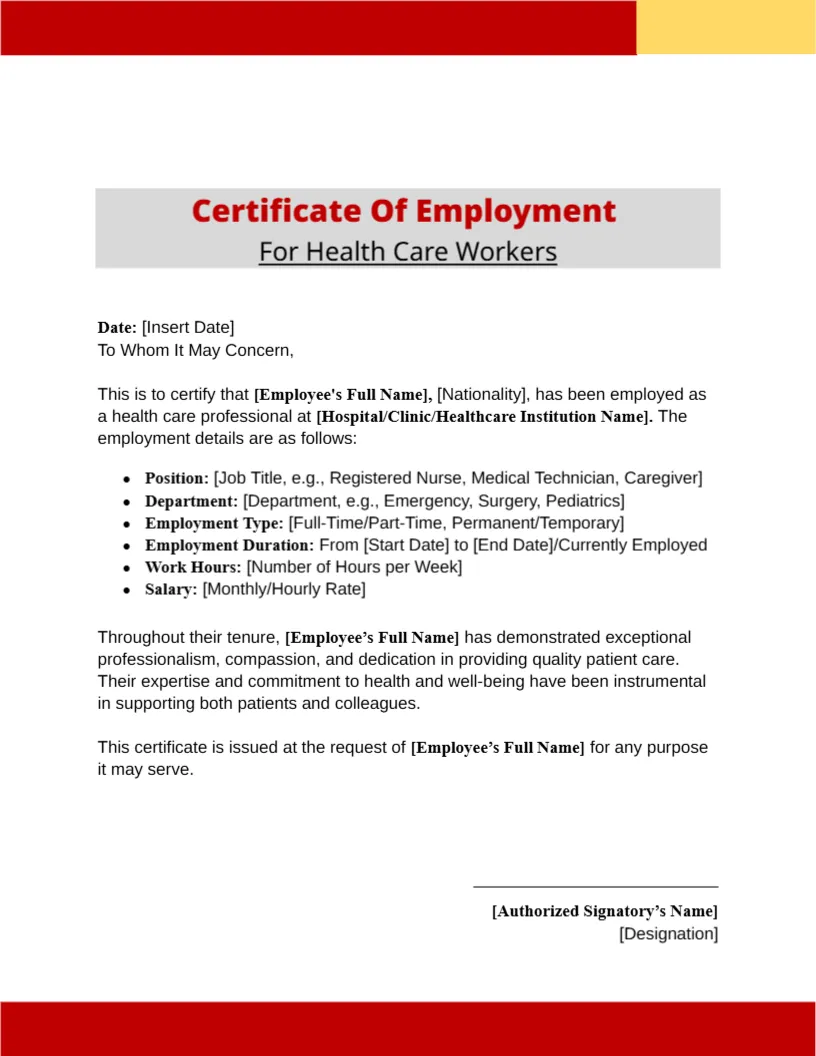
The page is Letter size portrait, 8.5 x 11 inches. A thick red band runs across the top with a short yellow block at its right end, and another red band closes the bottom of the page. In the upper middle, a grey box holds the title: Certificate Of Employment in red, with For Health Care Workers underlined in black below it. The body type is a clean serif and sans pairing, Noto Sans and Arimo.
The letter begins with a Date line and To Whom It May Concern, then says [Employee’s Full Name], [Nationality], has been employed as a health care professional at [Hospital/Clinic/Healthcare Institution Name]. The list shows Position (for example Registered Nurse, Medical Technician, Caregiver), Department (for example Emergency, Surgery, Pediatrics), Employment Type, Employment Duration, Work Hours and Salary. A paragraph praises professionalism, compassion and dedication to quality patient care, and says expertise and commitment to health and well-being have supported patients and colleagues. The letter closes with the usual line and a signature block.
Details That Matter in Clinical Work
- The exact position and grade, since registration bodies compare titles.
- The unit or department, such as intensive care or maternity.
- Whether shifts were day, night or rotating.
- Hours per week, which show clinical hours completed.
- Any registration or licence number, if the reader needs it, as an added bullet.
Privacy Comes First
The letter must never contain patient information or details of incidents. Keep it to employment facts and general conduct. If the receiving body asks for a reference about competence, that should be a separate letter written by a clinical supervisor.
Hours, Pay and Contracts
Health care contracts are often complicated, with banked hours, overtime, agency shifts and on call work. Decide whether to state a base rate or an average. For registration purposes, the number of hours worked in a period can be more important than pay, so make sure Work Hours is accurate.
Who Signs a Clinical Employment Letter
A nursing director, human resources manager or department head should sign, using the institution’s letterhead. Add an official stamp where required. Many foreign registration offices ask for the letter to be sent directly from the employer, so confirm the process with the employee.
Printing the Red Bands
The red bands use a fair amount of ink. Use the standard quality setting on 90 to 100 gsm paper, and test one copy. If your hospital has branded stationery, you may prefer to copy the text onto that and drop the coloured bands.
For related professions, see the teaching staff certificate and the IT professionals certificate. More are in employment certificates.