Make Daily Classroom Behavior Easier to See, Track, and Encourage
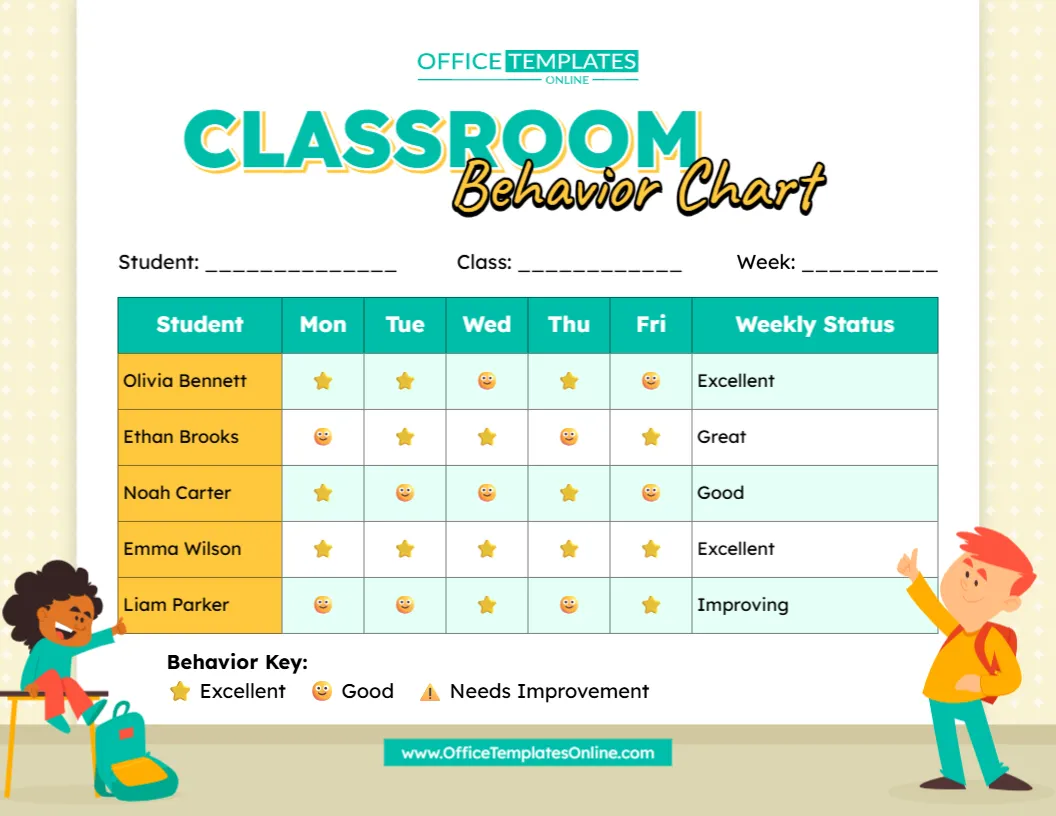
Managing classroom behavior becomes easier when teachers have a simple and consistent way to record how students are doing. This Classroom Behavior Chart template provides a colorful visual system for tracking individual student behavior from Monday through Friday and summarizing each student’s progress at the end of the week.
Instead of writing lengthy notes every day, teachers can use easy-to-recognize symbols to record daily behavior. The included Behavior Key uses a star for Excellent, a smiley face for Good, and a warning symbol for Needs Improvement. A separate Weekly Status column provides room for an overall summary such as Excellent, Great, Good, or Improving.
The chart is fully customizable. You can edit it online directly in your browser without creating an account or logging in. Replace the sample student names, change behavior categories, modify the symbols or wording, and adapt the chart to your own classroom system. When you are finished, download your customized classroom behavior chart in PDF, PNG, or JPG format.
One Chart for the Entire School Week
The template is arranged around a straightforward weekly table. This allows a teacher to look across a student’s row and quickly see how the week has progressed.
The chart contains columns for:
- Student – enter the names of the students being monitored.
- Monday – record behavior for the first school day.
- Tuesday – continue the daily record.
- Wednesday – mark the student’s midweek behavior.
- Thursday – add another daily observation.
- Friday – complete the week’s tracking.
- Weekly Status – summarize the student’s overall progress for the week.
There are also spaces above the table for Student, Class, and Week information. Since the template can be edited, these fields can be changed to suit the way you plan to organize or use your chart.
A Visual Behavior Key Students Can Understand
One of the most useful features of this classroom behavior chart is its visual rating system.
Rather than filling every cell with written comments, the teacher can use symbols to represent different levels of behavior. The original template provides three simple categories:
Excellent – for especially positive classroom behavior
Good – for behavior that meets expectations
Needs Improvement – for behavior that requires more attention
A visual system like this can make daily tracking quicker for teachers while also making the chart easier for students to understand.
You are not limited to these three categories. If your classroom already uses its own behavior levels, you can customize the template and replace the original labels with terminology that students already recognize.
Track Daily Behavior Without Losing the Weekly Picture
Behavior can change from one day to another. A student may have a difficult Monday but show noticeable improvement during the rest of the week. Another student may consistently demonstrate positive classroom habits across all five days.
Looking only at one day’s behavior may miss that wider pattern.
This weekly classroom behavior chart places all five school days side by side. Teachers can therefore use it to identify consistency, improvement, or areas that may need additional support.
The Weekly Status column adds another layer to the chart by allowing a short overall assessment after the daily entries have been considered. This can help distinguish between a temporary issue and a pattern that appears throughout the week.
Use the Chart to Recognize Positive Behavior Too
Behavior tracking does not have to focus only on mistakes or problems. This template can also be used to make positive classroom behavior more visible.
Teachers might use the chart to recognize students for following classroom expectations, staying focused, participating appropriately, cooperating with others, completing classroom tasks, being prepared, showing respect, or making an effort to improve.
This approach can make the chart useful for reinforcing the behaviors teachers want to encourage rather than simply recording when something goes wrong.
The exact expectations can be adjusted according to the age of the students, classroom rules, school policies, and the teacher’s own behavior management approach.
Customize the Classroom Behavior Chart Online
Every teacher manages a classroom differently. A behavior system that works well in one class may need changes before it makes sense in another.
That is why this template can be customized online before you download it.
The browser-based editor lets you personalize the existing design without having to build a new chart from a blank page. No login is required to start editing.
You could replace the sample names with your students’ names, change the weekly status labels, rewrite the Behavior Key, or modify headings to reflect your own classroom terminology.
For example, instead of Excellent, Good, and Needs Improvement, you might prefer categories such as Outstanding, On Track, and Keep Working, or another set of terms used by your school.
You can make the chart as close to your existing classroom routine as needed.
Suitable for Different Classroom Behavior Goals
The template can be adapted to track general behavior or a more specific classroom expectation.
A teacher might use it to monitor:
- Following classroom rules and instructions
- Respectful behavior
- Staying focused during lessons
- Positive participation
- Cooperation and teamwork
- Completing assigned tasks
- Being prepared for class
- Listening during instruction
- Using appropriate classroom manners
- Progress toward an individual behavior goal
For a particular student, you might customize the chart around one or two specific goals rather than general classroom behavior. For a whole class, you could use broader categories that apply to everyone.
This flexibility makes the same basic template useful for different grade levels, subjects, and learning environments.
Helpful for Weekly Check-Ins and Progress Discussions
Because the chart shows an entire school week in one place, it can provide a useful reference for regular check-ins.
A teacher can review the week’s entries with a student and talk about what went well and what could be improved during the following week. When appropriate and consistent with school procedures, the chart may also support discussions with parents, guardians, classroom support staff, or other educators.
For best results, behavior markings should be connected to clear and observable expectations. This helps students understand what each rating represents and what they can do to improve.
The chart is intended as an organizational and classroom feedback tool. It should not be treated as a diagnosis or a complete assessment of a student’s needs.
An Easy-to-Read Design for Busy Classrooms
A classroom tracking tool is only useful if teachers can use it without adding unnecessary work to an already busy day.
This template keeps the main tracking area compact. Student names appear in the first column, the five weekdays sit next to each other, and the final status appears at the end. The Behavior Key is displayed below the table for quick reference.
The school-themed illustrations and friendly visual style make the chart suitable for an educational setting, while the structured table keeps attention on the actual behavior record.
If you plan to display a completed chart where other students or visitors can see it, consider your school’s privacy requirements and whether individual student behavior information should be publicly visible. The editable design allows you to change names or adapt the format where necessary.
PDF, PNG, or JPG – Choose the Format You Need
Once the chart looks the way you want, you can download the completed design in three useful formats: PDF, PNG, and JPG.
PDF is a convenient option when you plan to print the chart or save it as a document. PNG and JPG provide image versions that can be useful for digital classroom materials or other appropriate uses.
There is no need to download the original and accept its wording as-is. Customize it online first, then save the version that fits your classroom.
Build a More Consistent Classroom Behavior Routine
Consistency can make behavior expectations easier for students to understand. When the same simple system is used throughout the week, students can see how their daily choices contribute to their overall progress.
This editable Classroom Behavior Chart template gives teachers a ready-made structure for doing exactly that. It combines Monday-to-Friday behavior tracking, individual student rows, visual behavior symbols, a weekly status column, and an easy-to-follow behavior key in one classroom-friendly design.
Use the template as provided or personalize it for your own behavior system. Edit the Classroom Behavior Chart online with no login required, make the changes you need, and download the finished version as a PDF, PNG, or JPG for your preferred use.