Clubs run on enthusiasm, not paperwork, which is exactly why their minutes so often go missing. Then a committee member asks who agreed to pay for the hall, or a new treasurer wants to know last year’s subscription rate, and nobody can say. A light, cheerful minutes page changes that. It is quick enough for a volunteer secretary to finish over a cup of tea, and it records the few facts a club genuinely needs later.
A Line of Pennants Across the Top
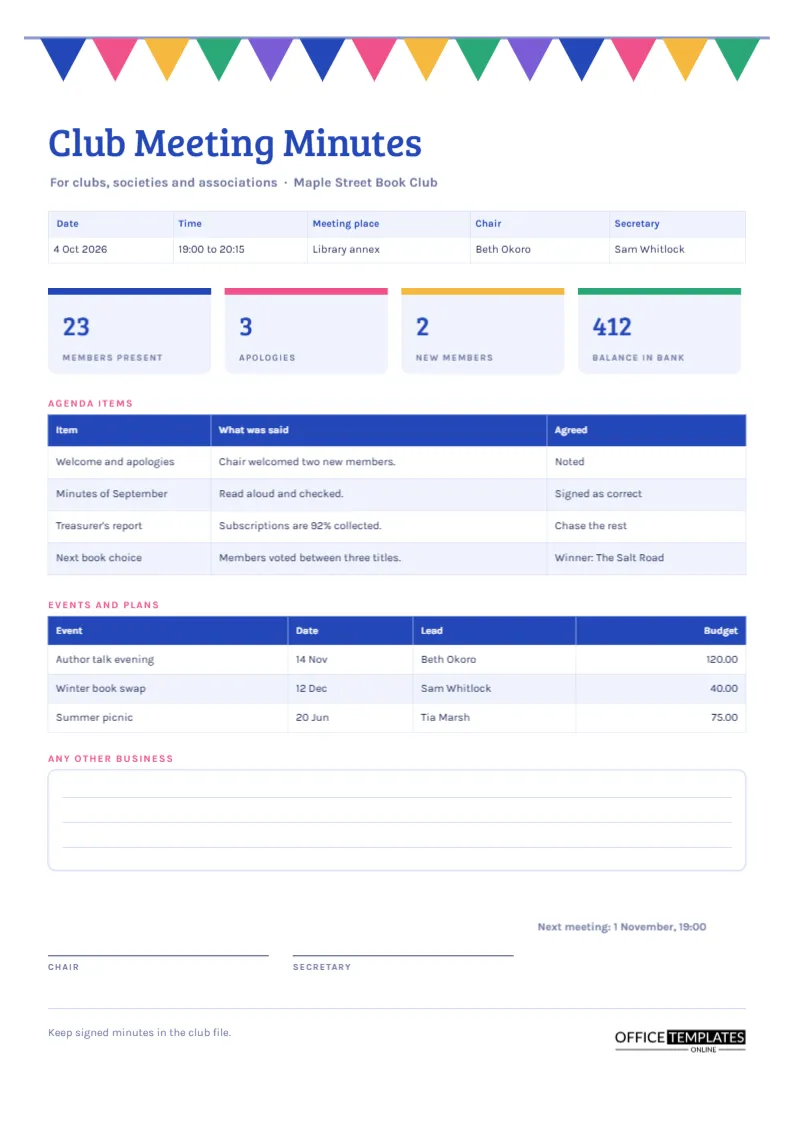
The page opens with a string of fourteen triangular flags in blue, pink, yellow, green and violet, hung from a fine rope that runs across the top. It is the same kind of bunting you might hang for a village fete or a society anniversary, and it sets the tone straight away: this is a friendly record, not a legal ordeal. Below it, the title Club Meeting Minutes appears in blue Bree Serif, followed by a grey-blue line naming the sample group, the Maple Street Book Club.
Quick Facts Strip and Four Count Tiles
A five-column strip lists date, time, meeting place, chair and secretary. Right under it, four tiles with coloured tops show the numbers a club most often needs: members present, apologies, new members and the balance in the bank. In the sample, twenty-three members attend, three send apologies, two join, and the bank holds 412. These four figures are the heartbeat of any club, and writing them at every meeting builds a history that is surprisingly useful at the annual meeting.
Agenda Ideas for Different Kinds of Clubs
The agenda table is deliberately general. To help you adapt it, here are typical items for several types of groups.
| Type of club | Items worth a row | Typical decision |
|---|---|---|
| Book club | Last book, next book, venue | Vote on the next title |
| Sports club | Fixtures, kit, ground fees | Approve a team entry fee |
| Garden society | Show date, plant sale, speakers | Book a guest speaker |
| Hobby or craft group | Workshops, materials, exhibition | Agree a budget for supplies |
| Alumni association | Reunion, newsletter, donations | Fix the reunion date |
What Was Said, and What Was Agreed
The main table has three columns: item, what was said and agreed. Keep the middle column to a sentence and the last column to the decision. In the sample, the treasurer reports that subscriptions are 92 percent collected, and the group agrees to chase the rest. Members voting between three book titles are recorded as a result, not a debate: the winner is The Salt Road.
Events and Plans With a Budget Column
A club without events is a mailing list, so the second table is devoted to them. Each row names an event, a date, who leads it, and the budget, with figures right-aligned so amounts line up. The sample lists an author talk evening for 120, a winter book swap for 40 and a summer picnic for 75. A treasurer can add the budget column in seconds, which makes the page an informal planning tool as well as a record.
Any Other Business Without the Chaos
A rounded box with ruled lines holds anything that came up at the end. Many clubs find that this section can swallow an hour. A simple habit helps: write each item as a single line, and ask whether it needs a decision tonight or can wait for the next agenda. The page offers four lines, which also quietly limits how much can be tabled.
Signatures and the Next Date
Two lines for the chair and the secretary stand at the foot, with the next meeting date set beside them. A small footer reminds you to keep the signed minutes in the club file. Even a small society benefits from a physical or digital folder that holds these pages in date order, because they become part of its history.
Recolouring the Bunting
The bunting is one grouped object, so you can select it and move or resize it. To change colours, ungroup it and select each flag individually, or recolour the title and tiles instead to match your own club colours. If your club has a crest, place it to the left of the title and shift the heading slightly right.
Handling Apologies and New Members
Two of the tiles deal with people. Apologies matter because they show who was not present when a decision was made, and new members matter because a club needs to remember who joined and when. List the names in the notes box if you wish. A simple record of arrivals can later help with membership renewals and welcome letters.
Keeping Records Simple for Volunteer Secretaries
Volunteer secretaries often change every year or two. A standard page means the next person can read the last three years of minutes in one sitting and understand how the club runs. Add a short handover note at the front of the folder explaining where the club keeps its bank details, its insurance and its membership list.
Printing the Page for the Club Folder
The page is A4 portrait. The bunting prints best in colour, but a black and white copy is perfectly readable. If you print one copy per meeting, punch holes in the margin and keep the pages in a ring binder labelled with the year.
Sharing With Members
A PDF of the minutes can be emailed to members or posted in the group chat after each meeting. Members who could not attend feel included, and everyone has the chance to point out mistakes before the next gathering.
Questions From Club Secretaries
Do we need minutes if we have no money?
Even a club with no funds benefits from recording decisions about events, rules and membership, so that disputes can be settled by looking at a page.
Can I add a line for subscriptions collected?
Yes. Add a row to the agenda table or retype one of the tiles to show the figure.
Is this suitable for a student society?
It works well. Change the member count tile to show committee and general members separately.