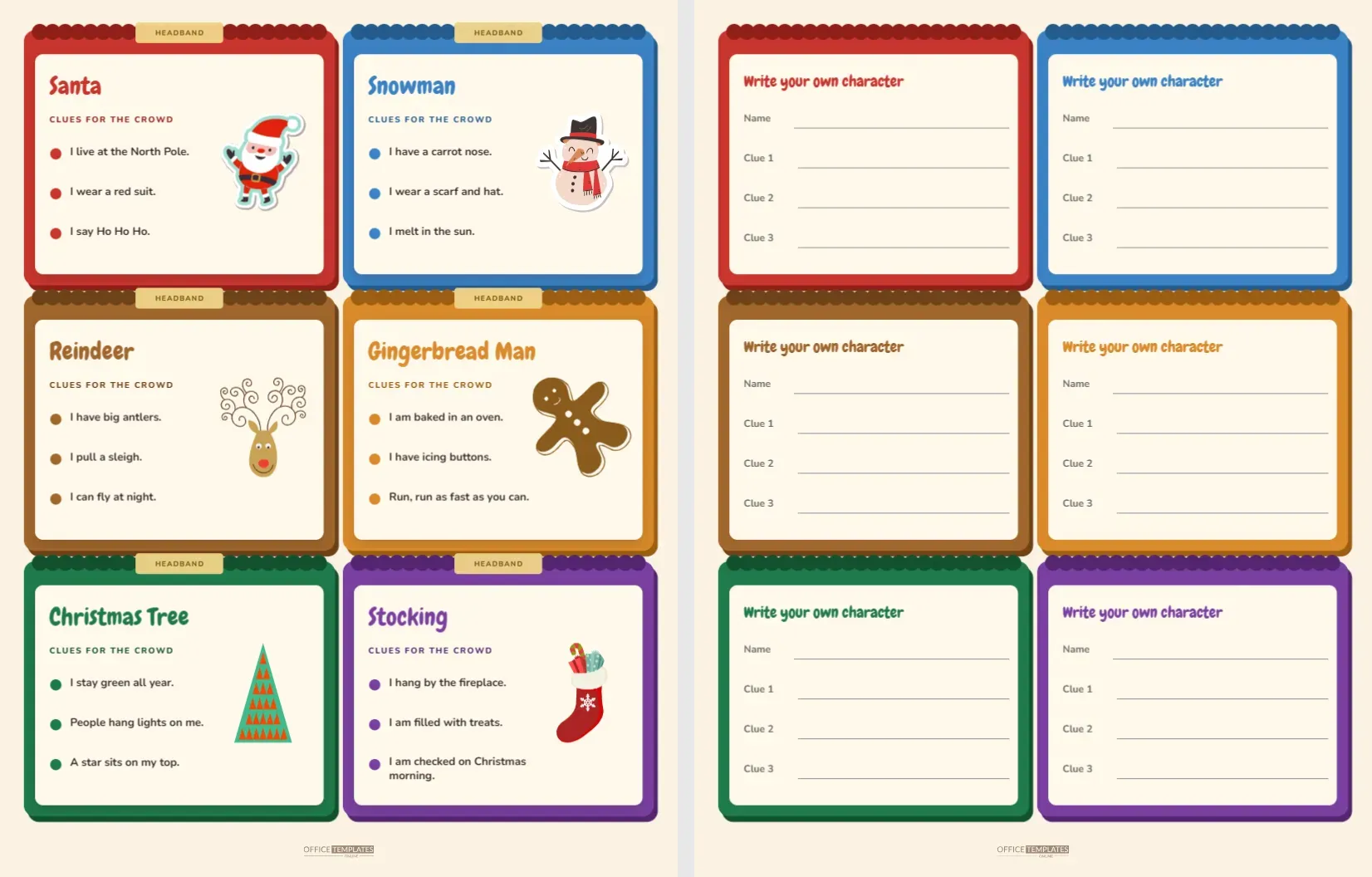
Who am I is the guessing game that needs no batteries and no board. One player wears a card on a headband without looking at it, the others give clues, and the wearer has to work out who they are. It is loud, silly and works for ages from five to ninety. This sheet gives you six Christmas characters with three clues each, plus six blank cards on a second page for children to make their own.
Layered Paper, Six Colours
Each card looks like a stack of cut paper. A coloured base sits slightly offset over a darker shadow of the same hue, a scalloped band runs across the top, and a cream panel inset in the middle carries the content. A small sandy tab labelled HEADBAND sits over the top edge to show where to tape or clip the card. Every card has its own colour, which makes the deck easy to sort and gives the sheet a cheerful, patchwork look.
The Six Characters and Their Clues
| Character | Card colour | First clue | Last clue |
|---|---|---|---|
| Santa | Red | I live at the North Pole | I say Ho Ho Ho |
| Snowman | Blue | I have a carrot nose | I melt in the sun |
| Reindeer | Brown | I have big antlers | I can fly at night |
| Gingerbread Man | Orange | I am baked in an oven | Run, run as fast as you can |
| Christmas Tree | Green | I stay green all year | A star sits on my top |
| Stocking | Purple | I hang by the fireplace | I am checked on Christmas morning |
How the Clues Are Used
The wearer cannot see the name or the picture, so the card has a section titled CLUES FOR THE CROWD. The audience can read the three clues aloud one at a time, in order, or paraphrase them if the wearer is stuck. Give the first clue and let the wearer guess. If they fail, give the second clue, and so on. Fewer clues mean a higher score, so a wearer who guesses after one clue earns three points, after two clues two points and after three one point.
Page Two, Write Your Own
The second page repeats the six colours and replaces the content with a heading that says Write your own character, a Name line and three Clue lines. Children can invent characters such as the Elf on the Shelf, a gingerbread house or a favourite pet in a Santa hat. Because each card has a space for three clues, young writers practise short descriptive sentences. A parent can help by asking: what does it look like, where does it live and what does it do?
How to Make the Headbands
- Cut a strip of card stock about two inches wide and long enough to fit around the head, with a little overlap.
- Cut out a character card along its coloured edge.
- Fix the card to the front of the strip with tape or a staple, or slip it into a clip.
- Close the band at the back and adjust the fit.
- Make sure the name faces outward and the wearer does not catch a glimpse in a mirror.
A more relaxed option is to tape the card to the wearer’s back, or to hold it against the forehead. For young children, a clean sticky note on the forehead is the easiest holder.
Game Variations
- Twenty questions: the wearer asks yes or no questions instead of receiving clues.
- Silent round: players mime clues rather than speaking.
- Team round: two teams take turns, and the team that guesses in fewer clues scores a point.
- Whisper round: clues are given only in a whisper, which adds suspense.
Printing and Cutting Notes
The six cards fill most of the sheet, with a narrow margin around the edges. Print at full size and choose a heavier paper if you can. When you cut, follow the outer coloured edge. The scalloped band along the top is part of the design, so trim just outside it. If your printer cannot print to the very edge, a thin white border will remain, and it looks like a paper mat around the card.
Editing the Cards
Every word on the cards is editable text. Click the character name to change it, and click each clue to type a new one. The pictures are vector art, so you can recolour them or swap one for another sticker from the library. If you want a seventh character, duplicate a card and change its colours with the swatches. Keep each clue under eight words so it fits on one or two lines beside the picture.
Using the Game With Mixed Ages
The same deck can be tuned to different players by changing which clues you read. For a toddler, give the third clue first, since it is usually the most direct. For a teenager, hold back the easy clue and start with the second, or invent a fourth clue that needs lateral thinking. Adults can be asked to guess characters from the blank card page that children have written, which is often much funnier than the printed deck. A grandparent who cannot see the card because it is on their forehead is a wonderful sight at a family gathering.
Turning the Game Into a Craft Hour
The blank page doubles as a craft activity. Ask each child to colour a card, choose a name for it and write the three clues, then add a little drawing in the blank space. The finished cards go into the main deck, so the whole group plays with characters that the children invented. Keep a few spare copies for the following year, so that the deck grows from season to season and becomes a family tradition.
Who Am I Game Questions
What age is the game suitable for?
Children from about five can play with an adult reading the clues. Older groups can use the blank cards to invent harder characters.
Can the characters be changed to people instead of objects?
Yes. Replace the pictures and the clues with film characters, family members or famous people, and the layout works the same way.
Do I need a printer that does colour?
Colour is best because each card has its own tint, but you can print in black and white and colour the cards with crayons, which makes a good activity in itself.