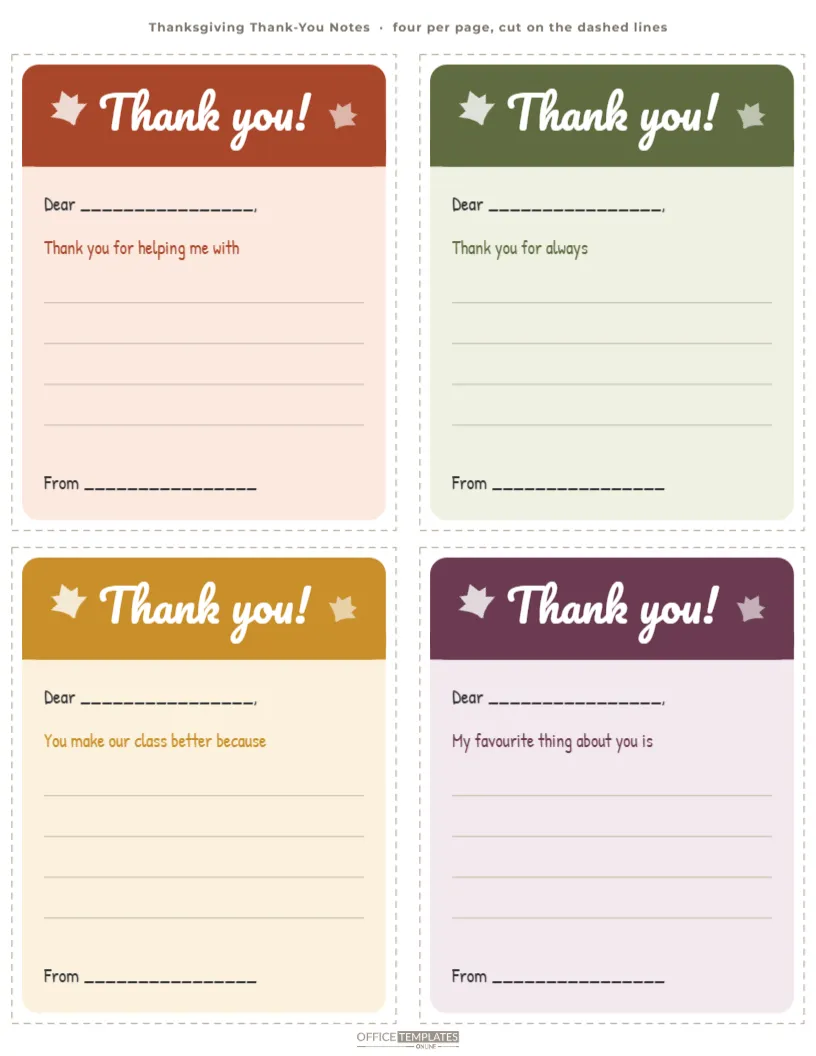
Writing a thank-you note is one of the simplest and most valuable habits a child can learn. At Thanksgiving, it becomes a meaningful classroom activity: each child chooses someone to thank, writes a few lines, and delivers the note. These Printable Notes make it easy, with four notes per page, each with its own colourful header and a prompt that helps children know what to write.
A Thank-You Note Lesson in Five Steps
Step 1: talk about thank-you notes
Ask children when they last said thank you, and who helps them every day without being asked. Make a list on the board: family members, teachers, the bus driver, lunch staff, the school nurse, coaches, librarians, friends.
Step 2: Choose a person
Each child chooses one person to thank. Encourage some children to choose school staff who rarely receive notes.
Step 3: write the note
Children fill in the Dear line, finish the prompt, and add a few words on the lines. Younger children can draw instead of writing.
Step 4: sign and decorate
They write their name on the From line and add small drawings or stickers.
Step 5: deliver
Children hand-deliver notes at school, or take them home for family members. Watching an adult read their note is often the best part for children.
The Note Sheet Design
The page is US Letter, 8.5 x 11 inches, portrait, with a small instruction line across the top. Four notes are arranged in a two-by-two grid, each surrounded by a dashed cut outline. Each note has a soft tinted background and a coloured header band at the top, in rust, olive, mustard, and plum. In each header, Thank you! is written in white Pacifico, a round, friendly script, with two small white leaves on either side.
Below the header, a Dear ________________, line sits in Patrick Hand, a neat handwriting font. A coloured prompt follows, different on each note, then four ruled lines for writing and a From ________________ line at the bottom. The brand mark sits small at the foot of the page.
The Four Prompts
| Note colour | Prompt | Good for thanking |
|---|---|---|
| Rust | Thank you for helping me with | Teachers, tutors, older siblings |
| Olive | Thank you for always | Parents, bus drivers, lunch staff |
| Mustard | You make our class better because | Classmates, aides, volunteers |
| Plum | My favourite thing about you is | Grandparents, friends, coaches |
Prompts give children a starting point, which is often all they need to write something heartfelt.
Editing the Notes
Every piece of text is editable. Change the prompts to suit your class, translate them, or replace Thank you! with Gracias! or Merci! for a language lesson. For older students, delete the prompt so they write freely. The header colours are simple shapes; recolour them to match a classroom theme or school colours.
Printing and Cutting the Thank-You Notes
Download the PDF and print one page per four students on white card stock or heavy paper. Card gives the notes a nicer feel and makes them easier to stand up on a desk. Cut along the dashed outlines with a paper trimmer; each note is a little under 4 x 5 inches. Students can fold their note in half if they want a card, or give it flat.
Adapting the Notes for Different Ages
- Pre-readers: an adult writes the name on the Dear line; the child draws a picture on the lines and signs with a scribble or initials.
- Early writers: one sentence finishing the prompt is plenty.
- Confident writers: encourage a specific example: Thank you for helping me with long division when I was stuck.
Thank-You Notes Beyond the Classroom
The notes work just as well at home and in community groups. Families can fill them in for relatives after Thanksgiving dinner, scout troops can thank community helpers, and youth groups can write notes for care home residents or veterans. Offices even use them for quick colleague thank-yous.
Creating a Thank-You Wall
Ask children to write a second note to their class or school, and pin all the notes on a Thank-You Wall in the hallway. Visitors, staff, and families love reading them, and children see how much gratitude there is around them.
Teaching Specific Gratitude
The most memorable thank-you notes are specific. Model the difference on the board: Thank you for being nice versus Thank you for sitting with me at lunch when I was new. Children quickly understand that details make a note special, a lesson that serves them long after Thanksgiving.
Storing Extra Note Sheets
Print a few extra sheets and keep them in a folder by the classroom door. Children who finish work early, or who want to thank someone during the year, can grab a note any time. The habit grows when the materials are always within reach.
Helping Reluctant Writers With Thank-You Notes
Some children freeze when they see empty lines. A few small supports help. Write a word bank on the board with useful words such as kind, helpful, funny, patient, brave, and always. Let children say their sentence out loud to a partner before they write it. Offer sentence starters that build on the printed prompt, for example, Thank you for helping me with reading, because now I can… For children who find handwriting tiring, a single sentence plus a drawing is a complete and lovely note.
Children learning English can write the note in their home language, with a short English line added with help. The person receiving it will treasure both. Above all, praise the thought rather than the spelling; the goal is for every child to feel proud handing over their note.
Thank-You Note Questions
Can I print the notes in black and white?
Yes. The coloured headers turn into grey bands, and children can colour them in before writing.
Are the notes suitable for adults?
The friendly fonts are designed for children, but adults use them for casual notes too.
How big is each note?
Each note is roughly 3.8 by 4.8 inches, a nice size for a short message and a drawing.
A few lines of thanks can brighten a whole week for the person who receives them. Print the notes, help your class choose who to thank, and enjoy watching the smiles when the notes are delivered.