Walk into almost any primary classroom, and you will find two adults, not one. Teaching assistants, learning support assistants, paraprofessionals and classroom aides run reading groups, support students with additional needs, prepare resources, supervise lunch and playtime, manage small crises and quietly keep lessons moving. Teachers know they could not do the job without them. Yet teaching assistants are often left out of awards that focus on teachers. This certificate is designed specifically to thank them.
The Gears That Keep Things Running
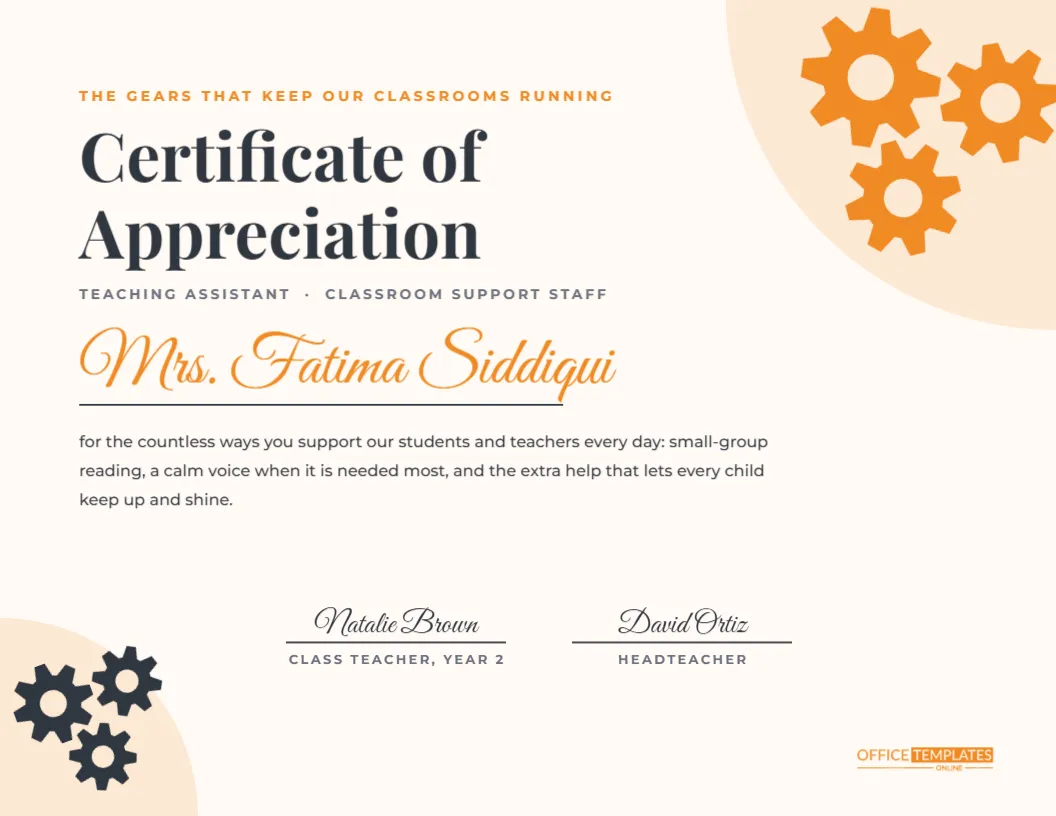
The idea behind this US Letter landscape certificate (11 x 8.5 inches) is simple: a classroom works like a machine, and teaching assistants are the gears that keep it turning. In the top right corner, three interlocking orange gears sit on a pale peach quarter-circle. In the bottom left corner, a smaller cluster of charcoal gears echoes them on a matching peach curve. The rest of the page is a warm cream.
At the top left, the gears that keep our classrooms running are spaced out in orange capitals. Below it, Certificate of Appreciation is set on two lines in large charcoal Playfair Display, followed by Teaching Assistant · Classroom Support Staff. The assistant’s name is written in orange script above a charcoal rule, then a citation and signature lines for the Class Teacher and the Headteacher, with our logo in the bottom right.
Roles This Certificate Recognises
The title of the role varies between countries and schools, but the certificate suits all of them. Change the subtitle to match:
| Title | Where it is common |
|---|---|
| Teaching Assistant (TA) | United Kingdom, Australia |
| Paraprofessional/Paraeducator | United States |
| Learning Support Assistant | UK, international schools |
| Educational Assistant | Canada |
| Classroom Aide/Helper | Many regions, especially in early years |
| Special Needs Assistant | Ireland and elsewhere |
What to Thank a Teaching Assistant For
The sample citation mentions small-group reading, a calm voice when it is needed most, and the extra help that lets every child keep up and shine. The most meaningful citations are specific. Consider:
- Leading intervention groups that helped students catch up in reading or maths.
- Supporting a student with additional needs so they could join every lesson.
- Preparing resources, displays and materials that made lessons possible.
- Noticing and gently handling a child’s worries or friendship problems.
- Stepping up to cover when the class teacher was absent.
- Bringing a particular talent, such as art, music or a second language, into the classroom.
Why Assistants Are Often Overlooked
Recognition schemes in schools tend to follow job titles: Teacher of the Year, Head of Department of the Year, Student of the Year. Teaching assistants fall between the categories, even though their impact on individual students can be enormous. They are often the adult a struggling child trusts most, the one who notices a problem at lunchtime, and the one who knows exactly how a particular student learns best. Giving them their own certificate, with their own title, corrects that imbalance and shows the whole staff that support roles are valued.
Who Should Sign?
The template’s first signature line is for the class teacher, reflecting the close partnership between teacher and assistant. The second is for the headteacher. You might instead ask the whole year group team to sign, or add a line from the students. For assistants who work across several classes, the SENCO or Inclusion Lead could sign the first line.
Making It Personal
- Type the assistant’s name in place of the sample name.
- Rewrite the citation with a real example of their work.
- Change Class Teacher, Year 2 to the right class and name.
- Recolour the orange gears to your school colour if you like; each gear cluster is an editable vector illustration, so you can change it from its colour swatch.
- Download as PDF for printing or as a PNG to include in a thank-you email.
When to Say Thank You
Many schools present teaching assistant certificates at the end of the summer term, but other moments work well too. Some countries hold a Teaching Assistants’ Day or a support staff appreciation week; the end of an intensive intervention programme is another natural point; and a mid-year thank-you after a difficult term can mean a great deal. The certificate is quick to prepare, so there is no need to wait for a formal ceremony.
A Partnership Worth Celebrating
The relationship between a teacher and a teaching assistant is one of the most important in a primary school. When it works well, students get twice the attention, twice the patience, and twice the ideas. A certificate from the class teacher is a way of saying we are a team in writing. Teachers can add a handwritten line on the back, and students can decorate the margins with drawings, turning the page into a personal keepsake from the whole class.
Printing on Warm Cream
The cream background and orange gears give the page a warm, friendly feel. Print it without scaling on US Letter, or choose the fit-to-page option for A4. A matte 250 gsm card suits the soft colours well. The gear clusters sit in the corners, leaving most of the page light, so the certificate is economical to print for every assistant in the school.
Recognising All Support Staff
The gear motif works for anyone whose work keeps the school running smoothly: office staff, caretakers, lunchtime supervisors, technicians, librarians and IT support. Change the kicker to The gears that keep our school running and the subtitle to the role. A set of matching certificates for all support staff at the end of the year is a powerful message that every role matters.
Teaching Assistant Certificate Questions
Can students give this certificate to their TA?
Yes. Change the first signature to the class name and let students present it.
Can I remove the gears?
Yes, but they carry the meaning of the design. You could instead replace them with another illustration from the editor.
What size is it?
US Letter landscape, 11 x 8.5 inches.
Thank the People Behind the Scenes
Teaching assistants make classrooms work, often without recognition. Add a name, a real example, and the class teacher’s signature, and let them know they are an essential part of the machine.