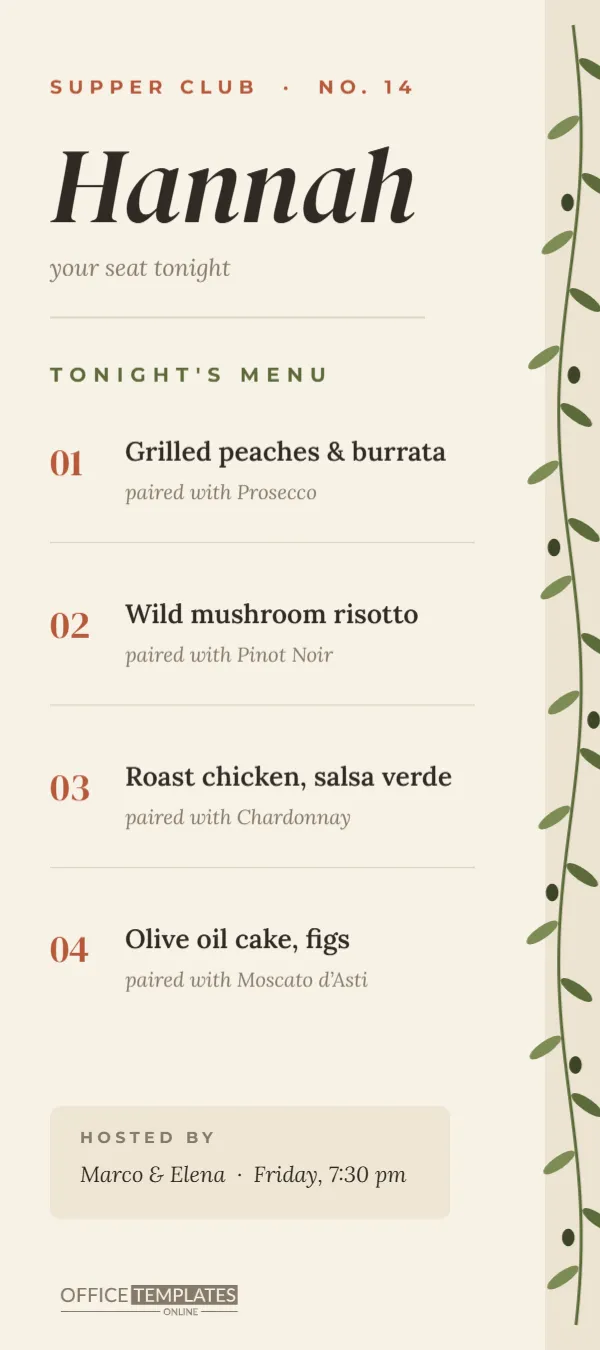
Dinner parties are back. Supper clubs, where friends take turns hosting a themed meal, have become one of the most popular ways to entertain at home. A printed menu at each seat turns a dinner party into an occasion: it tells guests what is coming, shows off the host’s planning, and makes a lovely keepsake. This design combines the menu and the place card. Each guest’s name is printed in large serif italics at the top, followed by four numbered courses with wine pairings, all framed by an olive vine climbing the right edge.
Name at the Top, Menu Below
The card is a flat 4 x 9 inch menu in portrait orientation. The background is a warm cream, with a slightly darker strip down the right edge where an olive vine winds from top to bottom, with green leaves and little dark olives. At the top, Supper Club · No. 14 is written in terracotta spaced capitals. Below it, the guest’s name, Hannah, is set very large in DM Serif Display italic, with your seat tonight underneath in grey italic and a thin rule. Tonight’s Menu follows in olive capitals, then four courses, each with a terracotta number (01 to 04), the dish in Lora, and paired with a wine in grey italic, separated by fine lines. A soft box near the bottom reads Hosted by Marco & Elena · Friday, 7:30 pm, and the logo sits at the foot.
Why Combine Menu and Place Card
At a dinner party, space on the table is precious. A single tall card on each plate tells guests where to sit and what they will eat, so there is no need for separate menus or name cards. Guests love seeing their name at the top of the menu; it makes the evening feel personal. The format is also easy to take home in a handbag or jacket pocket as a souvenir.
Writing a Four-Course Menu
Keep dish descriptions short and appetising: the main ingredient plus one or two accents. The sample menu shows the rhythm: Grilled peaches & burrata to start, Wild mushroom risotto as a pasta or rice course, Roast chicken, salsa verde as the main, and Olive oil cake, figs for dessert. If your supper club has a theme, such as Italian, Mexican, or Japanese, reflect it in the dish names and the wine or drink pairings.
Pairing Suggestions for Common Courses
| Course | Example dish | Classic pairing |
|---|---|---|
| Starter | Burrata with peaches | Prosecco or dry rosé |
| Pasta or risotto | Mushroom risotto | Pinot Noir |
| Fish main | Seared sea bass | Sauvignon Blanc |
| Meat main | Braised short rib | Cabernet Sauvignon |
| Poultry main | Roast chicken | Chardonnay |
| Dessert | Olive oil cake | Moscato d’Asti |
For alcohol-free dinners, write non-alcoholic pairings such as sparkling elderflower, iced hibiscus tea or a ginger shrub.
Personalising the Menu
- Write and proofread the four courses and pairings once.
- Update the supper club number, hosts, and date in the box.
- Click the large name and type the first guest’s name.
- Download the menu, then type the next guest’s name and download again.
DM Serif Display italic is wide; names longer than about nine letters need a smaller size to fit beside the vine.
The Olive Vine
The vine is a group of simple shapes: a gently winding stem, leaves in two greens and small dark olives. Recolour the leaves for a different plant, for example, to purple-red for a grape vine at a wine-tasting dinner, or to bright green for a herb garden theme. The darker strip behind it can change to any soft colour that suits your table.
Supper Club Themes
- Tuscan night: olive vine, Italian wines, cream and terracotta (as designed).
- Taco night: change the vine to chilli peppers, add mezcal pairings.
- French bistro: navy and white, a baguette icon, Bordeaux and Burgundy wines.
- Japanese izakaya: black and red, sake pairings, a cherry blossom branch.
- Harvest table: rust and gold, root vegetables, cider pairings.
Printing a 4 x 9 Menu
Print on heavy cream or white cardstock of 100 to 130 lb cover so the menu lies flat. Many printers can print a 4 x 9 inch custom size from the rear feed tray; otherwise print on letter-size card and trim. Use a matte setting at normal or high quality for the fine lines and small italic text.
Placing Menus on the Table
Lay each menu vertically on the dinner plate, on top of a folded napkin, or tuck it under a napkin tied with twine and a sprig of rosemary. The name at the top faces the seat, so guests find their places at a glance.
Running a Supper Club
Supper clubs usually rotate hosts monthly, with each host choosing a theme and cooking the main course while guests bring sides, dessert, or wine. Numbering each dinner, as in No. 14, turns the menus into a collectible series. Some groups keep every menu in a shared album, a delicious record of their friendship.
Dietary Needs at a Supper Club
Ask guests about allergies and dietary preferences when you invite them. With a personalised menu, you can adapt each guest’s card: swap the chicken for a roasted cauliflower steak on a vegetarian guest’s menu, or mark a gluten-free dessert. Guests feel looked after when they see their own needs reflected on their menu, and the host avoids awkward questions at the table.
Hosting Tips for a Smooth Evening
Print the menus the day before, after confirming final numbers, and set them on the plates as the last step of setting the table. Plan courses that can be prepared ahead, so the host spends the evening at the table rather than in the kitchen. Serve the first pairing as guests sit down, and announce each course briefly as it arrives; the printed menu means you only need a sentence.
Supper Club Menu Questions
Can I list five courses?
Yes. Tighten the gap between the existing courses and duplicate one numbered course for the fifth.
Is the menu folded?
No folding needed; it lies flat on the plate at 4 x 9 inches.
Can I use it for a restaurant event?
Yes. Replace Supper Club with the restaurant name and keep the guest names at the top.