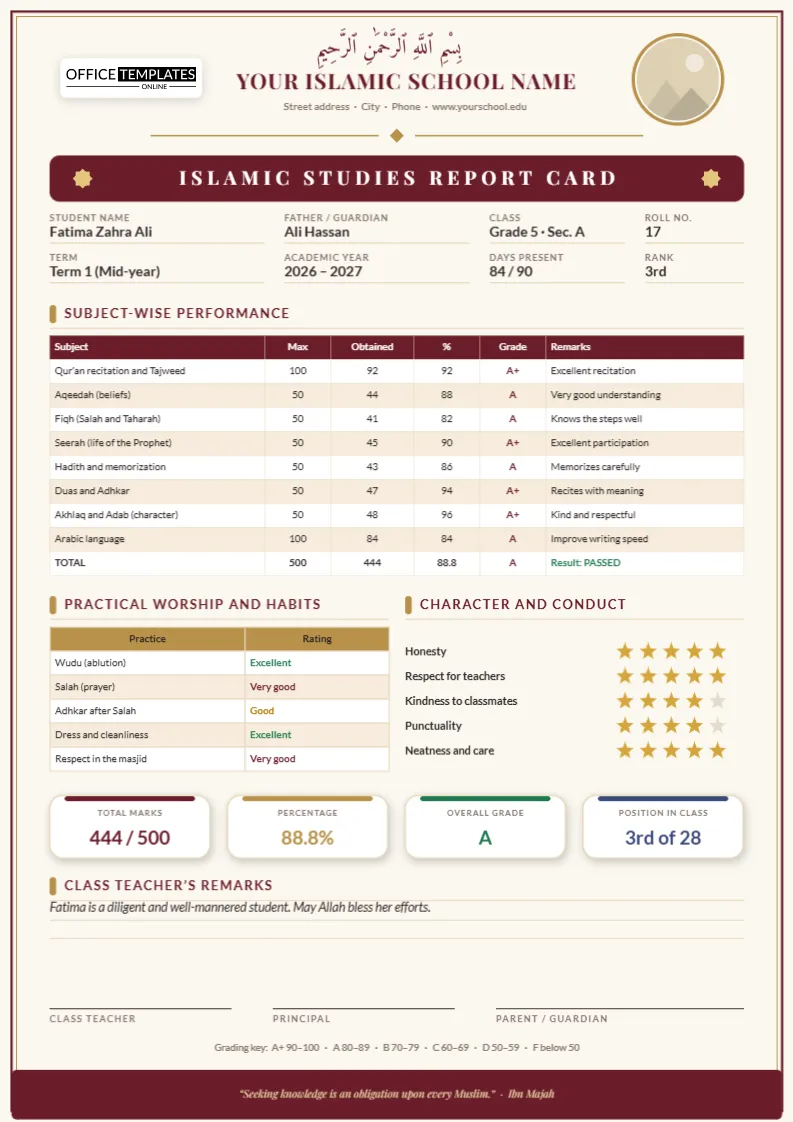
Madrasas, weekend Islamic schools, and full-time Islamic schools all face the same task at the end of each term: sending home a report that is fair, clear, and worthy of the subject. This Islamic studies report card template is a formal, professionally laid-out card in burgundy and gold that covers Qur’an recitation, the core Islamic subjects, practical worship habits, and character, all on one A4 page.
Designing a fair Islamic studies report
A good report in this field measures more than memory. It looks at understanding, practice, and character, and it explains results in a way parents can act on. The layout reflects that balance: marks and grades are precise, while worship habits and conduct are rated in descriptive words and stars.
The letterhead
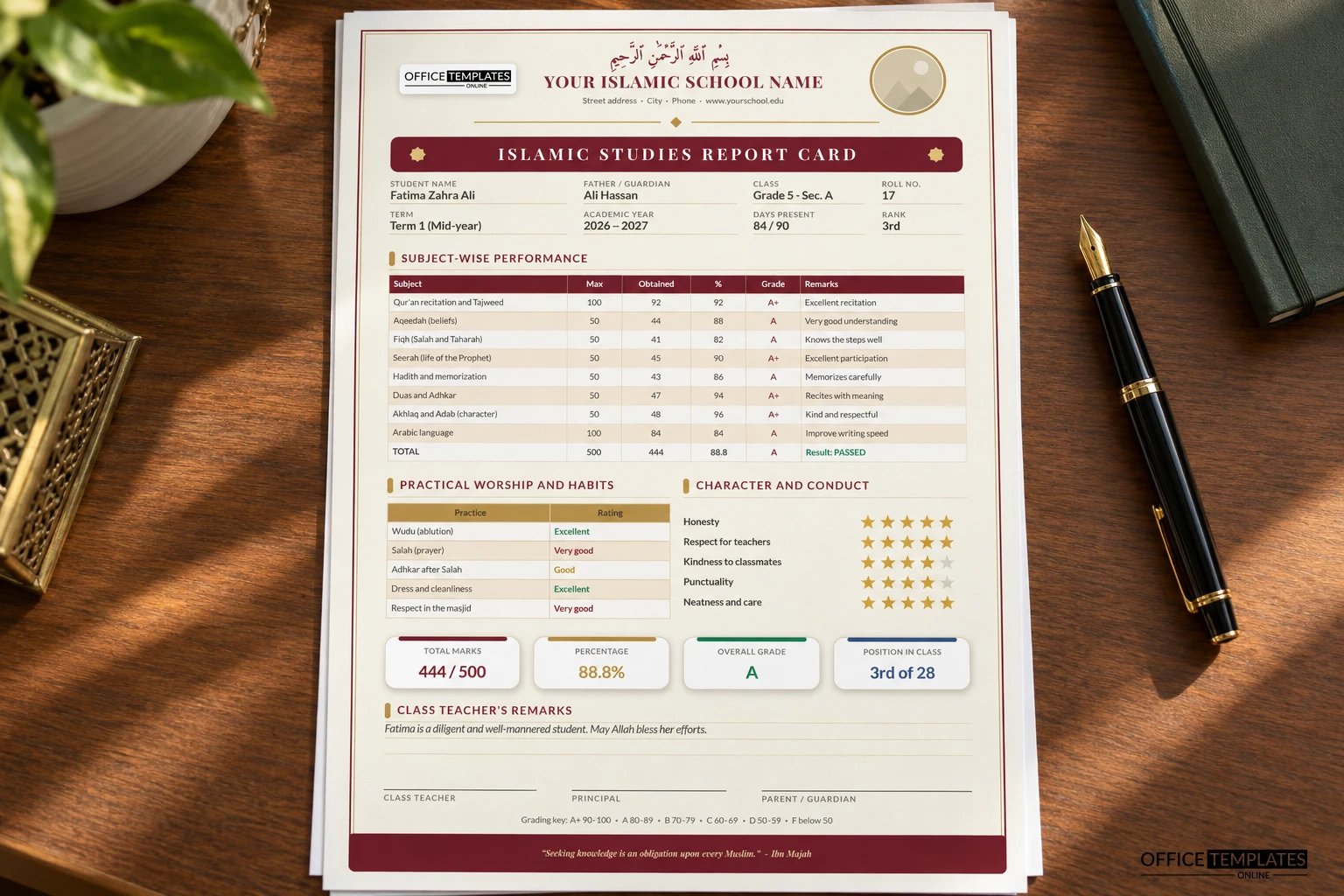
The top of the page works like an official letterhead. The Bismillah in Arabic calligraphy sits above your school name, with an address line and an ornamental divider below it. Our logo plate appears on the left, and a round photo frame on the right holds the student’s picture, which is optional. A burgundy title bar reads Islamic Studies Report Card with small gold stars at each end.
The subjects, one by one
Qur’an recitation and Tajweed
Marks for correct recitation, rules of tajweed, and fluency, often weighted highest in Islamic schools.
Aqeedah
Beliefs: understanding the foundations of faith at an age-appropriate level.
Fiqh, including Salah and Taharah
Knowledge of purification, prayer, and other practical rulings, taught according to your school’s approach.
Seerah
The life of the Prophet, taught through stories and lessons for daily life.
Hadith and memorization
Selected sayings learned by heart, with understanding of their meanings.
Duas and Adhkar
Daily supplications and remembrance, learned with their meanings where possible.
Akhlaq and Adab
Character and manners: honesty, respect, kindness, and etiquette at home and school.
Arabic language
Reading, writing, and vocabulary, valued as a key to understanding the Qur’an.
Every subject name is editable, so schools that teach different subjects, or divide them differently, can rewrite the list. Add rows for Islamic history, Qur’an translation or Urdu, and delete any you do not teach.
Marks, percentages and grades
The main table has six columns: subject, maximum marks, obtained marks, percentage, grade and remarks, with a total row that shows the overall result. Enter your maximum marks per subject, and type the obtained marks and percentage. The grade column is plain text, so it works with letters, numbers, or descriptive terms. A grading key at the bottom of the page states the scale in one line; edit it to match your own boundaries.
Practical worship, without judgment
Teachers often want to note how students are growing in wudu, salah, and habits, but this area is sensitive. The template uses gentle rating words such as Excellent, Very good, and Good, and encourages teachers to focus on what a child has learned and practiced in class, not on private matters between a person and their Lord. Keep remarks constructive, and edit or remove any row that does not fit your program.
Character and conduct with stars
Five-star ratings cover honesty, respect for teachers, kindness to classmates, punctuality, and neatness. Gold stars are earned, and gray stars are open; recolor a star to change a rating. Parents love this section because it shows that the school cares about who their child is becoming.
The result summary
Four tiles show total marks, percentage, overall grade, and position in class. If your school does not rank students, replace the position tile with attendance or any measure you prefer.
Using the card in different settings
- Full-time Islamic schools: Use it as the Islamic studies section of a wider report, or as a separate term card.
- Weekend and evening madrasas: Reduce the number of subjects and change the days present figure to match your schedule.
- Online classes: Replace the letterhead address with your website and export as a PDF to email.
- Home-based teachers: Use the card as a formal record for each child you teach.
Setting it up
- Open the template and type your school name, address, and details.
- Replace the photo with the student’s picture, or delete the frame.
- Fill in the student details and each subject’s marks and remarks.
- Update the worship ratings and character stars, and write the class teacher’s remarks.
- Download the report as a PDF, PNG, or JPG.
Printing on A4
The card is A4, 210 x 297 mm. Print it at actual size on white paper of 100 to 150 gsm, and keep the default page margins so the double border stays intact. The footer carries a well-known saying from Ibn Majah about seeking knowledge, which you can replace with any message. For a formal look, place the card in a school folder with the report of the year.
Quick answers
- Can I use the Arabic Bismillah?
- Yes. It is editable text in the Amiri font; delete or change it if you prefer.
- Can I add a school stamp?
- Yes. Upload an image of your stamp from the editor and place it near the signature lines.
- Is the grade scale fixed?
- No. Type any scale and edit the key at the bottom.
- Can I remove the ranking?
- Yes. Delete the rank field and the position tile, or replace them with other details.
Communicating results with sensitivity
Parents read a report card with hope and sometimes worry. Begin remarks with what the student does well, describe difficulties as things to work on, and end with a du’a or word of encouragement. Avoid comparing students, and when a mark is low, add a practical suggestion such as extra revision or a meeting with the teacher. A school that communicates with care earns the trust of its families.
Comparing term to term
Keep each term’s card as a separate file and compare percentages and grades over the year. A student who rises from 82 to 88 percent in Fiqh has made real progress worth celebrating, even if their overall rank has not changed. Some schools attach the term cards together in a folder at the end of the year, giving families a complete annual record.
Give every family a report that reflects your school’s care. Open the template, add your term’s results, and download a professional Islamic studies report card.