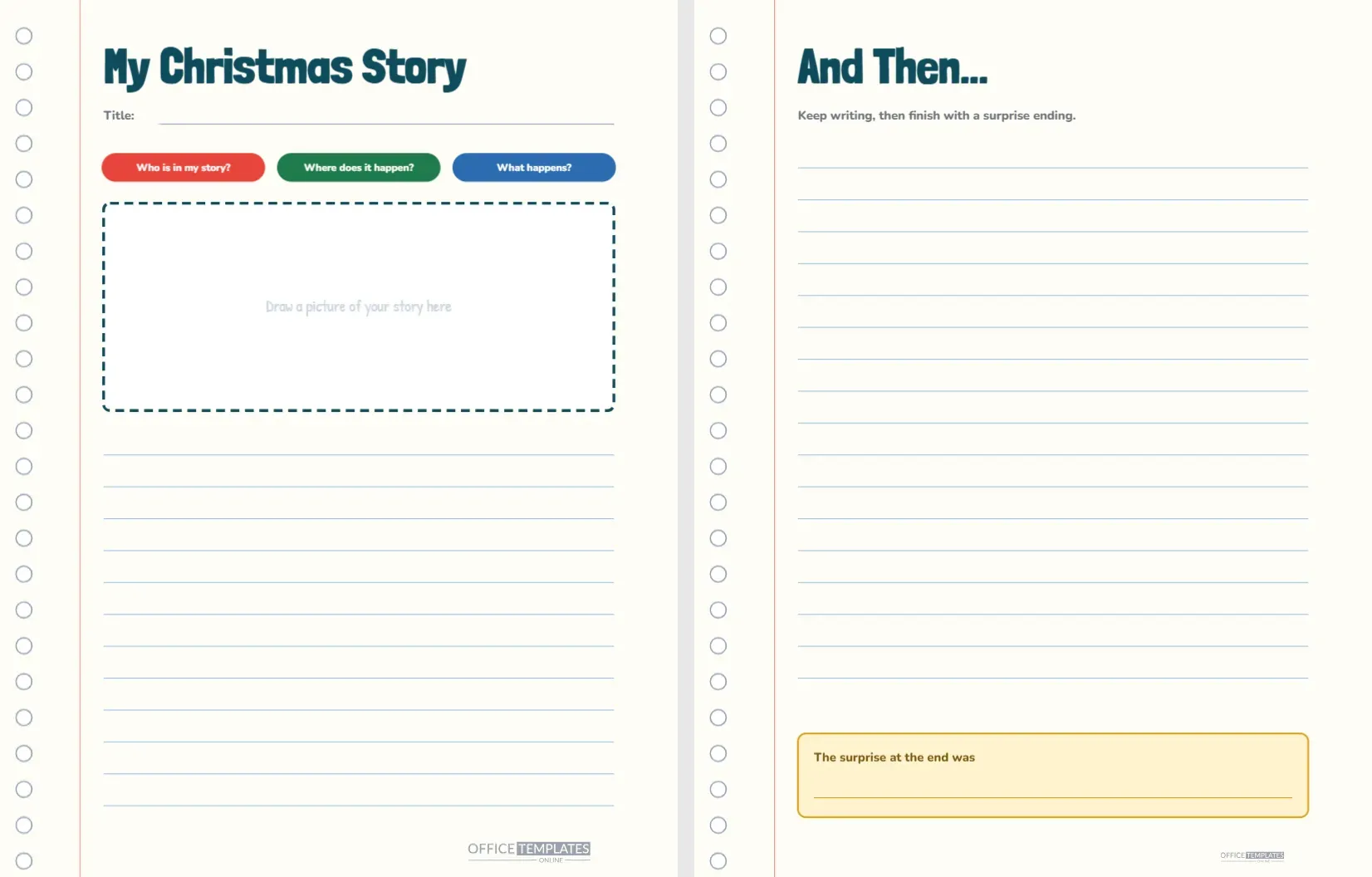
Stories begin with a spark: a person, a place and something that happens. This notebook style page gives children all three. A row of coloured prompt stickers asks who, where and what, a large dashed box invites a picture and a page of ruled lines waits for the story. The second page continues the tale and ends with a surprise.
A Notebook on Letter Paper
The page imitates a school exercise book. A column of round spiral holes runs down the left edge, each ringed in grey, and a thin red margin line sits just to the right of them. The background is a warm cream. The title My Christmas Story stands at the top in a heavy deep teal face, with a line below it that says Title and a rule for the child’s own title. Beneath, three coloured pills in red, green and blue read Who is in my story, Where does it happen and What happens.
The Notebook Page in Brief
| Section | Page one | Page two |
|---|---|---|
| Heading | My Christmas Story with a title line | And Then, with a note to keep writing |
| Prompts | Three coloured stickers: who, where, what | A gold box titled The surprise at the end was |
| Drawing space | A large dashed box for a picture | None, the whole page is for writing |
| Ruled lines | Twelve lines beneath the box | Seventeen lines across the page |
The Three Prompts
Young writers often freeze in front of a blank page. The three prompt stickers give them something to say right away. Who is in my story pushes them to choose a character: a child, a reindeer, a snowman or an elf. Where does it happen asks for a setting, such as a snowy hill, a toy workshop or the kitchen on Christmas Eve. What happens needs a problem or an event, from a lost present to a sleigh that will not start. Once all three are answered, the story practically writes itself.
Drawing Before Writing
Many children think in pictures. The big dashed box on page one lets them draw the scene before they write. A quick sketch settles the details: how many characters, what the room looks like and where the action happens. Then writing is a matter of describing the picture. For reluctant writers, this approach cuts the first hurdle in half, since the picture holds the ideas and the lines only need words.
Page Two, And Then
The second page keeps the notebook look, with the spirals and the margin, and carries a bold title And Then followed by a short instruction to keep writing and finish with a surprise ending. Seventeen light blue lines stretch from top to bottom. At the foot of the page, a pale gold box outlined in a darker gold reads The surprise at the end was, with a line for the final twist. A story with a surprise gives the writer a destination to aim for.
Writing a Story in Five Steps
- Choose a character, a place and a problem, and write each on the prompt stickers.
- Draw the scene in the box and add a few labels.
- Write a first sentence that names the character and the place.
- Describe what happens, adding one event for each new line.
- Turn to page two, keep writing and finish with the surprise.
What Teachers Look For
Teachers usually hope for a beginning, a middle and an end, and some details that bring the story to life. The prompts on this page match those aims. Children can be encouraged to use time words such as first, then and finally, or sense words such as cold, bright and sparkling. For older writers, ask for dialogue, with a character saying something in quotation marks. Younger writers can focus on a few simple sentences and a drawing. The same page serves both, by changing how much is expected.
Changing the Prompts and Lines
Every piece of text is editable. Change the title to match the story, such as My Christmas Adventure, or replace the prompts with questions of your own, such as What did the elf lose and Who helped. The drawing box can be moved, resized or deleted if your child prefers to write more. The ruled lines are thin rectangles, so you can add more or remove some by duplicating or deleting them. The spiral holes are a group of circles, which can be recoloured or hidden with a single click.
Ways to Share the Finished Story
- Read it aloud at the family dinner table.
- Staple the pages together and make a cover for a mini book.
- Post it to a grandparent with a Christmas card.
- Pin it to the classroom wall in a story corner.
Printing the Notebook Look
The cream background prints well on plain paper, but a cheaper option is to switch the page to white. The spiral holes are only a drawing, so they do not need punching. If you want a real hole punched binder, print on paper and punch the left margin yourself. Use a pencil or a pen for writing. The blue lines are light enough to disappear in photocopies, so check the result if you plan to copy the pages.
Story Ideas When Nothing Comes to Mind
Sometimes the prompts are not enough. Offer a few story starters: the night the reindeer got lost, the elf who could not wrap, the snowman who wanted a warm bath or the present that would not stop wiggling. Mix and match a character from one idea with a place from another for a silly twist. Roll a dice to choose a number between one and six and read out the matching starter. A short moment of laughter loosens the imagination, and most children are writing before they realise it.
Helping a Reluctant Writer
Not every child enjoys writing, and a long blank page can feel like a wall. Break the task into small steps. Let the child tell the story aloud first, then write only the first sentence together. Next day, add a second. Use the drawing box to plan, and let the child circle the part of the picture that matters most. Praise ideas before spelling and handwriting, and keep corrections for later. The aim is to enjoy the story, since a child who likes writing will naturally improve.
Story Page Questions
What age is the page for?
It suits ages six to ten. Younger children can dictate while a parent writes, and older children can use the page for a longer story.
How many words will fit?
About seventy to one hundred and fifty words on page one and up to two hundred on page two, depending on handwriting size.
Can I use the page for a non Christmas story?
Yes. Change the title and the prompts, and the layout works for any season.