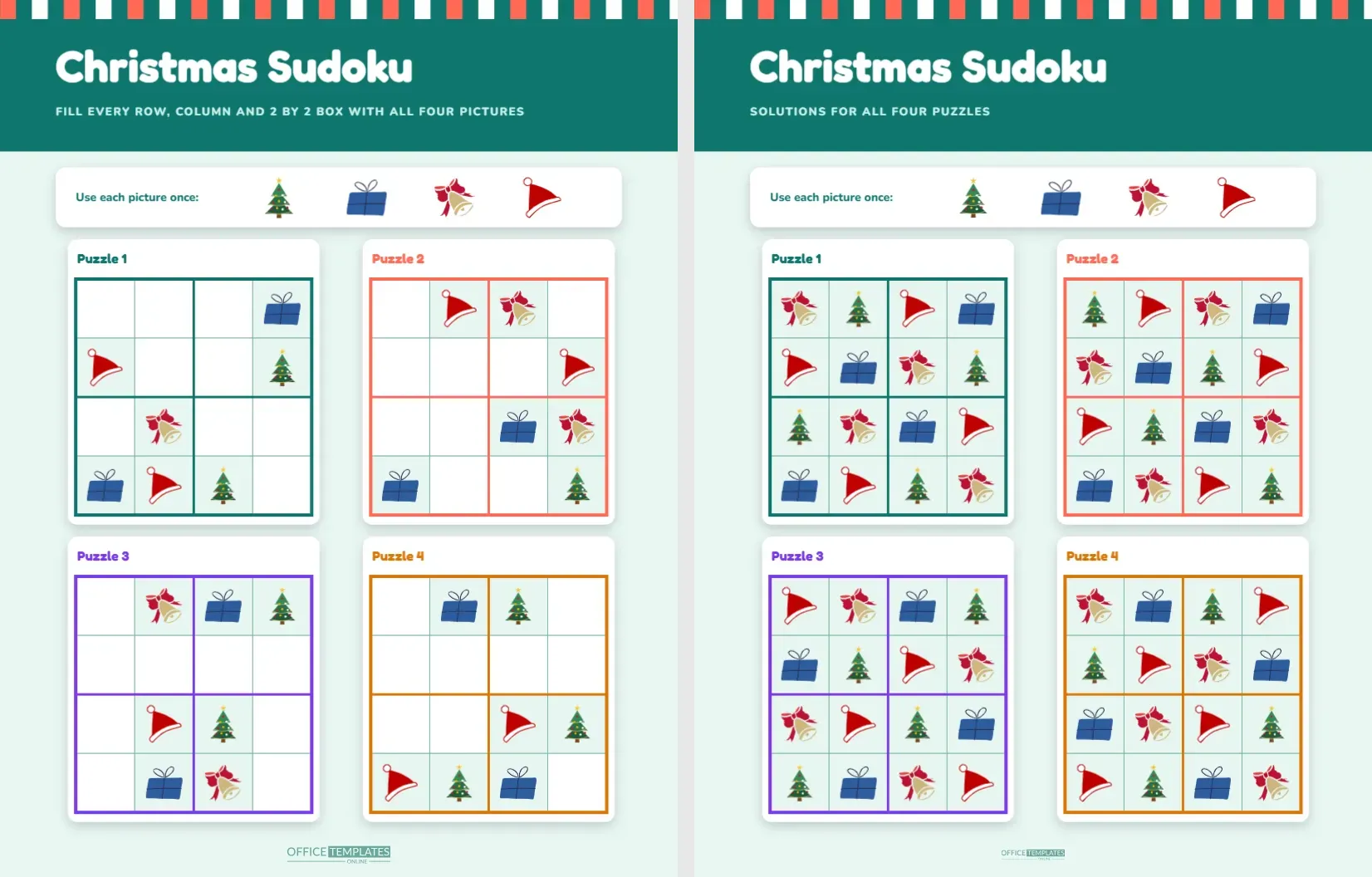
Sudoku has a reputation as a grown up puzzle, but the idea behind it is simple enough for a six year old: place each symbol once in every row, column and box. Replace the numbers with Christmas pictures, shrink the grid to four by four, and you have a puzzle that a child can enjoy and an adult can solve in a coffee break.
The Rules in One Sentence
Every row, every column and every two by two box must contain a tree, a gift, a bell and a Santa hat, with no picture repeated. That is the whole game. The page repeats the rule in a legend along the top, a white strip showing the four pictures. Children look at the legend if they forget which pictures to use.
Where Everything Sits on the Sudoku Sheet
A teal band with a striped candy edge heads the page and carries the title Christmas Sudoku in white rounded letters. Under it, a white card shows the four symbols in a row with the label Use each picture once. Four puzzle cards follow in a two by two arrangement, each with its own coloured outline: teal, coral, purple and amber. Inside each card is a four by four grid with thick lines marking the four boxes. Some squares hold pictures on a pale green tint, and the rest are empty white.
Four Puzzles With Seven Clues Each
| Puzzle | Outline colour | Pictures given | Squares to fill |
|---|---|---|---|
| Puzzle 1 | Teal | 7 | 9 |
| Puzzle 2 | Coral | 7 | 9 |
| Puzzle 3 | Purple | 7 | 9 |
| Puzzle 4 | Amber | 7 | 9 |
Every Puzzle Has One Answer
Each grid was generated by starting from a complete valid square and then removing pictures one at a time, but only when the puzzle still had exactly one solution. A solver program checked each removal. That means a child can always finish a puzzle by logic alone, without guessing. If a child gets stuck, it is not because the puzzle is faulty. There is always a square that can be filled by looking at what is missing from its row, column and box.
Solving Tips for Beginners
- Start with the box or row that has the most pictures.
- For an empty square, name the pictures already in its row, its column and its box. The picture that is left is the answer.
- Use a pencil and write a tiny dot in squares where you are unsure.
- Cross off a picture in the legend as you place it in a row, to keep track.
- Check each finished row, column and box by pointing at the four pictures and naming them.
Page Two, Four Solutions
The second page has the same layout with every square filled in. Children can check their work by comparing the finished puzzle with the answer. Parents can use it to give a hint, such as saying the top left square is a bell, without giving away the rest. Print it separately for classroom use so children cannot peek.
Building Logical Thinking
Sudoku trains logical thinking and attention. A child has to hold several rules in mind at once and test possibilities in a systematic way. The picture version helps because it removes the number reading step, so a child can focus on the logic alone. For teachers, it makes a good early finisher activity, and it also supports mathematical thinking through the idea of sets, in which every row and column holds the same four elements.
Making New Puzzles
The pictures are editable vectors and can be swapped for other stickers. To build a new puzzle, start with a solved grid, remove some pictures and check that only one answer remains. A simple trick is to start with a Latin square, swap rows within a band, and remove pictures one at a time while making sure no square can take two different pictures. You can also change the symbols to snowflakes, mittens, stars and stockings for a different theme. Keep the pictures similar in size so the grid looks neat.
Ways to Play
- Solo: one child works through the four puzzles in order.
- Pairs: two children share a puzzle and take turns placing pictures.
- Race: give each child the same puzzle and see who finishes first.
- Sticker version: cut out small pictures from a sticker sheet and place them on the grid.
- Family night: set up one puzzle on the kitchen table for anyone to add a picture to.
Printing the Sudoku Page
Print in colour so that the four pictures are easy to tell apart. In black and white, the tree, gift, bell and hat remain distinct by shape. Use a pencil with an eraser for drawing pictures, or print the puzzle on paper that can be covered with small stickers. Laminating the page and using dry erase pens lets you reuse it several times.
A Five Minute Lesson in Logic
Before the first puzzle, walk through one square together. Pick an empty square and ask the child to name the pictures that already sit in its row. Then ask the same about the column and about the box. Often the three lists together leave only one picture, and that is the answer. Say it aloud: the row has a tree and a gift, the column has a bell, so the square must be the hat. After two or three squares done this way, most children grasp the method and ask to finish alone. The skill you are teaching, eliminating possibilities, helps in maths, reading and everyday problem solving.
Adding a Reward for Each Puzzle
Children respond well to small celebrations. Give a sticker for each completed puzzle and a candy cane for completing all four. You can also add a star sticker to the corner of each finished card. Keep the solutions page out of sight until the puzzle is finished, and use it only to check. A calm, encouraging adult nearby is worth more than any prize, because logic puzzles can feel frustrating until the first breakthrough arrives.
Questions About Picture Sudoku
Can I use numbers instead of pictures?
Yes. Replace each picture with the numbers 1 to 4 using text boxes, keeping the same positions.
Is a four by four grid too easy for older children?
It is an excellent first step. Older children can move on to a six by six or a nine by nine grid once they master the logic.
Why does one puzzle seem easier than another?
Some puzzles have clues in positions that let you fill several squares at once, which makes them feel easier even when they have the same number of clues.
What age is it for?
Children from about six can try it with help, and seven to ten year olds can work alone.