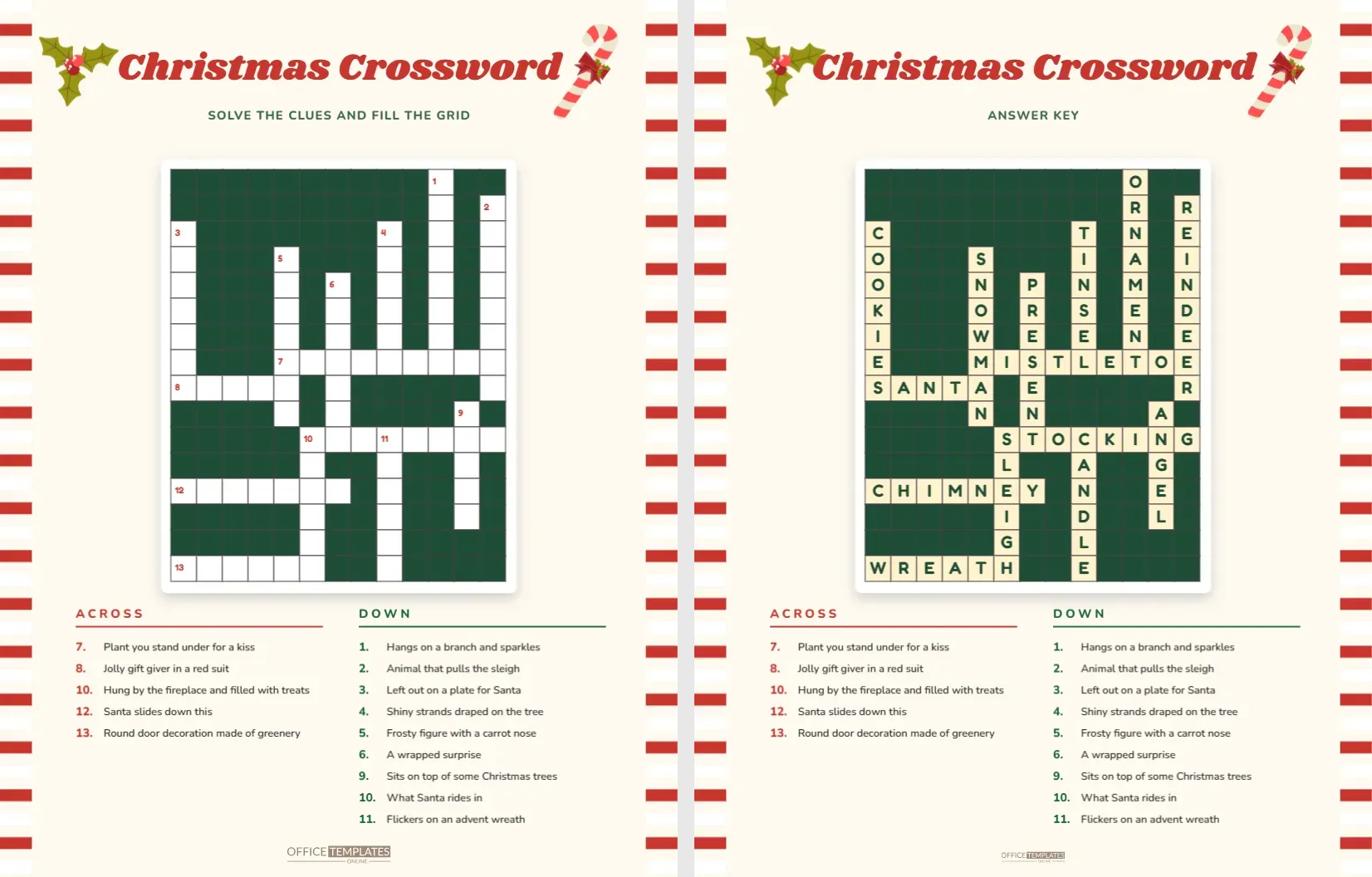
A crossword is a conversation between you and the person who wrote the clues. This one is friendly. The clues are short, the answers are Christmas words you already know, and the grid is small enough to finish before the kettle boils. Candy cane stripes frame the page in red and white, and a sprig of holly and a candy cane guard the title.
Reading the Page From the Top
The page is warm cream. Down the left and right edges runs a column of red and white stripes, like the wrapping on a candy cane. The title Christmas Crossword stands in a thick red script, with a holly sprig on the left and a candy cane on the right and a green line of capitals below telling you to solve the clues and fill the grid. In the middle is a white card holding the grid. Dark green squares are blocks, and white squares are for letters. Small red numbers in the corners mark the start of every answer.
Understanding the Grid
The grid is built as a real Table. Each white cell holds a tiny red number if an answer begins there, and each dark green cell is empty. On the answer key page, the same table holds the letters in bold green on a pale yellow background. A table gives you control that a drawing never could: you can double click it, open Manage Data and edit any cell, which lets you build new crosswords with the same look.
Across and Down at a Glance
| Direction | Count | What to look for |
|---|---|---|
| Across | 5 answers | Longer words such as MISTLETOE and STOCKING |
| Down | 9 answers | Shorter words crossing the long ones |
| Starting squares | 13 numbers | Shared numbers when a word starts both ways |
The Clues in Plain English
Below the grid, two lists are set side by side. ACROSS is headed in red and DOWN in green. Each clue begins with its number, then a short phrase. The clues avoid tricky wordplay and tell you what the answer is or does: the plant you stand under for a kiss, the figure with a carrot nose, the strands of shiny paper on a tree. A seven year old with a dictionary can follow them, and an adult can finish them in a few minutes.
A Solving Plan for Beginners
- Read every clue once and fill in the answers you know without thinking.
- Use the letters you have written to unlock crossing words. A known first letter makes the next clue far easier.
- Count the squares before you write, because the number of squares equals the length of the answer.
- If a clue stumps you, skip it and move on. Crossing answers often fill in the gaps.
- Write lightly in pencil so you can correct mistakes.
Using Crosswords for Learning
Crosswords train spelling, vocabulary and logical thinking at once. Teachers can use this one as a seasonal vocabulary check: print it, hand it out and ask pupils to write each answer in a sentence. For English learners, the clues give context, and the crossing letters offer a safety net. Parents can solve it with a child as a team, with the adult reading the clue and the child writing the answer. You can also cut the clues into strips and let the children match each clue to a picture before filling in the grid.
Writing Your Own Version
The grid layout is fixed, but the words and clues can change. Choose a different set of answers of the same lengths and cross them at the same squares, and the numbers stay in place. If your words have different lengths, you will need to rebuild the grid. A simple approach is to select all the table cells in Manage Data, clear the letters, fill the cells you want with a white background and colour the rest dark green. Then place the numbers by typing a small number in the cell where each answer begins.
Keeping Clues Fair
- Make each clue point to one answer only, and avoid clues that could fit two words.
- Match the tense and form, so that a plural clue has a plural answer.
- Avoid repeating the answer in the clue.
- Keep every answer as one word, with no spaces or hyphens.
- Check that crossing letters agree, which is easy to miss when you change a single word.
Printing the Crossword Without Smudges
The striped edges extend to the sides of the page, so a home printer may leave a thin white margin. That is fine. If you print in black and white, the stripes turn light grey and the green blocks become solid dark, which still reads well. Use a pencil and not a pen, and print on paper that does not smudge. A matt finish is kinder to pencil marks than glossy paper.
Teaching Tips for Parents and Teachers
If a child is new to crosswords, begin by solving the first two clues together out loud. Model your thinking: it has five letters and it is a person in a red suit, so it must be Santa. Then let the child take over with a pencil. After the crossword is complete, ask the child to read the answers in order and use each one in a sentence. This turns a quiet puzzle into a language lesson without any extra preparation. For a group, give each pair a copy and a different coloured pencil so that you can see which team filled in which words, and finish with a quick check against the answer key page.
Making Crosswords Part of a Holiday Routine
Some families set out a crossword on the table each Sunday in December. The puzzle waits next to a pencil, and anyone passing by may add a word. By the end of the week, it is finished, and the page goes on the fridge. Because this template is editable, you can create a fresh version every week by changing the clues and keeping the same look. Over a season you will build a small collection of puzzles that reflect your own family jokes and traditions.
Questions Solvers Ask
Why are some squares darker than others?
The dark green squares are blocks where no letter goes. They separate the words and give the grid its shape.
Where is the answer key?
It is on page two, with every letter filled in and each answer sitting in its own cell.
Can I print only the grid?
Yes. Hide the clue lists in the editor by selecting and deleting them, then print the page, or crop the grid and paste it into another document.
Is there a version for children?
Younger children can use the word lists on the clues as a word bank. Write the answers beside the clues in a scrambled list, and the puzzle becomes a matching game.