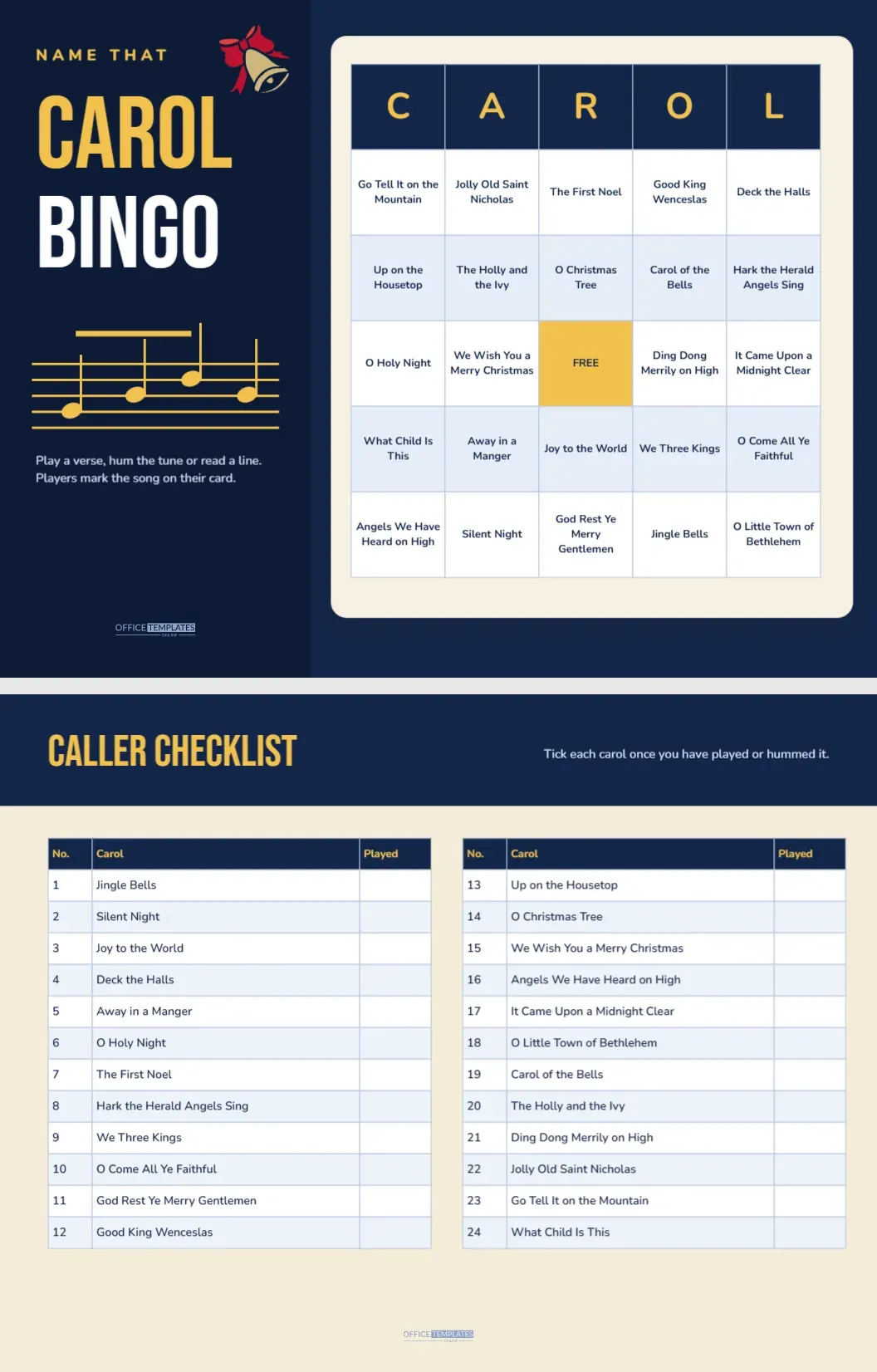
A carol night needs a game that gets people humming rather than reading. Carol bingo does exactly that. The caller plays a few bars, hums the tune or reads a single line, and players find the song title on their card. This landscape template is built for a church hall, a school assembly, a care home or a living room with a piano.
Is Carol Bingo Right for Your Group?
| Group | How it works | Tip |
|---|---|---|
| Family living room | Hum the tune, first to name it marks the square | Let children pick the carols they know best |
| Care home | Play a recording of the opening bars | Use a larger print size and pair players |
| Choir or school | Sing one line, ask the room to find the title | Switch to harder lines in later rounds |
| Church or community hall | Alternate bingo rounds with real singing | Give a hymn book as a small prize |
A Look at the Layout
The page is eleven inches wide and eight and a half tall. The left third is a deep navy panel with the words NAME THAT in small gold capitals, then CAROL in giant gold letters and BINGO in giant white ones. A real set of five gold staff lines runs below with four notes drawn on it, joined by a beam across the top, and a red and gold bell with a bow hangs in the corner. A short instruction in pale blue explains the play.
The right two thirds hold a cream rounded panel with a Table inside it. The header row spells C A R O L in gold on navy, five columns across, and five rows of song titles sit underneath with the centre cell marked FREE in gold.
The Song Titles
Every title is a traditional carol, so there is nothing here that depends on a modern recording. The card mixes well known songs such as Silent Night, Jingle Bells and Joy to the World with a few that need a moment of thought, including Coventry style favourites and Wassail songs. The full pool in the template has twenty four titles, each shuffled into a different position on the card. Because several titles run to four or five words, the cells are wide and tall enough to wrap onto two or three lines without losing the type size.
Page Two, the Caller Checklist
The second page is a warm cream sheet with a navy header that reads Caller Checklist. Two tables list the carols in the order they appear in the pool, each with a number, the title and a Played column for ticking. The checklist is your proof when somebody shouts bingo: read their line aloud and compare it to your ticks.
Preparing a Set of Cards
- Decide how many players you have and print that many cards.
- Double click the grid to open Manage Data and shuffle the titles between cells for each new card.
- Keep the FREE cell in the middle, or move it for a variation.
- Print the checklist once for the host.
- Pick a calling method before the game starts so everyone knows the rules.
Calling Methods, Easy to Hard
- Easy: read the title aloud while players mark it.
- Medium: hum the first line and let the room guess the title before marking.
- Harder: sing the second verse or a line from the middle of the song.
- Hardest: play the tune on a recorder or a phone with the words muted.
Paper Choices for the Navy Carol Card
The navy panel prints rich and dark, so use a good paper stock and expect some ink use. If you are printing twenty or more cards, switch the left panel to a pale blue in the editor to save ink and keep the gold lettering readable. Landscape orientation is already set on the page, so choose landscape in the print dialogue and turn off scaling.
Prizes and Rounds
Three rounds work well in a thirty minute slot: a straight line for the first, four corners for the second and a full card for the last. Offer small prizes such as hot chocolate sachets, mini candy canes or a piece of shortbread. For singing groups, give the winner the right to choose the closing carol.
Building a Carol Night Around the Game
A singing evening has a natural shape. Start with a warm up carol that everybody knows, then play one round of bingo while people settle in with a hot drink. Follow it with a sing along of the carols that came up in the game, since the group has just been thinking about them. A second round can follow after the interval, and the evening can close with a final carol sung all together. This rhythm keeps shy people involved, because the bingo gives them something to do with their hands and eyes while the music builds.
Helping Players Who Do Not Read Music
Nothing on the card requires any musical training. The staff and the notes on the left are decorative, and every square is a plain written title. A person who cannot hum a tune can still play, because the caller can read a line of the lyrics instead. For mixed groups, alternate between humming and reading so each kind of player gets a turn at feeling clever. If you have a pianist, ask them to play a single phrase and repeat it slowly, which gives everyone a second chance to catch the tune.
Questions About the Template
Can I swap carols for songs from my own tradition?
Yes. Open Manage Data on the table and type any titles you like, from hymns to winter songs of your own culture.
Why are there only twenty four songs?
The grid has twenty five cells and one is the free space. If you want a longer game, keep a bigger list on the checklist and rotate different titles across cards.
Can I change the navy and gold colours?
Yes. Select the left panel or the table header and pick a new colour, then check that the gold lettering still stands out from the background.