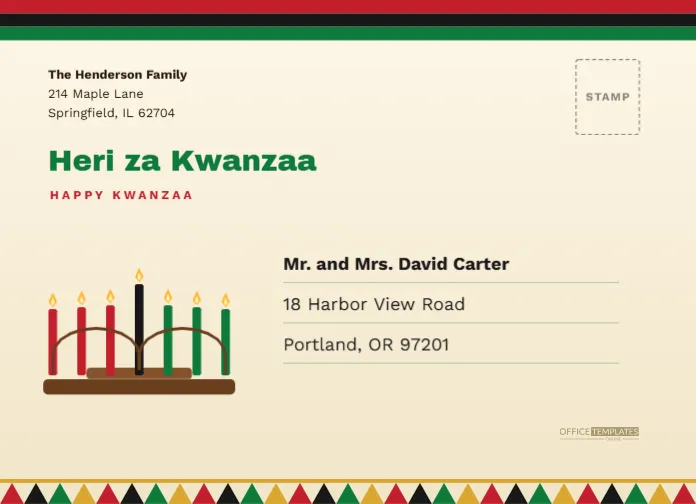
Kwanzaa runs for seven days, from December 26 to January 1, and each day honours one of seven principles. Cards sent during the holiday often carry a short message about community, creativity or faith. The envelope is the first thing the recipient sees, so it is worth giving it the colours and symbols of the celebration. This design uses the red, black and green of the Kwanzaa flag, a kinara with seven candles and a woven border in the Pan African colours.
The Symbols Used and What They Mean
| Symbol on the envelope | Where it sits | Meaning |
|---|---|---|
| Red stripe | Top band | The struggle of the people |
| Black stripe | Top band, middle | The people themselves |
| Green stripe | Top band, lower | The land and the future |
| Seven candles | Lower left | Three red, one black and three green, for the seven principles |
| Woven triangle border | Bottom edge | Inspired by traditional woven cloth in the same colours |
The Envelope Layout
This is an A7 envelope, 7.25 by 5.25 inches, in landscape. Three flat stripes of red, black and green run along the top edge, each about a seventh of an inch thick. The body is a warm cream gradient. In the lower left, a kinara stands on a brown wooden base with a smaller step above it. Seven candles rise from it, three red on the left, a black one at the centre and three green on the right, each with a small golden flame. Two curved brown arms connect the candle holders, drawn as simple arcs.
Across the bottom, a border of small triangles alternates in red, black, green and gold, with a thin gold line above it, which suggests woven cloth. The greeting, Heri za Kwanzaa, is written in Archivo Black in green, and HAPPY KWANZAA in red capitals sits below. The return address and the recipient lines use Work Sans, with the recipient on pale green rules, and a dashed stamp box sits in the top right.
Using the Greeting Respectfully
Heri za Kwanzaa is Swahili for Happy Kwanzaa, and it is the common greeting. If you are not sure how to say it, a short note on the card can help, or you can simply use Happy Kwanzaa. Many people also write the name of the day’s principle on the card inside, such as Umoja, which means unity, for December 26. The wording on the envelope is easy to change, so you can make it your own.
Editing the Candles
- Click a candle to select it. Each candle is a simple rectangle with a flame above it.
- Change a candle colour if you want a different arrangement, though the traditional order is three red, one black and three green.
- Move the whole kinara by selecting its parts together.
- Delete the flames or change them to a paler yellow if you want a quieter look.
- Edit the greeting and addresses as usual.
Timing a Kwanzaa Mailing
Because Kwanzaa begins the day after Christmas, many people send cards just before or just after the holiday week, or send them on the first day with a note of thanks. Some families send a card on each of the seven days to a group of friends, one principle at a time. Plan the dates, prepare your addresses in a list and stamp the envelopes in a batch.
Printing the Kwanzaa Stripes and Triangles
The red, black and green need good printing to stay distinct, so use a quality setting and a bright white or cream paper. The triangles along the bottom edge are small, so check the print for sharpness. A matte finish suits the design, and a pale cream paper makes the colours warmer.
Kwanzaa Envelope Queries
Do the candle colours matter?
Yes, in tradition. Three red candles sit on the left, three green on the right and one black in the middle.
Can I use the envelope for a Black History Month mailing?
Yes, with a different greeting. The colours and the woven pattern fit many celebrations of community and heritage.
Can I add a family name?
Yes. Add it in the return address or beneath the greeting.
Writing a Principle of the Day on the Card Inside
Each day of Kwanzaa has a principle: Umoja for unity, Kujichagulia for self determination, Ujima for collective work and responsibility, Ujamaa for cooperative economics, Nia for purpose, Kuumba for creativity and Imani for faith. A short line on the card matching the day gives the greeting depth. Keep the translation next to the word, so every reader can follow.
Sharing the Seven Day Celebration With a Group
A community group, a school or a workplace can send one envelope each day to a different member, writing a short thank you each time. Use the same envelope for each, and change the greeting to the day’s name. A shared list of addresses, divided between volunteers, makes it simple to complete the week without anyone writing more than a few.
Printing the Candles at a Larger Size for a Display
The kinara drawing works as a poster. Enlarge the candle group, print it on a large sheet and mount it on a wall for the seven nights, colouring a flame each evening. The same vector artwork prints cleanly at any size, so a small envelope design can become a classroom activity.
Choosing a Warm Cream Paper for the Red, Black and Green
A pale cream or natural stock softens the three stripe colours and lets the gold of the triangle border glow. Bright white paper makes the stripes more intense. Pick the paper according to the mood you want, and print a test to check that the black stays rich and the green does not turn muddy.
Adding a Handwritten Principle to the Back Flap
The back flap is a lovely place for a handwritten word. Write Umoja, Imani or the principle of the day in a calm pen colour, and add a small drawing of a candle. A little personal touch like this makes a printed envelope feel hand made.