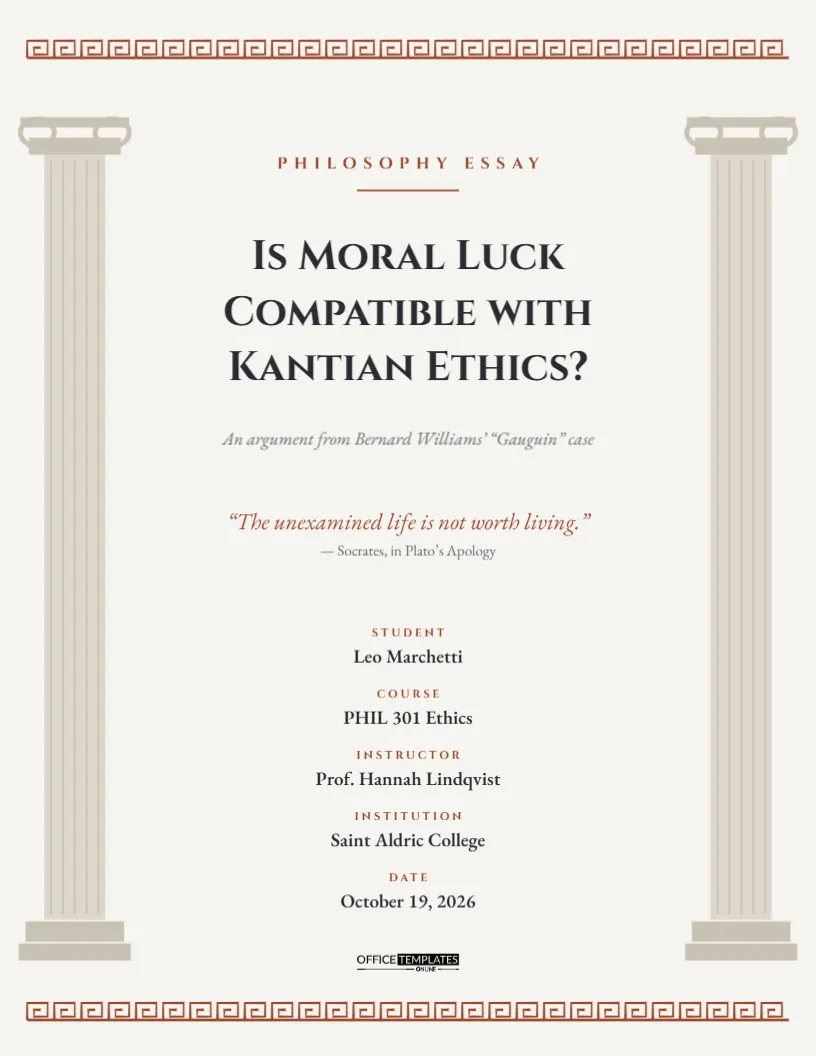
Philosophy began in the colonnades of Athens, where thinkers argued while walking between columns. The Stoics even took their name from the stoa, the covered porch where Zeno taught. This cover brings that setting to your essay. Two Ionic columns stand at either side of the page like the entrance to a temple, a terracotta Greek key pattern runs along the top and bottom, and the text sits in the space between, as calm and balanced as a good argument should be.
Why the Columns Suit Philosophical Writing
Philosophy essays are not like lab reports or case studies. They have no data tables and no figures. Their substance is argument: a claim, reasons for it, objections and replies. A cover for that kind of writing should be quiet and structured, with nothing to distract from the question being asked. The columns frame the page symmetrically, so everything between them is centred and orderly. The design suggests the long tradition you are joining without shouting about it.
Looking Closely at the Classical Design
The page is a soft stone white. A terracotta meander band, the interlocking Greek key that decorates ancient pottery and temples, runs across the very top and the very bottom of the page. On the left and right, two pale stone columns rise from stepped bases to curled Ionic capitals, their shafts lined with flutes. Between them, at the top, small spaced terracotta capitals read Philosophy Essay over a short rule. The title, Is Moral Luck Compatible with Kantian Ethics?, is set in large Cinzel, a typeface drawn from Roman inscriptions. An italic subtitle in EB Garamond names the argument’s source. A quotation from Socrates follows in terracotta italic, then five centred details, each a small capital label over a name or date, and the logo near the foot.
Philosophy Titles Are Often Questions
Many of the best philosophy essay titles are questions, because a philosophy essay answers one. Is Moral Luck Compatible with Kantian Ethics? immediately tells the reader the problem and the framework. If your essay defends a position, you might use a claim instead: Why Moral Luck Undermines Kant’s Good Will. Both work. Avoid titles that only name a topic, such as Moral Luck, which give no hint of your argument. Cinzel has no lowercase letters, so questions look striking, set entirely in its capitals.
Sample Essay Questions by Branch
| Branch | Sample title | Key thinkers to discuss |
|---|---|---|
| Ethics | Can Utilitarianism Account for Individual Rights? | Mill, Bentham, Nozick |
| Epistemology | Does the Gettier Problem Refute Justified True Belief? | Gettier, Plato, Goldman |
| Metaphysics | Is Free Will Compatible with Determinism? | Hume, Frankfurt, van Inwagen |
| Philosophy of mind | Does Mary Learn Something New When She Sees Red? | Jackson, Dennett, Lewis |
| Political philosophy | Would Rational People Choose Rawls’ Principles? | Rawls, Nozick, Sandel |
| Ancient philosophy | Is Virtue Sufficient for Happiness in the Stoics? | Epictetus, Seneca, Aristotle |
The Subtitle Names Your Way In
The italic line under the title says which argument, text, or thought experiment you use: An argument from Bernard Williams’ ‘Gauguin’ case. This is a helpful habit. It tells your reader which literature you engage with and shows you have a focused approach. Other examples: A reply to Frankfurt’s counterexamples, reading the Meno’s slave-boy passage, or testing the trolley problem against Thomson’s loop case.
The Socratic Quotation and Alternatives
The unexamined life is not worth living, attributed to Socrates in Plato’s Apology, is a fitting motto for any philosophy essay. You can keep it, or choose a line connected to your topic. For an essay on Kant, Two things fill the mind with ever new and increasing admiration and awe… the starry heavens above me and the moral law within me is classic. For existentialism, Sartre’s Man is condemned to be free works well. Cite the source beneath the quote in the same way as the sample.
Centred Details Between the Columns
The five details are stacked in the centre: Student (Leo Marchetti), Course (PHIL 301 Ethics), Instructor (Prof. Hannah Lindqvist), Institution (Saint Aldric College) and Date (October 19, 2026). Each has a small terracotta capital label and a name in EB Garamond. Click any line to edit it. If you need a word count or student number, add another pair by duplicating one of the existing label and value lines and moving it down.
Recolouring Stone and Terracotta
The two columns are grouped so they stay level and symmetrical. Ungroup them to change the stone colours, for example to a cooler grey marble. The meander bands are groups too; change the terracotta to deep blue for a Byzantine feel, black for the look of Greek black-figure pottery, or gold for a more festive cover. Keep the background pale so the columns read as stone.
A Brief Note on Structuring the Essay
Philosophy instructors often grade structure as heavily as content. A classic shape is: introduce the question and your thesis; explain the key view fairly; present your argument in numbered premises; raise the strongest objection; reply to it; conclude by stating what your argument shows and what it does not. Clear signposting, such as I will argue that… and One might object that…, is encouraged in philosophy even where other subjects discourage it.
Printing the Temple Cover
The page is US Letter, 8.5 x 11 inches. The stone background and pale columns use very little ink, and the fine flute lines print best on a laser printer or at high quality on an inkjet. Download as a PDF and print at true size. Matte paper suits the classical feel; glossy paper can make the stone tones look plastic.
Philosophy Cover Questions
Is a decorative cover too much for a philosophy essay?
The design is restrained, so most instructors are happy with it. If your department asks for plain pages, delete the columns and bands.
Can I use it for a theology or classics paper?
Yes. The columns and Greek key suit classics especially well; change the label to Classics Essay.
What if my title is long?
Cinzel is wide, so long titles take more lines. Reduce the size slightly or shorten the question.