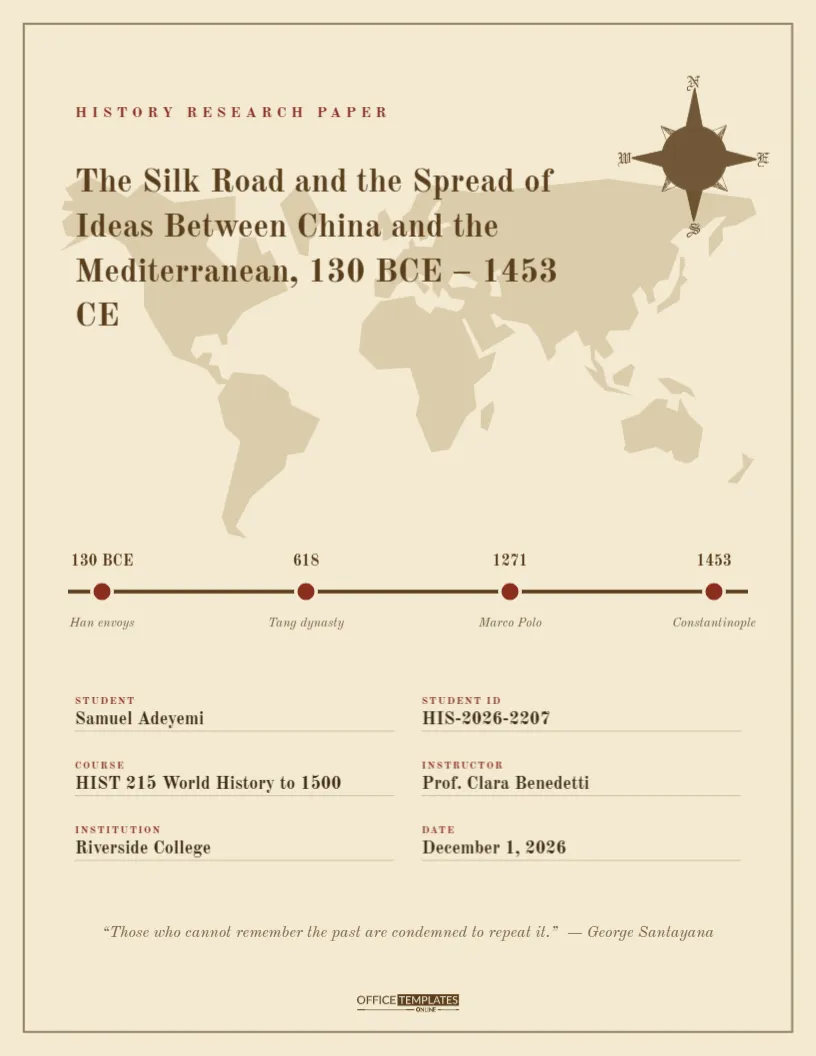
History is about time and place, and this cover puts both on the page. A faded world map spreads behind the title like an old atlas plate, a compass rose points north in the corner, and a timeline marks four dates that frame the paper’s argument. The palette is parchment and sepia with a broad red accent, and the type is Old Standard TT, modelled on the typefaces of nineteenth-century books. Use it for research papers in world history, American history, European history, ancient history, or any course where the past is the subject.
An Atlas Page, Not a Plain Sheet
The background is warm parchment with a thin sepia rule framing the page. A large world map in pale tan fills the upper half at low opacity, so it reads as texture behind the text. In the upper right, a dark sepia compass rose stands out from the map. A deep red label reads History Research Paper, and the title, The Silk Road and the Spread of Ideas Between China and the Mediterranean, 130 BCE – 1453 CE, runs in sepia over the map. In the middle of the page, a horizontal sepia line carries four red markers, each with a bold date above and an italic caption below. Six details in two columns follow, then a quotation from George Santayana, and a sepia logo at the bottom.
Building Your Timeline
The timeline is the feature that makes this cover a history cover. It holds four moments that define your paper’s scope. The sample marks 130 BCE (Han envoys), 618 (Tang dynasty), 1271 (Marco Polo), and 1453 (Constantinople). Choose dates that matter to your argument, not simply the first and last events. A good set includes a starting point, one or two turning points, and an end point. The timeline is a group; ungroup it to edit dates and captions, then regroup it so it moves as one piece.
Timeline Ideas for Popular History Topics
| Paper topic | Date 1 | Date 2 | Date 3 | Date 4 |
|---|---|---|---|---|
| American Revolution | 1765 Stamp Act | 1775 Lexington | 1776 Declaration | 1783 Treaty of Paris |
| French Revolution | 1789 Bastille | 1793 Terror | 1799 Brumaire | 1804 Empire |
| Civil Rights Movement | 1954 Brown | 1955 Montgomery | 1963 March on Washington | 1965 Voting Rights Act |
| World War I | 1914 Sarajevo | 1916 Somme | 1917 U.S. enters | 1918 Armistice |
| Fall of Rome | 235 Crisis begins | 330 Constantinople | 410 Sack of Rome | 476 Romulus deposed |
Writing a Historian’s Title
History titles usually contain a topic, an angle, and a date range. The date range is important: it tells the reader the period you studied and signals that you understand historical scope. The Silk Road alone is a book topic; The Silk Road and the Spread of Ideas Between China and the Mediterranean, 130 BCE – 1453 CE is a paper. Use an en dash between dates and include era markers (BCE, CE) where your instructor expects them. Some departments prefer BC and AD; follow your syllabus.
Six Details for a History Paper
The details are Student (Samuel Adeyemi), Student ID (HIS-2026-2207), Course (HIST 215 World History to 1500), Instructor (Prof. Clara Benedetti), Institution (Riverside College), and Date (December 1, 2026). Each value is set in Old Standard TT and sits above a thin tan rule. Click to edit. For a paper written under Chicago style, you might also want the Chicago/Turabian title page in this collection, which follows that manual’s layout more strictly.
Choosing a Quotation for the Foot of the Page
The sample quotation, Those who cannot remember the past are condemned to repeat it, by George Santayana, is famous but general. A quotation from a primary source in your own topic is far more effective. For a Silk Road paper, a line from Marco Polo’s travels or a Tang dynasty poem would bring the reader into the period. For a civil rights paper, a sentence from a speech or letter of the time works well. Always attribute it correctly, and check that it is genuine; many famous quotes online are misattributed. Or delete the quotation for a cleaner page.
Swapping the Map for Your Region
The world map suits global and comparative history. If your paper covers one region, you might prefer a different backdrop. The map is an editable vector graphic; you can recolour it or reduce its opacity further. To use a historical map instead, such as a scan of an old map of Europe or the Americas, add a public-domain image from a library collection, place it behind the text and lower its opacity so the title stays readable. The compass rose can stay as it is; it suits any map.
Sepia, Red and Parchment: Changing the Palette
The page uses three colours: parchment for the background, sepia for the text, frame and compass, and a deep red for the label, timeline markers and field labels. For a modern history paper, switch to a cooler palette: pale grey background, charcoal text and navy accents. For military history, olive and khaki suit the subject. Keep strong contrast between the title and the map behind it.
Printing an Old-Paper Look
The page is US Letter, 8.5 x 11 inches. Printing the parchment colour on white paper gives a convincing old-paper look but uses some ink. For an even more authentic feel, change the background to white and print on cream or ivory paper; the map and sepia text will look as though they were printed on period stock. Download as a PDF for online submission.
History Cover Page FAQ
Should a history paper include a cover page?
Many history instructors expect a Chicago-style title page. A designed cover like this one is welcome where the syllabus allows it.
Can I add an image of a historical figure?
Yes, from a public-domain source. Place it small near the compass rose and credit the source in your paper.
What if my paper covers only one year?
Use the timeline for months or key days instead, such as Jan 6, Mar 4, Jul 2, and Nov 8.