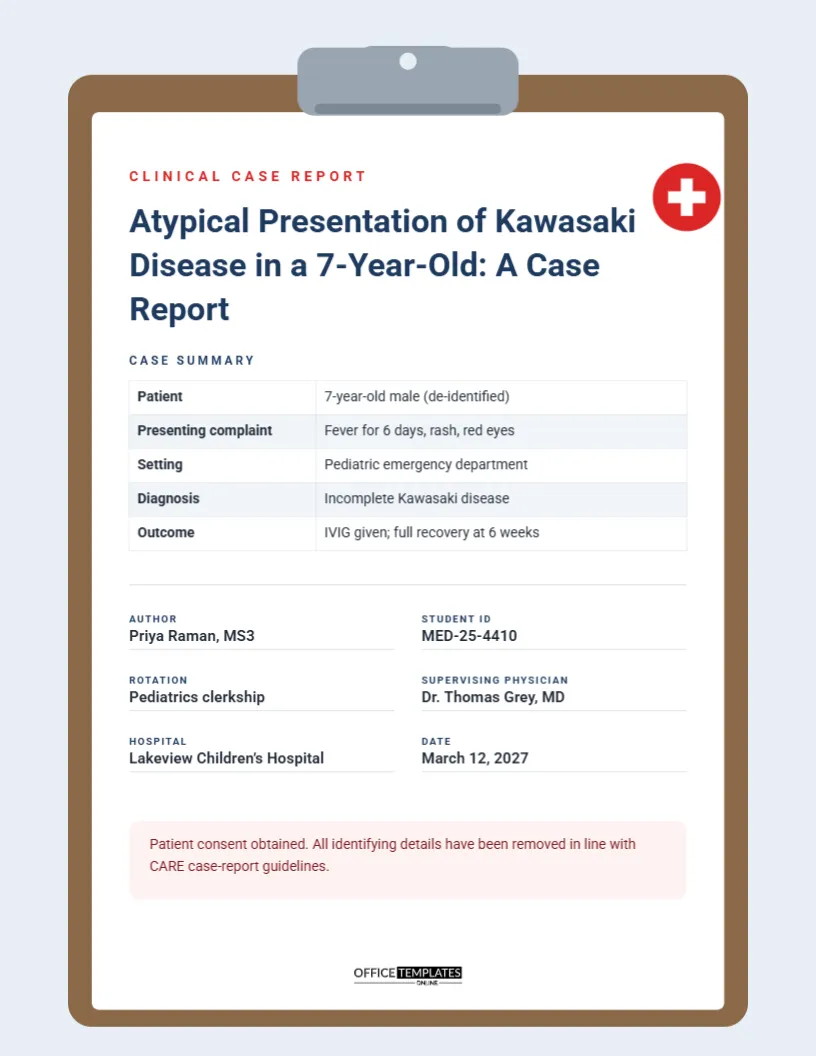
Medical students, residents, physician assistant students, and pharmacy students all write case reports. They are short, structured accounts of a single patient whose presentation, diagnosis, or treatment teaches something. On rotations, case write-ups are a routine assignment; for some, a polished case report becomes a first publication or a poster at a conference. This cover treats the case like a chart on a ward. The page is a clipboard, the metal clip holds the case sheet, and a compact table summarises the case before the reader even opens the report.
A Clipboard on a Ward Desk
The background is a soft hospital blue-grey. A brown clipboard with rounded corners fills most of the page, and a grey metal clip grips its top edge. A white sheet sits on the board. In the top right corner of the sheet, a red circle with a white cross marks it as a clinical document. A red label reads Clinical Case Report, and the title, Atypical Presentation of Kawasaki Disease in a 7-Year-Old: A Case Report, is set in navy Roboto. A Case Summary table follows, then a fine divider, six author and rotation details, a pale red note about consent and de-identification, and the logo centred near the bottom of the sheet.
The Case in Five Rows
The case summary is a real two-column table: Patient (7-year-old male, de-identified), Presenting complaint (fever for 6 days, rash, red eyes), Setting (pediatric emergency department), Diagnosis (incomplete Kawasaki disease), and Outcome (IVIG given; full recovery at 6 weeks). Select the table and use Edit Table Data to replace the rows with your case. Keep each entry short; the table is a snapshot, and the details belong in the case presentation section. If your case needs a row for Key investigation or Learning point, add one with Add Row.
De-identification Before Anything Else
Patient privacy is the first rule of case reporting. Use an age range or an age in years, the sex if relevant, and a general setting. Never include names, initials, medical record numbers, exact dates of admission, the town where the patient lives, or photographs that show a face or distinctive tattoo. Under HIPAA in the United States, dates more specific than the year count as identifiers. The pink note on the cover, Patient consent obtained.All identifying details have been removed in line with CARE case-report guidelines, reminds you and your reader that this has been done. Only keep the statement if it is true for your case.
Following the CARE Guidelines
CARE (Case Reports) guidelines give a checklist that most journals expect. Even for a rotation write-up, following it makes your report clearer. The main sections are:
- Title with the words case report and the main condition or intervention.
- Keywords, usually two to five.
- Abstract covering introduction, case presentation, and conclusion.
- Introduction explaining why the case is unique or educational.
- Patient information with de-identified demographics, symptoms, and history.
- Clinical findings, timeline, diagnostic assessment, and interventions.
- Follow-up and outcomes, including adverse events.
- Discussion with a review of the literature and the main lesson.
- Patient perspective where possible, and informed consent.
Author, Rotation, and Supervisor
The six details on the sheet are Author (Priya Raman, MS3), Student ID (MED-25-4410), Rotation (Pediatrics clerkship), Supervising physician (Dr. Thomas Grey, MD), Hospital (Lakeview Children’s Hospital), and Date (March 12, 2027). Write your training level after your name, such as MS3, PGY-1, or PA-S2. If you are writing for a journal and have co-authors, list everyone in the author field and remove the student ID.
What Makes a Case Worth Writing Up
Supervisors usually suggest a case, but if you are choosing, look for one of these: an unusual presentation of a common disease, a rare disease presenting commonly, an unexpected drug reaction, a diagnostic challenge with a clear lesson, or a new use of an existing treatment. The sample title, an atypical presentation of Kawasaki disease, fits the first category. Common conditions with typical presentations are rarely publishable, though they can still make excellent teaching write-ups on rotation.
Five Case Report Titles to Learn From
| Case type | Example title |
|---|---|
| Unusual presentation | Appendicitis Presenting as Isolated Right Shoulder Pain: A Case Report |
| Rare disease | Takayasu Arteritis in a 16-Year-Old Presenting With Hypertension: A Case Report |
| Adverse drug reaction | Lamotrigine-Induced DRESS Syndrome After Dose Escalation: A Case Report |
| Diagnostic challenge | Hypercalcemia of Unclear Origin Revealing Sarcoidosis: A Case Report |
| Treatment lesson | Successful Management of Severe Hyperkalemia With Hemodialysis in an Infant: A Case Report |
Colours, Clip and Badge
The clipboard board and clip are separate pieces: the brown board is one shape, and the clip is a small group. Change the board to grey, black, or navy for a more modern look, or to light wood for a softer one. The red cross badge is also a small group; ungroup it to change the red to green for a pharmacy case or blue for a radiology case. The page background behind the board can be changed to white if you prefer a clean edge.
Presenting the Case at Morning Report
Case reports are often presented aloud. Download the cover as a PNG and use it as the first slide of your presentation; the clipboard reads instantly as a clinical case on a projector, and the summary table gives your audience the key facts while you introduce the patient. For a poster, use the same title and summary table so your printed poster and written report match.
Printing and Paper Notes for Clinical Write-Ups
The page is US Letter, 8.5 x 11 inches. Save it with Download As PDF and keep the printer at 100% scale. The clipboard brown and the blue-grey background print well on both inkjet and laser printers. If you need to save ink for a quick rotation write-up, change the background to white and keep the clipboard; it still carries the design.
Case Report Cover Questions
Do I need written consent for a class case write-up?
Requirements vary. Many schools do not require written consent for de-identified internal assignments, but journals almost always do. Ask your clerkship director.
Can I include an X-ray or clinical photo?
Inside the report, yes, if de-identified and permitted. Keep the cover free of patient images.
Is this suitable for veterinary case reports?
Yes. Change the patient row to the species and breed, and the setting to the clinic type.