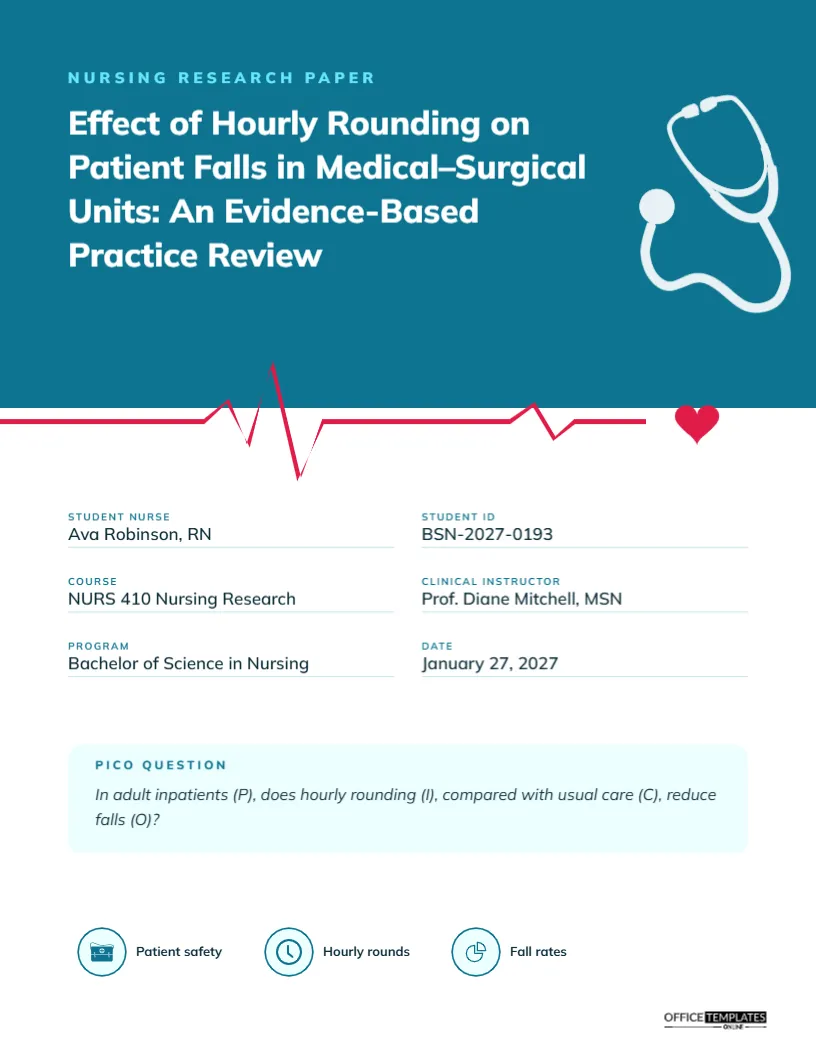
Nursing students write a particular kind of paper. Evidence-based practice (EBP) projects, nursing research critiques, and quality improvement proposals all start from a clinical question and end with recommendations for patient care. A generic academic cover does not capture that. This one does. A heartbeat line runs across the page and ends in a red heart, a stethoscope sits beside the title, and a dedicated box presents your PICO question, the framework every nursing research course teaches.
The Heartbeat That Runs Across the Page
The top of the page is a deep clinical teal. A light aqua label reads Nursing Research Paper, and the title, Effect of Hourly Rounding on Patient Falls in Medical–Surgical Units: An Evidence-Based Practice Review, is set in bold white Mulish. A white stethoscope curls beside the title on the right. Where the teal band ends, a red ECG trace crosses the boundary from the left edge, spikes in a QRS complex, settles, ripples in a smaller wave, and runs into a red heart on the right. Below, on white, six details sit in two columns with teal labels. A pale aqua box holds the PICO question, and a row of three small round icons with labels, Patient safety, Hourly rounds, and Fall rates, leads to the logo in the corner.
PICO on the Cover: Why It Helps
PICO stands for Population, Intervention, Comparison, and Outcome. It turns a broad interest into a searchable, answerable clinical question. Putting it on the cover tells your instructor immediately that your paper is anchored in a well-formed question, which is often worth marks in an EBP rubric. The sample reads: In adult inpatients (P), does hourly rounding (I), compared with usual care (C), reduce falls (O)? Edit it to your own question, keeping the letter labels in brackets so the structure is visible.
PICO Examples From Common Nursing Topics
| Topic | P | I | C | O |
|---|---|---|---|---|
| Pressure injuries | ICU patients | Two-hourly repositioning | Four-hourly repositioning | Pressure injury rate |
| Hand hygiene | Nursing staff | Alcohol-based hand rub stations at each bed | Stations at unit entrance only | Compliance rate |
| Pain management | Post-operative adults | Music therapy | Standard care | Pain scores |
| Burnout | New graduate nurses | Structured mentorship | No mentorship | Retention at 12 months |
| Diabetes education | Adults with type 2 diabetes | Teach-back method | Written leaflet | HbA1c at 3 months |
Student Nurse Details
The six fields are Student nurse (Ava Robinson, RN), Student ID (BSN-2027-0193), Course (NURS 410 Nursing Research), Clinical instructor (Prof. Diane Mitchell, MSN), Program (Bachelor of Science in Nursing), and Date (January 27, 2027). Add your credentials after your name if you have them, as RN-to-BSN students often do. If your course is taught by a faculty member who is not your clinical instructor, rename the field Course faculty.
Keeping Patient Privacy on the Cover
Nursing papers often draw on clinical experience. Never put patient names, room numbers, dates of birth, or any detail that could identify a patient on the cover or in the paper. The same applies to photos: if you add an image, use a stock photo or an empty unit, never a real patient. Most nursing programs treat a privacy breach in an assignment as a serious professional issue, so it is worth a final check before you submit.
Tailoring the Three Icons
The icon row is grouped so the three icons stay evenly spaced. Each icon sits in a round aqua badge with a teal outline and a short label beside it. Ungroup the row to change the labels so they match your topic: for a hand hygiene project, try Infection control, Compliance and Audit data; for a pain management paper, try Pain scores, Comfort and Recovery. The icons themselves are editable vectors and can be recoloured from their swatches.
Using the Cover for Other Nursing Assignments
The same design works for a nursing care plan, a case study, a quality improvement proposal, a capstone EBP project, or a DNP scholarly project. Change the label at the top, for example, to Quality Improvement Proposal or Evidence-Based Practice Project, and use the PICO box for your aim statement if PICO does not apply. A useful aim statement format for quality improvement is: By [date], reduce [problem] on [unit] from [baseline] to [target].
Turning Your PICO Into a Literature Search
The PICO box is not only a label; it is the starting point of your search strategy. Each element becomes a group of search terms. For the sample question, P gives inpatient OR hospitalized adults, I gives hourly rounding OR intentional rounding OR purposeful rounding, and O gives accidental falls OR fall rate. Combine the groups with AND in CINAHL or PubMed, then filter for the last five to ten years and for study designs your course accepts. Writing the question on the cover first keeps your search, your appraisal and your recommendations aimed at the same target.
Changing the Colour of the Clinical Band
Teal suggests hospitals and calm care. To match your school, change the band colour to navy, royal blue or deep purple. Keep the ECG line red so it stays visible across both the coloured band and the white page; it is a group, so you can recolour or move it as one piece. If you change the band to a very dark colour, the stethoscope and title stay white and readable.
Printing for Clinical Courses
The page is US Letter, 8.5 x 11 inches. The teal band uses moderate ink. Download as a PDF for submission through your learning platform. If you need printed copies for a poster day or a nursing research conference, print on bright white paper on a laser printer; the red heartbeat line looks sharp, and the white text in the band stays crisp.
Nursing Paper Cover FAQ
Does APA style apply to nursing papers?
Yes, most nursing programs use APA. If your instructor requires a strict APA title page, place this cover in front of it or ask whether a designed cover is allowed.
Can I use this for a PICOT question?
Yes. Add the time frame with (T) at the end, for example, over six months (T).
Is the stethoscope required?
No. Delete it if you need more room for a long title.