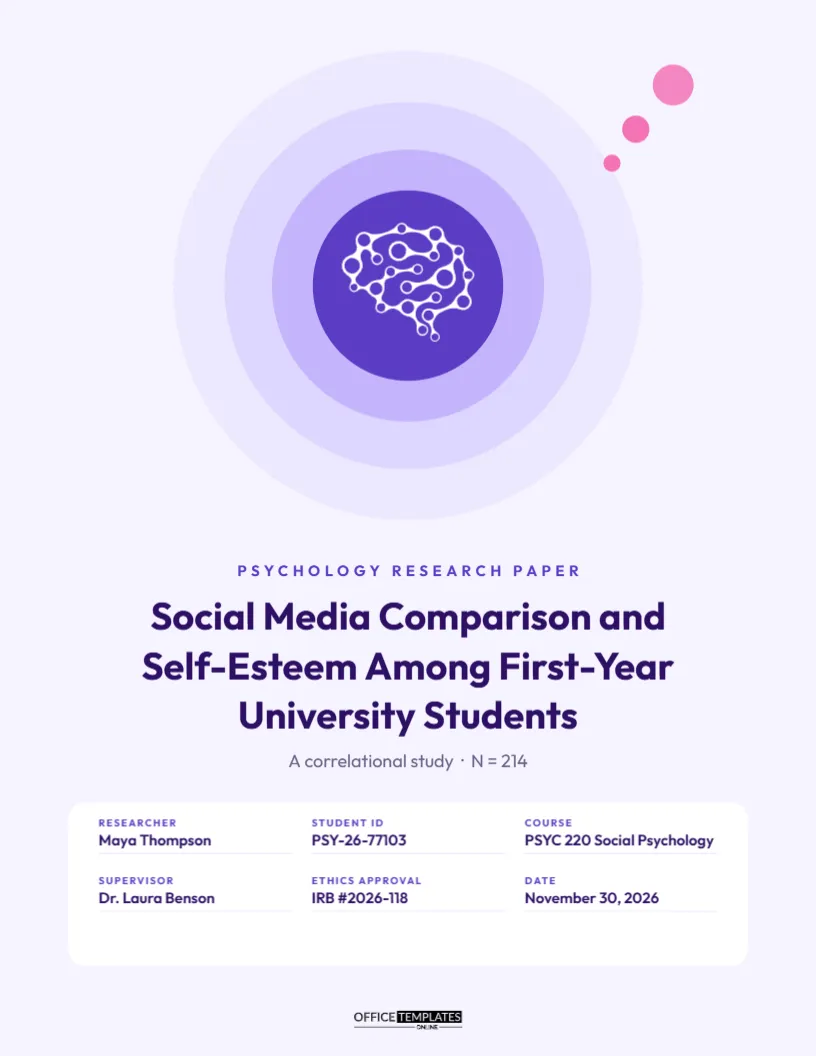
Psychology papers sit between the sciences and the humanities. They report studies with participants, statistics, and ethics approvals, yet they deal with feelings, thoughts, and behaviour. This cover reflects both sides. A brain-network icon at the centre of soft lavender rings speaks to the science of the mind; pink thought bubbles drifting upward add a human, slightly playful touch. Below, a clean white card holds the details a psychology instructor needs, including an ethics approval number that most general covers forget.
Lavender, Rings and a Network Brain
The page has a pale lavender background. In the upper half, three concentric circles in deepening shades of lilac surround a solid violet disc, and inside it sits a white brain drawn as connected nodes, a common symbol for neuroscience and cognition. To the upper right, three pink circles of growing size rise like thought bubbles. Below the rings, a violet label reads Psychology Research Paper; the title, Social Media Comparison and Self-Esteem Among First-Year University Students, is centred in deep purple; and a grey line notes the study type and sample: A correlational study · N = 214. A white rounded card holds six details in three columns, and the logo is centred at the foot of the page.
Study Details, Including Ethics Approval
The white card holds Researcher (Maya Thompson), Student ID (PSY-26-77103), Course (PSYC 220 Social Psychology), Supervisor (Dr. Laura Benson), Ethics approval (IRB #2026-118), and Date (November 30, 2026). The ethics field matters. Any study that collected data from human participants, even a short anonymous survey of classmates, usually needs approval from an Institutional Review Board (IRB) or a departmental ethics committee. Showing the approval number on the cover reassures your reader that the study was conducted properly. If your paper is a literature-based essay with no participants, change the label to Paper type and write Theoretical review.
Describe Your Design in One Short Line
The grey line under the title is a small but powerful feature. In psychology, the design of a study shapes what conclusions it can support. A reader who sees A correlational study knows not to expect causal claims; A randomised controlled experiment tells them the opposite. Add the sample size with N, as APA style does. Examples:
- A correlational study · N = 214
- A 2 x 2 between-subjects experiment · N = 120
- A longitudinal survey across two semesters · N = 86
- A qualitative interview study · 12 participants
- A replication of Strack et al. (1988) · N = 160
Psychology Titles That Follow APA Advice
APA recommends that a title summarise the main idea simply, ideally identifying the variables and their relationship. Social Media Comparison and Self-Esteem Among First-Year University Students names two variables and the population in thirteen words. Avoid filler such as A Study of or An Investigation Into, which APA specifically discourages. Cute titles with puns are fine for blog posts but can make an academic paper harder to find; if you want one, add a plain subtitle after a colon.
Using This Cover With an APA Paper
Most psychology courses require APA style, and APA has strict rules for its own title page. This decorative cover is best used where your instructor allows a designed front page, such as a research project portfolio, a poster session handout, an honours project, or a course where the syllabus says include a cover page. If your instructor requires a standard APA title page, place this cover in front of it or use the APA 7 student title page in this collection instead.
A Helpful Pre-Submission Check for Psychology Papers
| Check | Why it matters | Where it shows |
|---|---|---|
| Ethics number is correct | Confirms the study was approved | Cover card and method section |
| Sample size matches results | Reviewers compare N across sections | Cover line and participants section |
| Design wording is accurate | Correlational studies cannot claim causation | Cover line and discussion |
| Supervisor name spelled correctly | Courtesy and accuracy | Cover card |
| Participant data is anonymous | Protects participants | Results and appendices |
Swapping Colours and the Brain Icon
The rings and violet disc are grouped so they stay perfectly centred. Ungroup them to change shades: soft teal works for clinical psychology, warm coral for developmental psychology, and slate blue for cognitive neuroscience. The brain icon is an editable vector; its colour swatches let you change the white to any shade. The thought bubbles are a separate small group. Recolour them to match, or delete them for a more serious tone.
From Lab Report to Honours Thesis
Psychology students write many kinds of documents over a degree: short lab reports in research methods, a replication study in second year, a research proposal, and often an honours or senior thesis. The same cover can follow you through all of them. For a proposal, change the study line to Proposed study · target N = 150 and the ethics field to Ethics: application submitted. For an honours thesis, change the label to Honours Thesis in Psychology and add your second marker as a seventh detail. Keeping one visual identity across your work makes a portfolio look deliberate.
Topics This Cover Suits
The design suits almost any psychology subject: social, cognitive, developmental, clinical, health, educational and organisational psychology. It also works for related fields like neuroscience, behavioural economics and counselling. For a neuroscience lab report, change the label to Neuroscience Lab Report and the study line to the method, such as EEG study or Reaction-time task.
Printing a Pale Background Neatly
The page is US Letter, 8.5 x 11 inches. The pale lavender background is light enough to print economically, and the rings print smoothly on most inkjet and laser printers. For a crisp result, download as a PDF and print at actual size. If your printer tends to band on large pale areas, switch the background to white; the rings will still carry the design.
Psychology Cover FAQ
Should I include my participants’ details on the cover?
Only the sample size. Never include names or identifying details of participants anywhere in a paper.
What if I do not have an IRB number?
Some class projects are exempt or approved at course level. Write Course-level approval or ask your instructor what to put.
Can I use this for a psychology poster?
It is designed as a page cover, but you can download it as a PNG and use it as a handout to accompany your poster.