Business schools teach through cases, and students write case analyses constantly: in strategy, marketing, operations, finance, and leadership courses, and in MBA programs almost every week. A case analysis is closer to a consulting report than an essay, so its cover should look like one. This template borrows from business magazines and consulting decks. A large photo fills the top of the page, a navy band carries the title, the central case question is stated plainly, and a strip of key facts tells the reader which company, industry, time frame, and framework the analysis covers.
Built Like a Business Magazine Cover
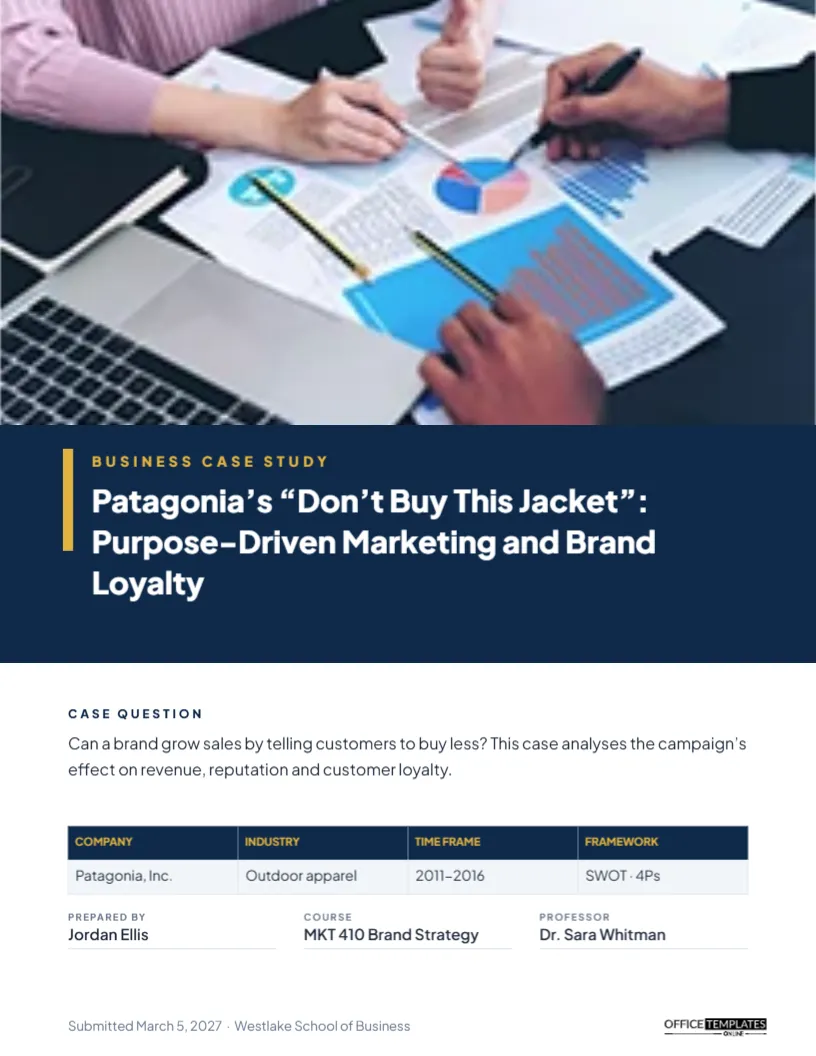
The top half of the page is one wide photo slot, edge to edge. Overlapping its lower part is a solid navy band. On the left of the band, a short gold bar and a gold label reading Business Case Study introduce the title, Patagonia’s ‘Don’t Buy This Jacket’: Purpose-Driven Marketing and Brand Loyalty, set in heavy white Plus Jakarta Sans. Below the band, on white, a navy label introduces the case question in a short paragraph. Next comes a four-column table with a navy header row and gold column titles. Three details follow in a row, and the footer carries the submission date and school beside the logo.
Choose a Photo That Sets the Scene
The photo slot is the first thing a reader sees, so choose with care. Select it and click Replace Image. Good options include the company’s storefront, its product in use, a factory floor, a city skyline where the company is based, or an abstract image linked to the industry, such as mountains for an outdoor brand or a container port for a logistics case. Use a royalty-free image or one you took yourself, and avoid using a company’s copyrighted ad imagery. Landscape photos fit best; the slot is wide and relatively short, and the navy band covers its lower edge, so keep the key subject in the upper part of the picture.
One Question That Frames the Whole Case
Good case analyses answer a decision question. The sample reads: Can a brand grow sales by telling customers to buy less? This case analyses the campaign’s effect on revenue, reputation and customer loyalty. Notice that it is a real question with a debatable answer. Write yours the same way. Should Netflix enter live sports? Or how should Starbucks respond to unionisation? Invites analysis; This paper is about whether Netflix does not. The question also guides your reader: everything in your report should help answer it.
The Key Facts Strip
The table under the question has four columns: Company (Patagonia, Inc.), Industry (Outdoor apparel), Time frame (2011-2016), and Framework (SWOT · 4Ps). It is a real table, so select it and use Edit Table Data to type your facts. Instructors love this strip because it tells them at once what the case is and how you approached it. Change the column titles if you need different facts, such as Revenue, Headquarters, or Decision maker.
Frameworks You Might List
| Course | Typical frameworks | Best for |
|---|---|---|
| Strategy | Porter’s Five Forces, SWOT, VRIO | Industry attractiveness and competitive advantage |
| Marketing | 4Ps, STP, customer journey | Campaigns, positioning and segmentation |
| Operations | Process mapping, Lean, capacity analysis | Bottlenecks and efficiency problems |
| Finance | DCF, ratio analysis, NPV | Investment and valuation decisions |
| International business | PESTEL, CAGE distance | Market entry and expansion |
| Leadership | Kotter’s 8 steps, stakeholder mapping | Change management and culture |
Prepared By, Course and Professor
Three short fields sit in a row under the table: Prepared by (Jordan Ellis), Course (MKT 410 Brand Strategy), and Professor (Dr. Sara Whitman). For a group case, list all names in Prepared by or write the team name. The footer line, Submitted March 5, 2027 · Westlake School of Business, gives the date and school. Every item is plain text and can be edited by clicking it.
Writing the Case Title
Case titles often follow a pattern: the company and the decision, joined by a colon. Patagonia’s ‘Don’t Buy This Jacket’: Purpose-Driven Marketing and Brand Loyalty names a specific campaign and the theme you analyse. Other strong examples: Airbnb in New York: Growth Versus Regulation, LEGO’s Turnaround: Focus, Innovation and the Return to Bricks, Zara’s Fast Fashion Supply Chain: Speed as Strategy. Keep it to two or three lines in the band. If you are analysing a Harvard Business School or Ivey case, you can use the published case title, but adding your angle after a colon makes your report stand out.
Recolouring for Your School or the Company
Navy and gold look corporate and serious. To echo the company you are analysing, change the band and table header to a colour associated with the brand, but keep it dark enough for the white title to stay readable. Deep green, burgundy, and charcoal all work. The gold bar and labels can switch to any bright accent, such as orange or teal. Select the band, the table, and the small bar in turn and change their colours.
Presenting the Case in Class
Many case courses end with a presentation. Download this cover as a PNG and use it as your opening slide, or show it on the screen while your team sets up. Because the layout is clean and the type is large, it reads well on a projector. For the written submission, download as a PDF and place it in front of your report.
Print Notes for Case Reports
The page is US Letter, 8.5 x 11 inches. The photo and navy band bleed off the top and sides, so a home printer will leave a small white margin; for a cleaner result at a print shop, turn on bleed and crop marks when downloading the PDF. Photos look best on a laser printer or on bright, smooth paper. If the photo is dark, lighten it before uploading so it does not merge into the navy band.
Business Case Cover Questions
Can I use the company’s logo?
For a class assignment, many instructors accept it for identification. Avoid using it in ways that suggest the company endorsed your report.
Where does the executive summary go?
On the next page. The case question on the cover is not a summary; it is the problem your summary will answer.
Is this suitable for consulting club or competition submissions?
Yes. Replace the course fields with the competition name and round.