A Literature Review is a different animal from a research paper. You are not presenting your own experiment; you are searching, reading, and synthesising what others have already found. Its cover should signal that. This design does it with three things a reviewer cares about most: a magnifying glass that suggests careful searching, three scope chips that report how many studies you reviewed, over which years, and from how many databases, and a bookshelf of colourful spines along the bottom. It suits standalone literature reviews, systematic and scoping reviews, and the literature chapter of a thesis submitted as a separate assignment.
Scope at a Glance: The Three Chips
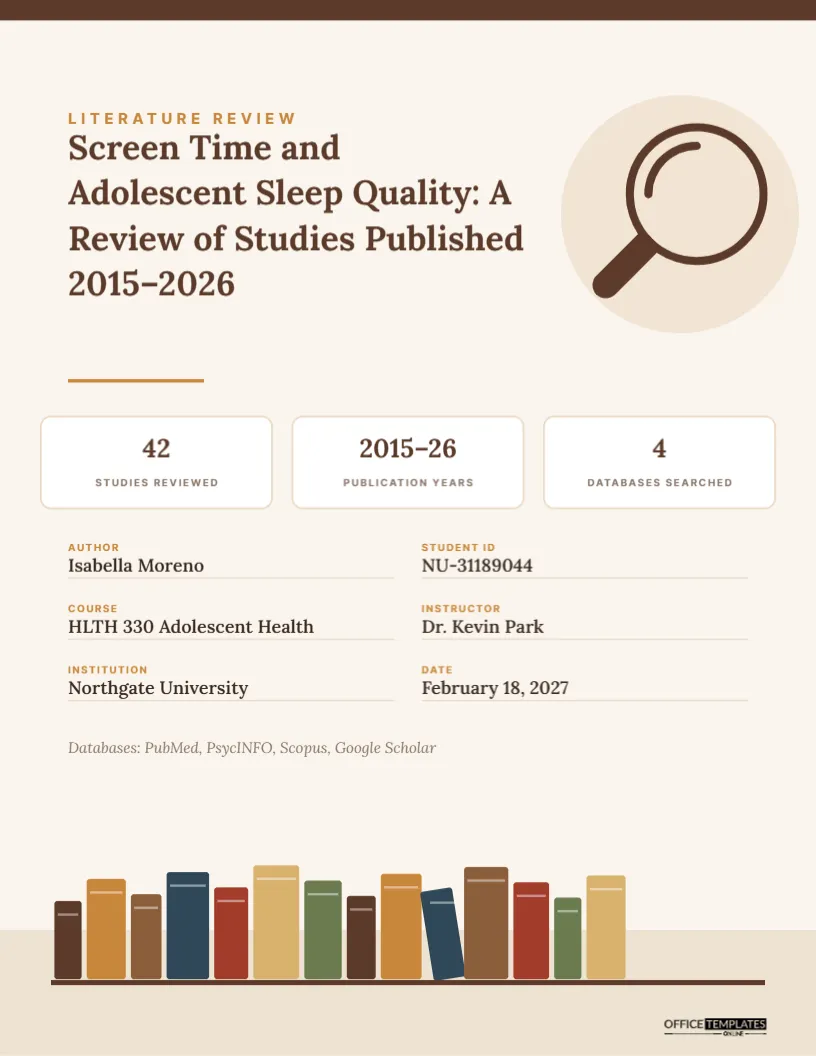
Under the title, three white rounded cards sit side by side. The samples read 42 · Studies reviewed, 2015-26 · Publication years, and 4 · Databases searched. Together they tell the reader the size and boundaries of your review before they turn a page. Markers of literature reviews often check whether the search was wide enough and recent enough; these chips answer both questions. Replace the numbers with your own. If your review is narrative rather than systematic, you might change the labels to Key themes, Decades covered, or Primary sources.
The Look: Library Warmth
A thin dark brown bar runs across the top of a warm cream page. On the upper right, a large magnifying glass sits inside a pale tan circle. On the left, a tan label reads Literature Review above the title, Screen Time and Adolescent Sleep Quality: A Review of Studies Published 2015-2026, set in brown Lora. A short tan rule leads to the scope chips, then six details in two columns with tan labels. An italic line lists the databases searched. At the foot of the page, fourteen book spines in brown, tan, slate blue, brick red, olive, and gold stand on a dark shelf, some taller, one tilted, as on a real bookshelf. The logo sits in the bottom right.
Six Details on the Page
The details are Author (Isabella Moreno), Student ID (NU-31189044), Course (HLTH 330 Adolescent Health), Instructor (Dr. Kevin Park), Institution (Northgate University), and Date (February 18, 2027). Each is a label above a value with a thin line beneath. Click any value to edit it. The labels can be renamed, for example, Supervisor instead of Instructor for a thesis chapter.
How to Fill the Scope Chips Honestly
- Studies reviewed: count only the studies included in your final synthesis, not every record your search returned. If you followed PRISMA, these are the studies included in the review box of your flow diagram.
- Publication years: state the range you set as an inclusion criterion, such as 2015-2026, not merely the oldest and newest paper you happened to find.
- Databases searched: count the databases, not the search strings. List them on the line below the details: Databases: PubMed, PsycINFO, Scopus, Google Scholar.
Accurate numbers matter because a literature review’s credibility rests on its method. A cover that overstates the search can raise questions later. If your review is still in progress, for example, a draft submitted for supervisor feedback, write the current numbers and add (draft) after the date, then update the chips when the search is final.
Literature Review Titles: Topic Plus Boundaries
A strong literature review title names the topic and signals the boundaries of the review. The sample does this by naming the population (adolescents), the two variables (screen time and sleep quality), and the period (2015-2026). Other good patterns include A Systematic Review of…, A Scoping Review of…, or What We Know About…: A Narrative Review. Avoid titles that sound like original research, such as The Effect of Screen Time on Sleep, which might make a reader expect your own data.
Databases by Discipline
| Field | Databases students commonly search |
|---|---|
| Health and nursing | PubMed, CINAHL, Cochrane Library, Embase |
| Psychology | PsycINFO, PubMed, Web of Science |
| Education | ERIC, Education Source, Google Scholar |
| Business | Business Source Complete, ABI/INFORM, Scopus |
| Engineering and computing | IEEE Xplore, ACM Digital Library, Scopus |
| Humanities | JSTOR, Project MUSE, MLA International Bibliography |
Update the italic databases line on the cover to list the ones you actually used.
Customizing the Bookshelf
The book spines and the shelf are one group, so they move as a single object and cannot be clicked apart by accident. To change the colours, ungroup the shelf and recolour individual spines; a palette of your university colours can look smart. You can also straighten the tilted book or remove a few spines to make room for a footer note. The magnifying glass is an editable vector, so its swatches let you match it to any new colour scheme.
Printing a Review Cover on Ivory or White Stock
The page is US Letter, 8.5 x 11 inches. The cream background and warm browns print well on standard white paper, but they look especially good on a lightly tinted or ivory paper. Download as a PDF for online submission. If you print at home and want to save ink, change the background to white; the bookshelf and chips still give the page its character.
Where the Literature Review Fits in Bigger Projects
In a thesis or dissertation, the literature review is usually a chapter, not a separate document, and it would not have its own cover. But many programs set a literature review as a standalone assignment before the proposal, or require one as a milestone for a capstone. In those cases, a cover like this one feels complete, and the scope chips give your supervisor a quick picture of your progress.
Literature Review Cover FAQ
Should I put my research question on the cover?
You can. Replace the databases line with Review question: … if your instructor wants it up front.
What if I reviewed fewer than ten studies?
That is normal for an undergraduate review. Show the real number; quality of synthesis matters more than quantity.
Can I use the cover for an annotated bibliography?
Yes. Change the label to Annotated Bibliography and the first chip to Sources annotated.