In Ramadan, the moment the sun sets is shared by millions of people at once. A date is broken, a glass of water is lifted, and the long day of fasting ends together. Inviting friends, family, and neighbours to share that moment is one of the most generous traditions of the month. This invitation brings the quiet glow of Ramadan nights to your guests’ hands.
Lanterns, Moon and Skyline
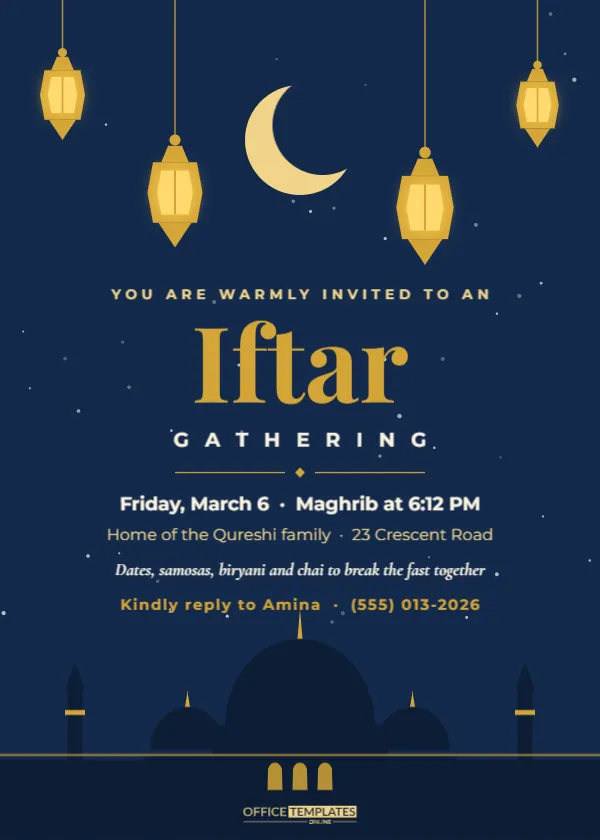
The card is 5 x 7 inches with a deep navy night sky lightly scattered with stars. Four geometric lanterns hang from the top of the card on thin gold cords of different lengths. Each lantern has a domed cap, a hexagonal frame, and a warm glowing panel inside, finished with a pointed base. Between them, a pale golden crescent moon sits in the sky.
Below the lanterns, you are warmly invited to anIftar in soft gold capitals, set large in gold Playfair Display, with GATHERING in widely spaced cream capitals beneath it and a gold divider. The details follow: Friday, March 6, Maghrib at 6:12 PM in cream, the host family’s home and address in soft gold, an italic line about dates, samosas, biryani, and chai to break the fast together, and a gold reply line. At the bottom, a mosque skyline in darker navy rises across the card, with a central dome, two smaller domes, two minarets with gold bands, three softly lit gold arched doorways, and a fine gold line along the horizon. The OTO logo rests in pale gold beneath the skyline.
The Evening Around Maghrib
An iftar invitation is unusual because the start time depends on sunset, which changes every day. This timeline helps guests and hosts plan around it.
| Time | What happens | Host’s role |
|---|---|---|
| 30 minutes before Maghrib | Guests arrive and settle | Dates, water, and drinks laid out, ready |
| At Maghrib | The fast is broken with dates and water | Announce the time, often with a short dua |
| A few minutes after | Maghrib prayer for those who pray | A quiet room with prayer mats and the qibla direction |
| 15 to 20 minutes after | Main iftar meal | Serve the main dishes |
| Later in the evening | Tea, dessert and conversation | Chai, sweets and fruit |
| Isha and Taraweeh | Some guests leave for the mosque | Wish them well, pack leftovers |
Always check the exact Maghrib time for your city and date using a local prayer timetable, and update the time on the card. It shifts by a minute or two each day.
Breaking the Fast: Traditional Foods
Iftar menus vary from country to country, but some foods appear on almost every table. Dates and water come first, following the tradition of the Prophet. Then come light starters such as samosas, pakoras, spring rolls, fruit chaat, and lentil soup. The main meal might be biryani, pulao, grilled meats, curries, stuffed vegetables, or a big pot of harira. Popular drinks include Rooh Afza, fresh juices, laban, and sweet tea. Desserts like kunafa, sheer khurma, qatayef, or gulab jamun round off the evening. Offer a mix of light and filling dishes, because people who have fasted all day often prefer to eat slowly.
Welcoming Guests Who Are Not Fasting
Iftar gatherings are a beautiful way to share Ramadan with friends of other faiths, colleagues and neighbours. Many hosts include a short explanation of the fast and the meaning of iftar, either in conversation or on a small card on the table. Guests who are not fasting are welcome to eat with everyone at sunset; simply ask them to wait until the fast is broken, as a gesture of solidarity. Modest dress is appreciated but rarely required at a home iftar. If you are inviting people for the first time, a friendly note in the message alongside the card (Arrive a little before sunset; we break the fast at 6:12) helps them feel at ease.
Personalising the Lanterns and Text
All the text is editable with a double-click: the host family, the date, the Maghrib time, the address, the menu line, and the reply contact. For a community or office iftar, change GATHERING to Community Iftar or Office Iftar and add the venue.
The four lanterns are grouped, so you can move them as one or ungroup them to change the length of a cord, the size of a lantern, or its glow colour. The mosque skyline is a single group; recolour the buildings or the gold doorways, or ungroup it to add another minaret. The background navy can become deep teal, burgundy, or emerald green. Fonts are Playfair Display, Cormorant Garamond, and Montserrat, all in the editor’s list.
Iftar for Children and Families
Children love being part of iftar, even before they are old enough to fast. Give them a job: handing out dates, filling water glasses, or counting down the last minute to Maghrib. A small table of their own, with fun cups and a Ramadan colouring activity, keeps them busy while adults chat. Some families celebrate a child’s first full fast with a special iftar; the card works perfectly for that with a line such as Celebrating Zara’s first roza.
Printing and Sharing in Ramadan
Download the card as a PDF and print on a smooth white or cream card. The navy and gold look elegant and festive. Many families print a stack at the start of Ramadan and change only the date and time for each iftar they host. For quick sharing on messaging apps, download a PNG or JPG. Because the Maghrib time changes daily, double-check it before each send.
Iftar Invitation Questions
How far in advance should I invite guests?
One to two weeks is ideal. Weekend iftars fill up quickly during Ramadan.
Should guests bring anything?
It is customary to bring a small gift such as dates, sweets or fruit, but never required.
Can I use this card for an Eid dinner?
Yes. Change Iftar to Eid Dinner and the time to the evening of your choice.
What if I host at a restaurant?
Many restaurants offer iftar set menus. Replace the address and book well ahead.
Add your family’s name, check tonight’s Maghrib time, and share the card. Ramadan Kareem, and may your table be full.