A Card That Tells a Life in One Paragraph
Obituary cards are small, but the paragraph on them is often the most read part of a funeral. It is where people learn that the man they knew as a neighbour was also a youngest brother, a worker in a trade, a father who taught his son to fish. This template for a father gives that paragraph room, and it frames the text with soft flowers and a photograph that suggests affection between family members.
Peonies, a Green Frame and Two Men Laughing
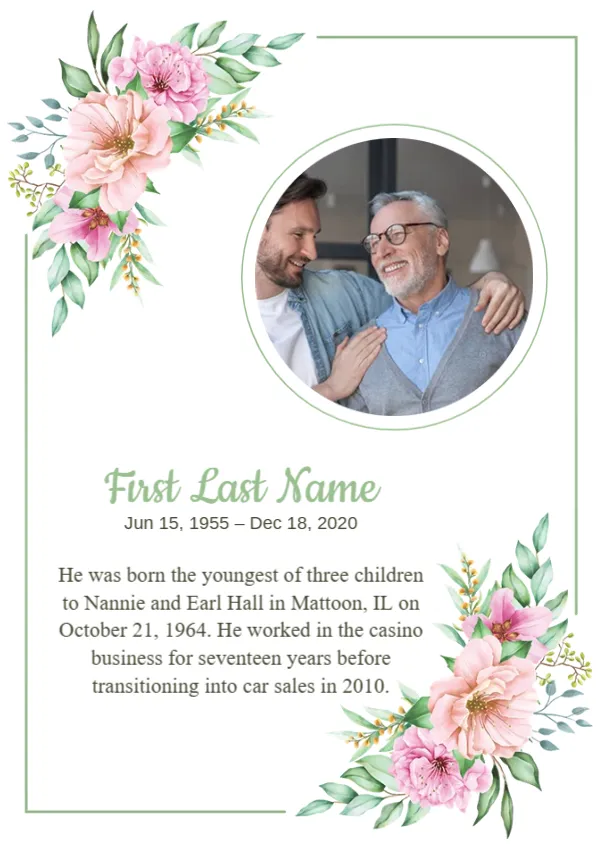
The card is A6 portrait, 4.13 x 5.83 inches (105 x 148 mm). The background is white, with a thin green line that frames the page. Watercolour pink and peach peonies with green leaves fill the top left and the bottom right corners. In the upper half, a round photograph shows two men, a younger man with a beard and an older man with grey hair and glasses, laughing together with an arm around the shoulder, inside a thin green circle.
Below the photograph, First Last Name is written in a green script, with the dates, Jun 15, 1955 to Dec 18, 2020, in a small grey line. The biography paragraph is set in a serif font beneath. The fonts are Cookie, Arimo and Carlito.
Check the Dates Against the Story
The sample text and the sample dates do not agree. The dates show Jun 15, 1955, but the paragraph says he was born on October 21, 1964, in Mattoon, IL, to Nannie and Earl Hall, and that he worked in the casino business for seventeen years before moving into car sales in 2010. These are placeholders, but they show how easy it is to create a mismatch. When you write the real text, check the dates, the places and the names once more, and have a family member read the card out loud.
A Simple Structure for the Paragraph
- Birth: where and when he was born, and to whom.
- Family: his marriage, children and grandchildren.
- Work: the jobs he did and what he was proud of.
- Interests: what he loved, such as fishing, football or gardening.
- Closing: the date of death and a short line about how he will be remembered.
How Long Can the Paragraph Be?
The text space holds about five or six lines at the default size. If your story is longer, reduce the font by a point or two, or use the back of the card by duplicating the page. Avoid squeezing in too much, because a crowded card is hard to read. A short, warm paragraph often works best.
Choosing the Father’s Photograph
The sample photograph shows a father and son, which fits the theme. You may prefer a portrait of your own father alone. Click the picture and choose Replace Image. A natural photograph, where he is smiling, is often the one families choose. Check the resolution, because the circle is small and the face will be seen at a few centimetres.
Printing the Memorial Card
Print on matte card stock of 250 to 300 gsm, and cut to A6. The light colours mean that a home printer will do well. If you need many copies, a print shop can print on both sides and cut to size. Keep a few cards for the family album.
For a card for a mother, see the mother obituary card. For a two panel program with a thank you page, see the funeral program and thank you card. More are in condolence templates.