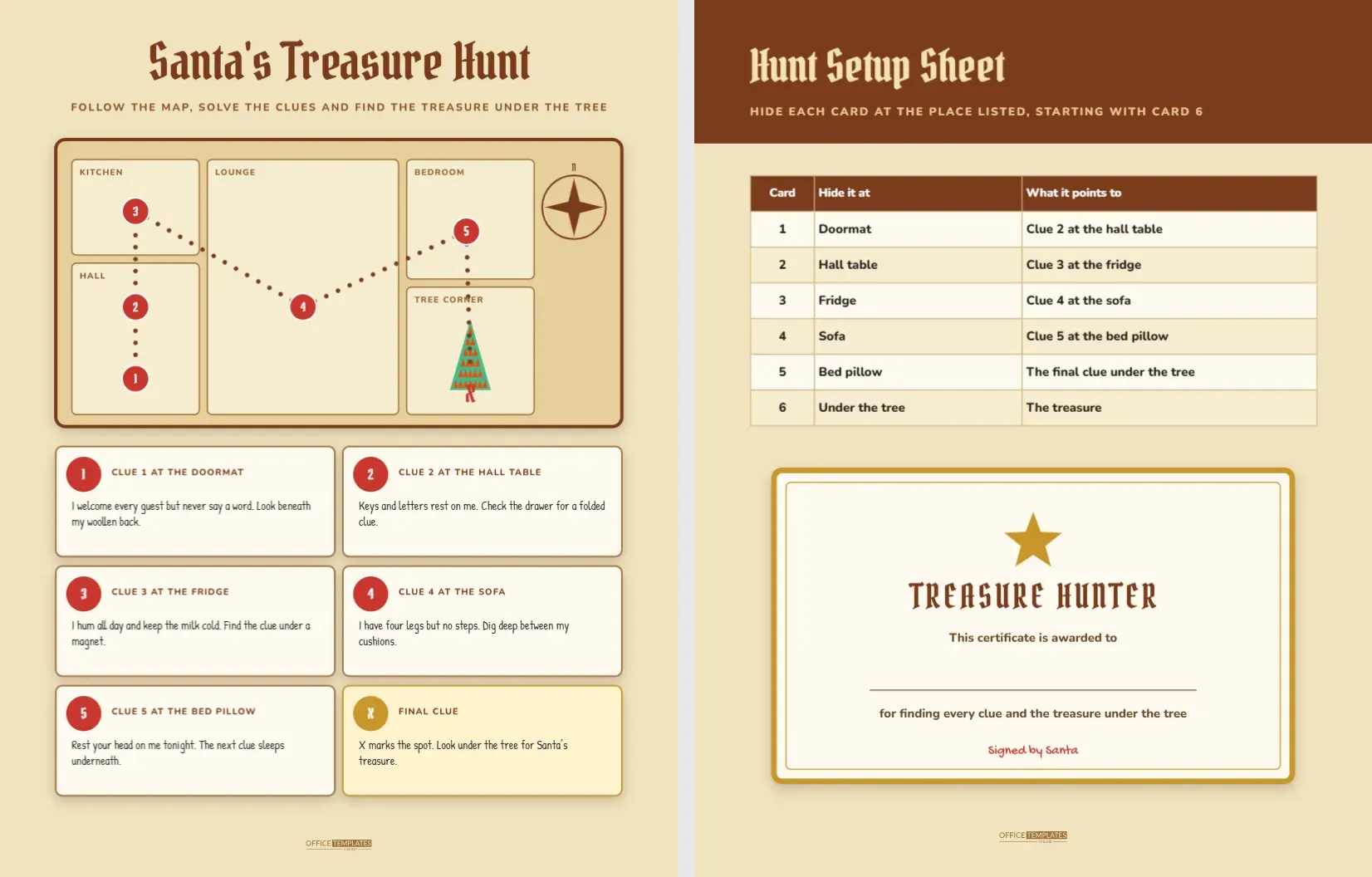
Picture a quiet Christmas Eve afternoon. The children have been told that Santa left a map behind, and when they unroll it, there is a dotted trail winding from the front door through the kitchen, over the sofa and up to a bedroom before it ends at a red X. This printable treasure hunt gives you that map, six riddle cards and a certificate for the winner, all laid out on two letter pages.
The Map on Page One
The first page is the colour of old parchment. A tall title in a hand cut treasure face reads Santa’s Treasure Hunt, with a line of capitals telling players to follow the map, solve the clues and find the treasure under the tree. Below it sits a map with a thick brown border. Inside, five rooms are drawn as soft cream blocks: Hall, Kitchen, Lounge, Bedroom and Tree Corner. A compass rose with a letter N sits at the right.
A trail of small brown dots runs from room to room. Five red numbered markers show where the clues wait, and a bold red X marks the Christmas tree where the treasure lies. The tree is drawn as an editable vector picture, so you can recolour it or replace it.
The Six Clue Cards
Under the map, six cards in two columns carry the riddles. Each has a white face, a warm brown border, a round number badge and a label such as CLUE 3 AT THE FRIDGE. The riddle text is set in a handwritten face that children find friendly. The last card is gold and marked FINAL CLUE.
| Card | Found at | First words of the riddle | Points to |
|---|---|---|---|
| 1 | The doormat | I welcome every guest but never say a word | Hall table |
| 2 | The hall table | Keys and letters rest on me | Fridge |
| 3 | The fridge | I hum all day and keep the milk cold | Sofa |
| 4 | The sofa | I have four legs but no steps | Bed pillow |
| 5 | The bed pillow | Rest your head on me tonight | Under the tree |
| 6 | Under the tree | X marks the spot | The treasure |
The Hunt Setup Sheet
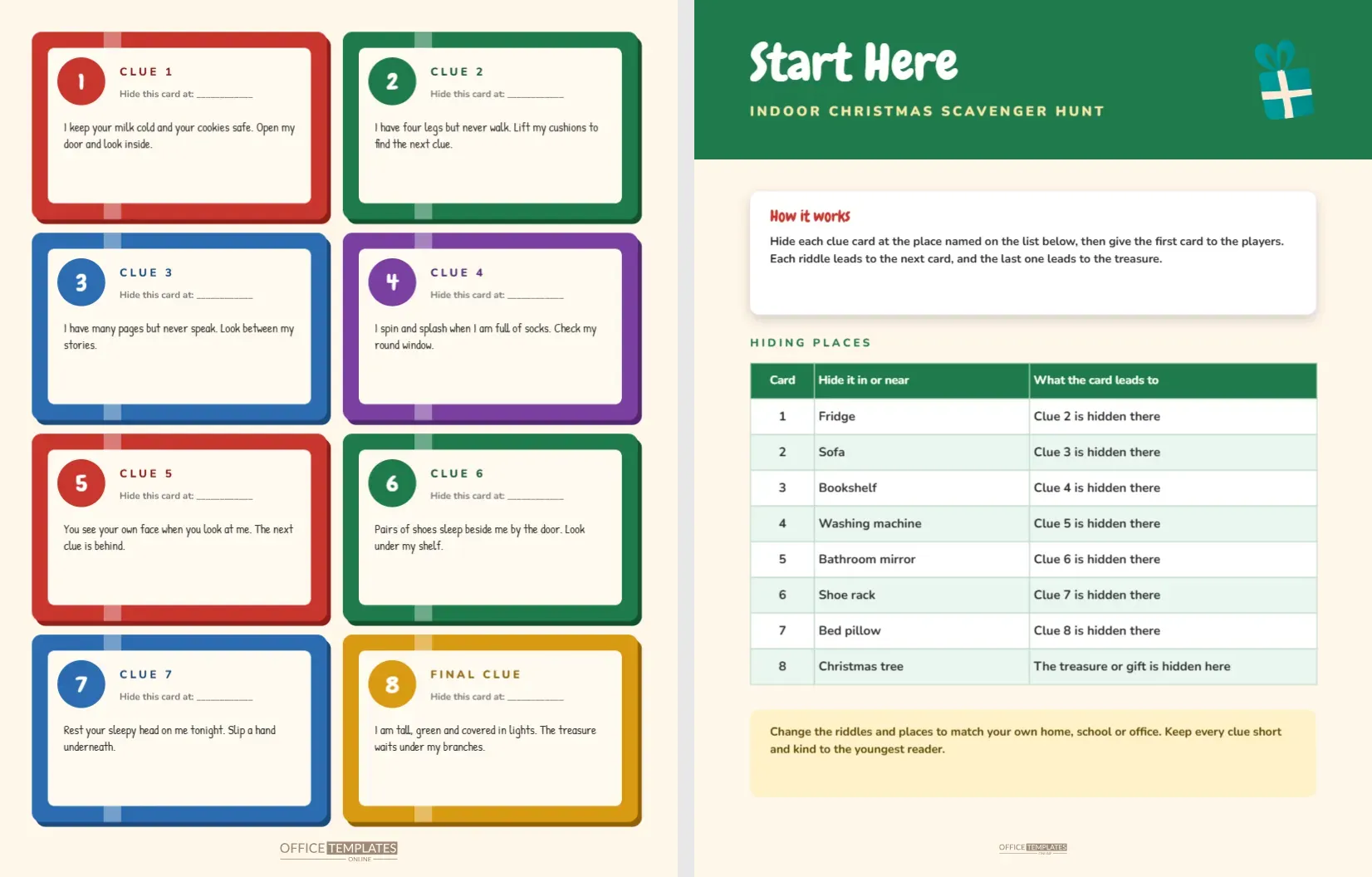
Page two begins with a deep brown band that reads Hunt Setup Sheet. A table with three columns, Card, Hide it at and What it points to, repeats the route above in plain words so that you can set the hunt up without turning back to page one. Under the table, a certificate with a gold frame says TREASURE HUNTER, with a line for the winner’s name and the words Signed by Santa in a handwritten face. A gold star sits above the heading like a seal.
Preparing the House Without Spoiling It
- Walk through the map and decide whether the five rooms match your own home. If they do not, rename the rooms by clicking the labels.
- Rewrite any riddle that does not suit your home. A riddle about a washing machine is no good in a home that has none.
- Print both pages and cut out the six cards along their borders.
- Start at the end. Put card 6 with the treasure under the tree, and keep the map for the starting gun.
- Hide card 5 under the pillow, card 4 in the sofa, and continue back to card 1 under the doormat.
- Give the map to the players and let them read the first line of the first riddle aloud.
Why a Map Makes the Hunt Better
Riddles alone ask children to hold everything in their heads. A map gives them a picture to look at, a sense of how the house fits together and a shared object to argue over. Young children can follow the dotted line and find the next room without reading the clue at all, while older children can ignore the map and rely on the riddles for a harder game. Because the map is not to scale and the dots are plain circles, it works for any home, a flat, a farmhouse or a classroom.
Changing the Route to Fit Your Space
Every word on the page is editable text and every shape is a vector. To make a new route, move the numbered red circles to different rooms and drag the dots into a new line. To add a seventh room, duplicate one of the room blocks, rename it and place a new numbered marker inside it. If you rewrite a riddle, update the matching row of the setup table so the hiding place list always matches the cards. The route on page one is only a picture, and you can delete it altogether for an older group who should find their way with the riddles alone.
Writing Riddles That Children Can Solve
A good riddle names three things in three short sentences and does not hide the answer behind long words. Start with a very clear hint, such as something that keeps milk cold, and end with an action, such as look under the magnet. For children who cannot yet read, swap each riddle for a drawing of the next hiding place and let an older sibling read the card aloud. For a group of teenagers, write the clues as short puns and let the cards lead to places that are harder to guess, such as the back of a framed photograph.
Making the Certificate Count
The certificate is a little ceremony. Ask the winner to stand up, read the line for finding every clue and receive the sheet with a handshake. Because the page is editable, type the child’s name into the space before printing, or leave the line blank and write by hand. If several children hunted together, print a copy for each and write a different title on each, such as Chief Navigator or Master of Riddles. A small prize is lovely but not essential. Many children keep the certificate for years.
Printing the Parchment Look
The warm cream background prints well on plain white paper, and the brown ink gives a printer a gentle workload. If you want the cards to feel old, print on cream or kraft paper and trim the edges slightly uneven. For a heavier hunt, laminate the six cards so they survive being slipped under cushions and behind books. The map can be printed on its own as a poster, with the clue cards cut off below, if you want to pin it to a door.
Treasure Hunt Questions
How long does the hunt take?
With six cards and five rooms, most families finish in fifteen to thirty minutes.
Can I hold the hunt outside?
Yes. Replace the room names with garden places such as the bench or the gate, and seal the cards in plastic bags.
What can the treasure be?
Anything from a box of biscuits to a family gift. Choose something the whole group can share if several children are playing.