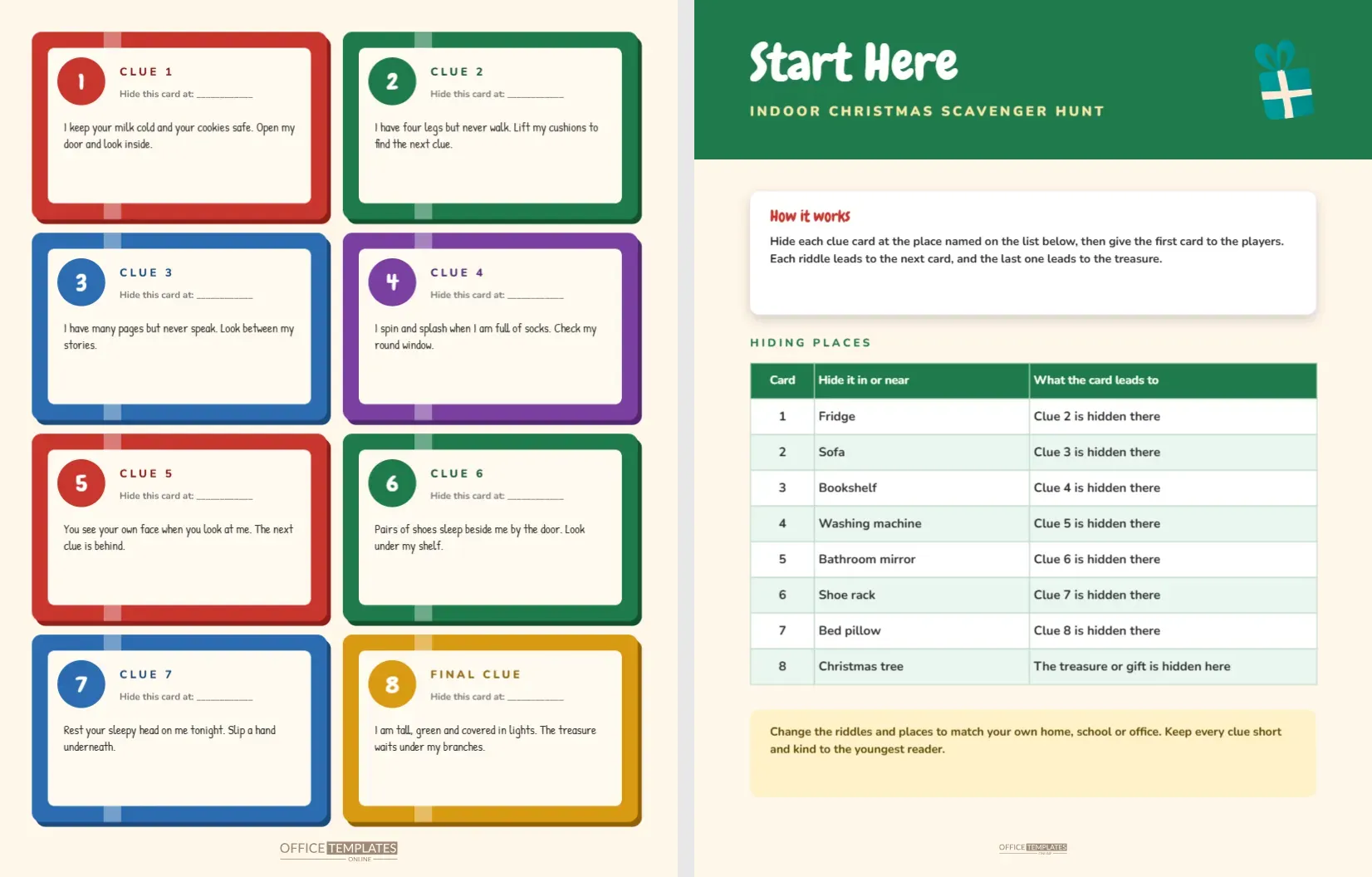
A treasure hunt makes a gift feel like an adventure. Instead of handing over a present, you give a riddle, and the riddle leads to another riddle, until the last clue points to the tree. This indoor scavenger hunt prints eight clue cards on the first page and a start here sheet on the second, so that a parent, a teacher or an older sibling can set up the hunt in ten minutes.
The Hunt at a Glance
| Card | Riddle starts with | Where the next card hides |
|---|---|---|
| 1 | I keep your milk cold | Fridge |
| 2 | I have four legs but never walk | Sofa |
| 3 | I have many pages but never speak | Bookshelf |
| 4 | I spin and splash when I am full of socks | Washing machine |
| 5 | You see your own face when you look at me | Bathroom mirror |
| 6 | Pairs of shoes sleep beside me | Shoe rack |
| 7 | Rest your sleepy head on me | Bed pillow |
| 8 | I am tall, green and covered in lights | The Christmas tree, with the treasure |
The Clue Cards on Page One
Page one is a warm cream sheet with eight cards in two columns and four rows. Each card looks like a wrapped gift, with a coloured outer frame in red, green, blue or purple, a pale ribbon stripe down the left and a cream inner panel. A large numbered circle sits on the left of each panel, and a small label reads CLUE followed by its number. Beneath the label, a short line says Hide this card at, with a blank for you to fill in. The riddle sits across the lower half of the card in a friendly handwritten face. Card eight is gold and carries the label FINAL CLUE.
The Start Here Page
Page two begins with a green band and the words Start Here in a bold rounded face, with a small teal gift to the right. A white panel explains how the hunt works in two sentences. Below it, a table with three columns lists each card number, the place where you hide that card and what the card leads to. The last row says the treasure or gift is hidden there. A pale yellow note at the foot reminds you to change the riddles to match your own home, school or office.
Setting Up in Seven Steps
- Print both pages and cut out the cards.
- Read the riddles and decide whether they suit your home, and swap any that do not.
- Write the hiding place on the line at the top of each card.
- Hide card 8 at the final spot with the gift or treat.
- Work backwards, hiding card 7 where card 6 points, and so on, until card 1.
- Hand the first card to the players, or tape it to the front door.
- Stay out of the way and listen for cheers.
Why Work Backwards
If you hide the cards from first to last, you may forget which card goes where. Hiding from the last clue backwards gives you a clear chain: the final card goes with the treasure, the card before it goes at the place named on the final card, and so on. Use the table on page two as your checklist and tick each row as you hide the card. It also helps to carry a small bag with tape, so that you can stick a card to the back of a mirror or under a cushion without leaving marks.
Writing Your Own Riddles
The cards are fully editable, so you can write riddles that match your own home. Think of a place, list three things about it and turn them into a puzzle. A good riddle gives one strong hint in the first line and a pointer in the second. For example, a doormat might say: I welcome every guest but never say a word. Look beneath my feet. Keep the language simple for young readers, and use short sentences. For children who cannot read yet, replace the riddle with a drawing of the next hiding place.
Adapting the Hunt for Different Groups
- Toddlers: use picture clues and stay close to guide them.
- Primary school children: use the riddles as written and let them work in pairs.
- Teenagers: write harder riddles with wordplay, and add a time limit.
- Office parties: hide cards around the building and end at the staff kitchen with a plate of treats.
- Classroom: use rooms and objects in the school, and finish at the teacher’s desk with a small prize.
Making the Final Prize Special
The last clue should lead to something worth the wait. It could be a wrapped gift, a bag of chocolate coins, a voucher for a family outing or a note announcing a Christmas trip. For several children, hide one treat for each child and ask them to hunt together. Put a note with each treat so that no one feels left out. If you want to keep it cheap, hide a single treasure, such as a tin of biscuits, and let the group share it at the end.
Safety and Courtesy
Keep the hiding places safe and child friendly. Avoid cupboards with chemicals, hot ovens and high shelves. Tell guests which rooms are off limits before the hunt begins. If you play in an office or a classroom, check that the places you choose will not disturb others or hide private property. For a younger child, accompany them through the house and read the riddles together. Cards are paper, so keep them away from water and food.
Printing and Reusing the Cards
Print on slightly heavier paper so that the cards survive being tucked behind pillows. Laminate them if you want to use them every year, and write the hiding place on a sticky note instead of on the card, so that you can change it. Keep the set in an envelope with the table from page two folded behind it. When you pull it out next year, you will find the set ready to go, and you can change one or two riddles to keep things fresh for children who remember last year’s hunt.
Hunt Organiser Questions
Can I use the cards outdoors?
Yes, if you use a garden or a park. Replace the household riddles with outdoor clues such as the bench, the swing or the old oak tree, and keep the cards in sealed plastic bags.
How long does the hunt take?
Most families finish eight clues in fifteen to thirty minutes, depending on the size of the house.
What if my home does not have a washing machine or a shoe rack?
Change the riddles by clicking the text and typing a new one, and update the hiding places table to match.
Can the cards be printed on coloured paper?
Yes, though the design already has colour, so white or cream paper gives the best result.