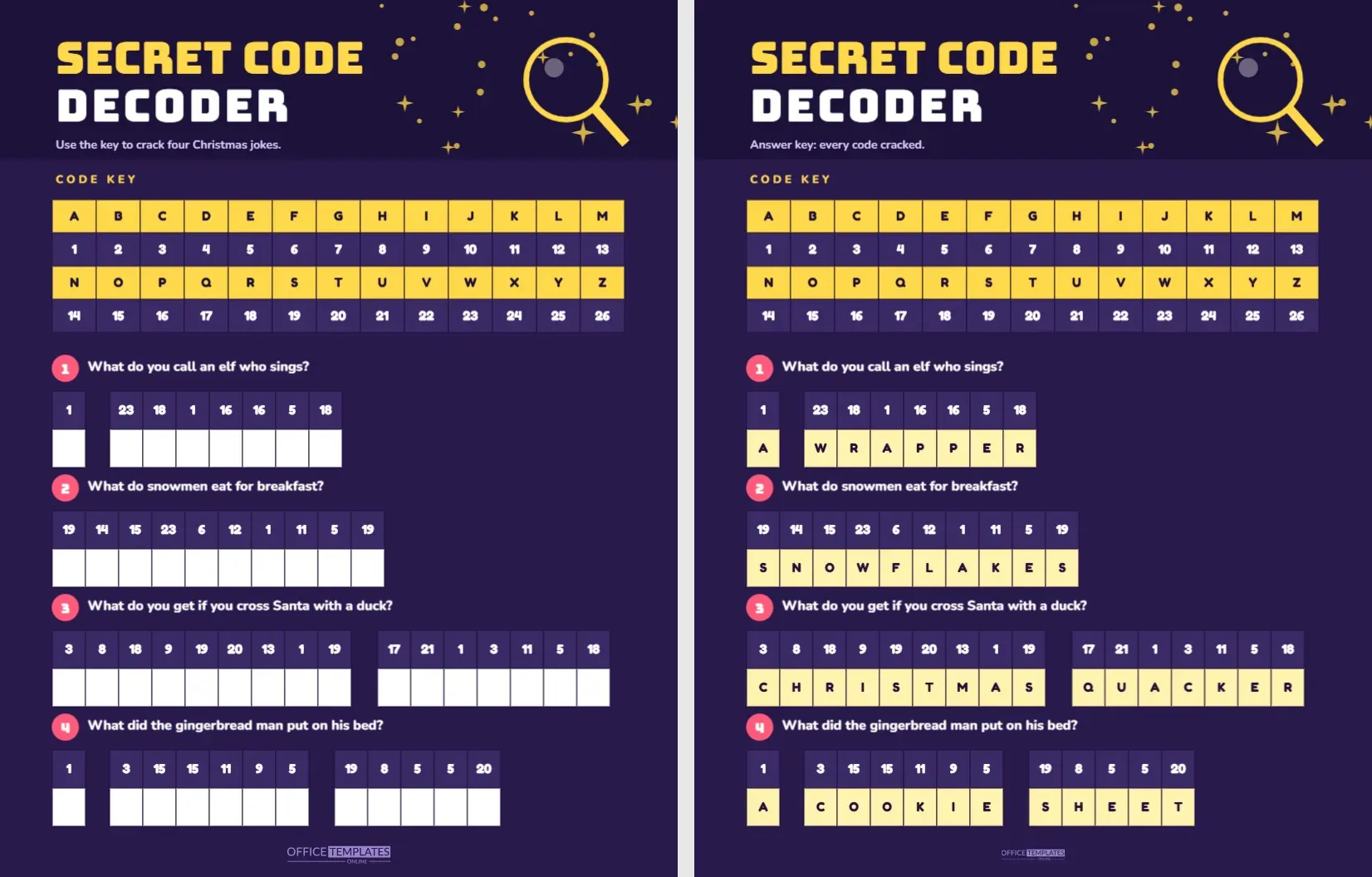
Kids love secrets. A page that looks like top secret mail from a spy agency makes even the most reluctant writer lean in. This secret code decoder gives children a number key, four Christmas jokes written in code and blank boxes to fill, and rewards them with a groan worthy punchline when they crack each one.
Agent Briefing: The Whole Page
Page one is a rich purple, the colour of a night sky just after sunset. A darker band across the top carries the words Secret Code in gold and DECODER in white, with scattered gold sparkles and a gold magnifying glass at the right. Below the band is a label reading CODE KEY and a table of four rows, which pairs every letter of the alphabet with a number from 1 to 26. The jokes follow, each with a pink numbered badge, a question in white and a row of boxes to decode.
How the Number Cipher Works
The cipher is the simplest kind, the one used by children for generations. A is 1, B is 2, and so on through to Z, which is 26. To read a coded word, look up each number in the key and write the matching letter in the box beneath. To write a coded word, do the reverse. Because every number maps to exactly one letter, it is a safe puzzle for beginners, yet it still takes concentration because each word has several letters to decode.
The Four Jokes and Their Answers
| No. | Question | Letters to decode |
|---|---|---|
| 1 | What do you call an elf who sings? | Two words, 1 and 7 letters |
| 2 | What do snowmen eat for breakfast? | One word, 10 letters |
| 3 | What do you get if you cross Santa with a duck? | Two words, 9 and 7 letters |
| 4 | What did the gingerbread man put on his bed? | Three words, 1, 6 and 5 letters |
The Box Rows, Looked at Closely
Each word has its own two row table. The top row holds the code numbers on a medium purple background, and the bottom row is blank and white, ready for a pencil. Words are separated by a small gap so that children can see where one ends and the next begins. On the answer page, the bottom row is filled with the correct letters on a pale yellow background, so a parent can check the jokes at a glance.
Solving Strategy, in Five Steps
- Read the question aloud and guess what the answer might be, since many jokes have a pun.
- Look up the first number in the key and write the letter.
- Continue through the word, one number at a time.
- Read the whole answer aloud, and then read the question and answer together to enjoy the joke.
- Repeat for the other jokes, and ask the child to read their favourite to the family.
Turning the Puzzle Into a Lesson
A cipher is a first step toward understanding how codes work. After the child solves all four jokes, ask them to write a short secret message of their own to a friend using the same key. They can swap messages and decode each other’s notes. Teachers can link the activity to a history lesson on wartime codes or to a maths lesson on numbering and sequences. For older children, introduce a shift cipher, in which every letter moves along the alphabet by a fixed number, and see whether they can crack a new puzzle without the key.
Writing Your Own Coded Jokes
All the text and tables can be edited. To write a new joke, change the question text, work out the answer word by word and replace the numbers in the top row of each table. The word table can be resized by double clicking it to open Manage Data, where you can add or remove columns. Keep each answer short enough to fit on one line at the printed size. A joke with a total of sixteen or seventeen letters is about the limit for a single row. Remember to update the answer page too, so the letters match the new numbers.
Ideas for Using the Sheet
- Christmas card insert: print small copies and tuck one inside a card for a young relative.
- Party activity: leave sheets on the tables with a pencil and let guests compete.
- Classroom treat: hand out the puzzle on the last day of term as a quiet reward.
- Rainy afternoon: a spy themed morning with the sheet, a magnifying glass and a torch.
Print Settings and Paper
The deep purple page prints well in colour, but it uses plenty of ink. For a lighter version, change the page background to a pale lavender and the white text to dark purple. The yellow and pink accents will stay clear. If you print on a laser printer, use plain paper and set the quality to normal. Pencil does not show well on the dark purple, but the boxes where children write are white, so they work in pencil or pen.
Hints for Stuck Decoders
When a child is stuck, do not give the answer. Ask a gentle question instead. Which letters have you already found? What does the question sound like it is asking? Many of these jokes rely on a pun, so say the partial answer aloud and listen for a word. Encourage the child to check each number twice, because a single slip, such as reading 18 as 13, makes the whole word look wrong. Where two words appear, solve the short one first. A single letter word such as A is often the quickest way to build confidence and get the pencil moving.
Making the Page a Family Tradition
Some families put one coded joke inside each advent calendar door. You can use this page for that. Print it, cut the four jokes apart and slip one into each of four doors in the last week of the countdown. Children collect the jokes, decode them and read the whole set aloud on Christmas Eve. The same idea works for a treasure hunt, with each decoded word revealing a place to look. Because the sheet is editable, you can write new jokes each year and keep the look the same.
Questions Decoders Ask
Do children need to know the alphabet well?
They need to know the order of the letters, which the key supplies, so the puzzle works for children from about seven.
Can I swap the jokes for riddles?
Yes. Any question with a short answer works, so you can write riddles about Christmas, school or the family pet.
Is the cipher secure?
No, and it is not meant to be. It is a classic children’s code that anyone with the key can read.
How long does it take?
Most children finish the four jokes in ten to twenty minutes, depending on how much they stop to laugh.