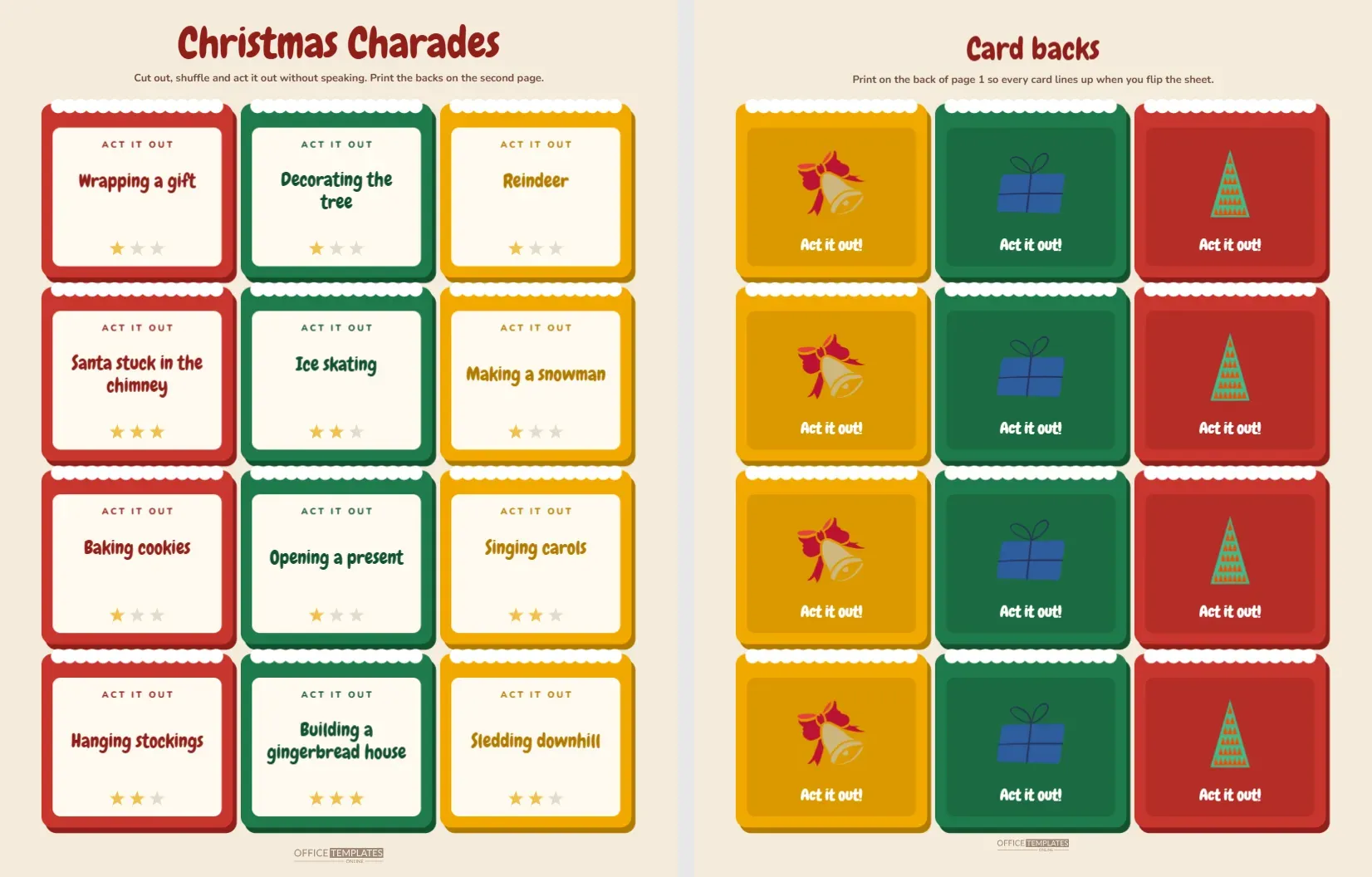
Charades has been a party staple for generations because it needs nothing but people willing to look a little silly. These cards turn the game into a ready made deck. Each one holds a Christmas word or phrase, a difficulty rating and a layered paper look that feels handmade even though it prints in minutes.
What Makes the Cards Look Like Cut Paper
Every card is built from a few offset layers. A darker block sits slightly down and to the right to act as a shadow, a bright base colour sits on top, and a row of white scallops runs along the upper edge like torn paper or icing. A cream panel inset in the middle holds the words. The four colours, red, green, gold and blue, rotate across the twelve cards in a diagonal pattern so that neighbouring cards never share a colour. It is a simple recipe, and it gives the sheet depth without any photographs.
The Twelve Words and Their Difficulty
| Word or phrase | Stars | Hint for the actor |
|---|---|---|
| Wrapping a gift | 1 | Fold, tape and tie a bow |
| Decorating the tree | 1 | Reach high, hang something shiny |
| Reindeer | 1 | Hands as antlers, pawing the ground |
| Santa stuck in the chimney | 3 | Squeeze, wriggle and puff |
| Ice skating | 2 | Wobble and glide with arms out |
| Making a snowman | 1 | Roll a ball, stack, add a nose |
| Baking cookies | 1 | Stir, roll dough, open the oven |
| Opening a present | 1 | Shake the box, rip the paper |
| Singing carols | 2 | Hold a lantern and open your mouth wide |
| Hanging stockings | 2 | Stand on tiptoe, pin along the mantel |
| Building a gingerbread house | 3 | Squeeze icing, press candy to the wall |
| Sledding downhill | 2 | Climb, jump on, lean and scream |
How the Star Ratings Work
Each card shows three small stars, filled in yellow for the difficulty level and grey for the rest. One star means an easy action that almost anyone can mime. Two stars mean a longer sequence or a less obvious word. Three stars mean a scene with several steps, which suits older players or a team round. Mixing the cards from the pile gives a natural rising scale, and you can deal out all the one star cards to children and keep the three star ones for adults.
Printing Both Sides Correctly
Page two holds the card backs, twelve coloured rectangles with a small picture and the words Act it out. The columns on page two are mirrored, so the colours line up with the card they sit behind when you flip the sheet along the long edge. Print a test pair on plain paper before using your good stock. Hold the two sheets against a window to see whether the cards overlap. If they miss, adjust the alignment settings in your printer, or print the backs onto a separate sheet and glue the two together.
A Standard Round, Step by Step
- Shuffle the deck and place it face down.
- The first player draws a card and shows it to the group without speaking.
- Start a timer, usually sixty to ninety seconds.
- The player mimes the phrase without making sounds or pointing to objects that spell out the words.
- The group shouts guesses. If someone gets it right, the guesser scores a point and the actor scores a point.
- If time runs out, the card goes to the bottom of the deck.
Variations for Different Crowds
- Picture round: draw the answer on a whiteboard instead of acting.
- Team charades: split into two teams and alternate between them, with the host keeping time.
- Silent night: the entire game is played in whispers, so the audience can only whisper guesses.
- Toddler version: use only the one star cards and let adults help the actors.
Editing the Deck
Everything on the cards is editable text. Click a word and type something else, such as a name from your own family or a local winter event. If you add a longer phrase, check that it still fits in the cream panel, and lower the size by a point if needed. The star ratings are small shapes, so you can recolour any star to change the difficulty, or select all three and delete them. Paper cut shapes are plain rectangles and circles, so you can recolour a card from its colour swatches in a few clicks.
Cutting Tips
A paper trimmer cuts the straight edges fast. Cut along the outer coloured edge of each card and keep the scalloped band, which is part of the design. For a longer life, print on light card stock and round the corners with a corner punch. Keep the deck in a small gift box, with a rubber band around the cards to stop them spreading across the table.
Choosing Words That Work for Your Group
A good charades word has a clear action and a clear object. Wrapping a gift and baking cookies are easy because everyone has done them. Words such as Santa stuck in the chimney require the actor to tell a short story, which is a challenge worth saving for confident players. If your group is shy, begin with the easy cards and let laughter warm the room. If the group is experienced, remove the obvious cards and add a few abstract ones, such as the last minute shopping rush or a power cut on Christmas Eve.
Rules That Keep the Peace
Agree a few ground rules before the first card. Decide whether sounds are allowed, whether the actor can point at objects in the room and whether guesses must be given as complete phrases. A simple rule keeps the game fair: the actor may not speak, spell out letters in the air or mouth the words. Rotate the actors so that everyone has a turn, and keep a spare pile of cards for a tie break at the end.
Charades Night Questions
Can younger children play?
Yes, if they are paired with an adult. The one star cards use simple actions such as wrapping and baking.
How long does a game take?
A round of twelve cards usually runs fifteen to twenty minutes with a lively group.
Can I add my own words?
Yes. Duplicate a card, change the word, and print an extra sheet with the matching back on page two.