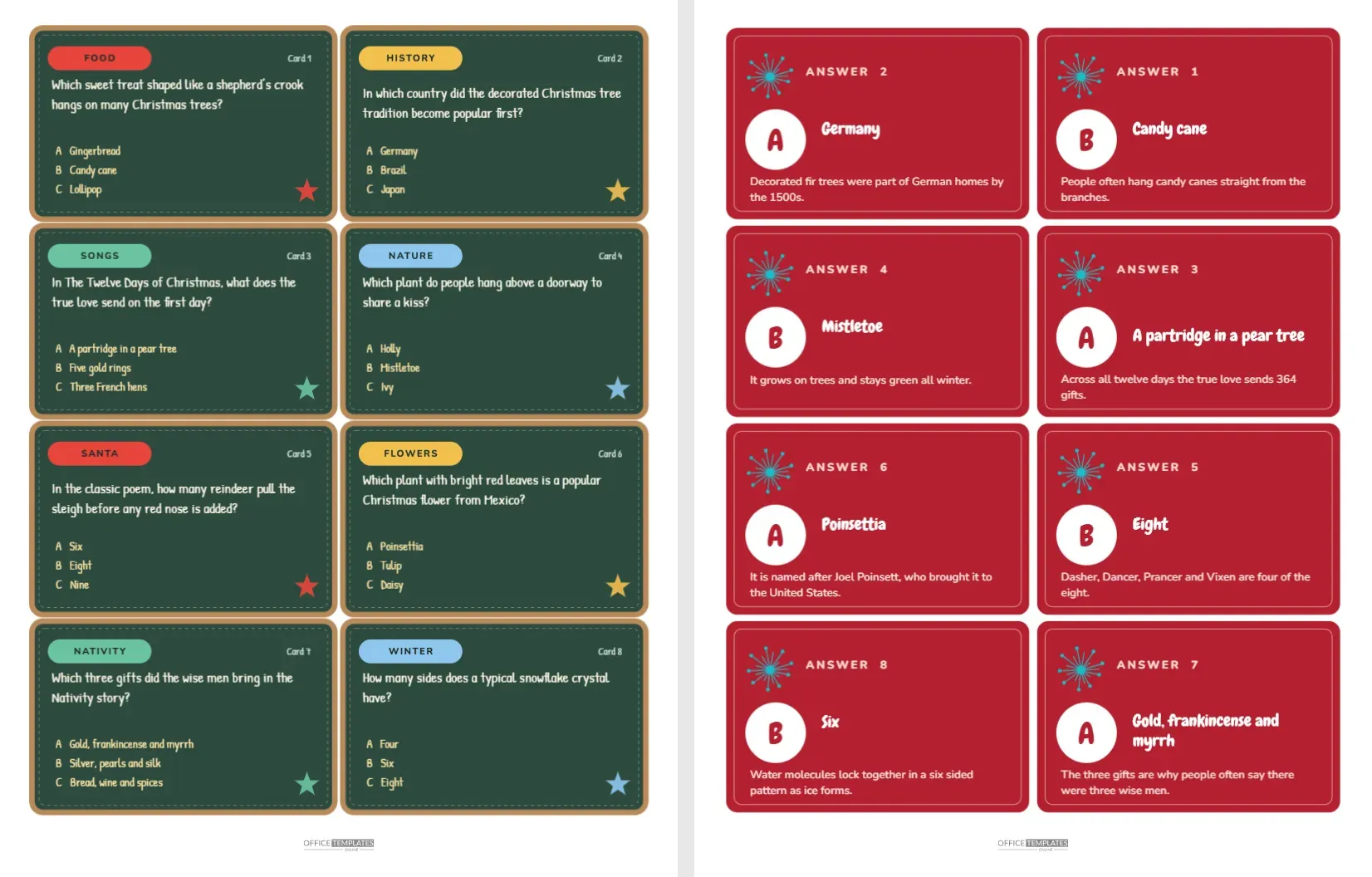
A good trivia night does not need a quiz master with a thick book. It needs a stack of cards, a pen for keeping score and a few friends who like to argue about reindeer. These Christmas trivia cards give you eight questions on the front, with the answers printed on the back, so you can shuffle the deck, draw a card and read the question without peeking at the solution.
Eight Cards in Chalkboard Dress
Page one is a white sheet carrying eight cards in two columns and four rows. Each card is a dark green board with a warm wooden frame and a faint dashed line inside the edge, like chalk marks. A small coloured pill at the top gives the category, from FOOD and HISTORY to SONGS, NATURE, SANTA, FLOWERS, NATIVITY and WINTER. The question sits underneath in a handwritten face, and three answer choices marked A, B and C stand in warm yellow below it. A small star in the category colour closes each card.
Page Two, the Answer Backs
Page two is a sheet of red cards, each one carrying a white circle with the correct letter, the full answer in a chunky face and a short fun fact underneath. A snowflake burst and the word ANSWER with the card number appear at the top. The cards are arranged in mirror order, so that when you print on both sides and flip the sheet along the long edge, each answer lands directly behind its question.
The Eight Questions at a Glance
| Card | Category | Topic | Answer |
|---|---|---|---|
| 1 | Food | The sweet shaped like a shepherd’s crook | Candy cane |
| 2 | History | Where the decorated tree became popular | Germany |
| 3 | Songs | The first gift on the twelve days | A partridge in a pear tree |
| 4 | Nature | The plant hung above a doorway | Mistletoe |
| 5 | Santa | Reindeer in the classic poem | Eight |
| 6 | Flowers | The red leaved Christmas plant from Mexico | Poinsettia |
| 7 | Nativity | The three gifts of the wise men | Gold, frankincense and myrrh |
| 8 | Winter | Sides of a snowflake crystal | Six |
How the Double Sided Print Works
Most printers will turn a page over for you if you pick two sided printing and flip on the long edge. Print a test on scrap paper first, since printers differ. Mark an X on the corner of page one, put the sheet back in the tray and print page two to see where it lands. If the answers are upside down, switch to flip on the short edge. A card and its answer should line up within a couple of millimetres, which is enough if you cut with a steady hand and trim a hair inside each frame.
Three Ways to Play
- Team trivia: split into two teams, draw a card for each turn and score one point for a correct answer.
- Pass the card: the reader asks the player on their left, and if that player gets it wrong, the question passes on.
- Table quiz: put one card on each table at a party so that guests can answer between courses and write their guess on a napkin.
Writing Your Own Questions
The text on the cards is editable, so you can use the layout for local trivia, family memories or classroom topics. Click a question and type over it, and do the same for the three options. Keep the question to about twenty words, so that it fits above the options at the printed size. If you swap an answer, remember to update the matching card on page two, including the letter in the white circle and the fun fact. A common slip is to change the options but forget the back, so check each pair before you print.
Keeping Questions Fair and Accurate
Trivia only works if the answers are correct, so double check any fact you add. For traditions, mention that many customs vary by country and family. For example, the number of reindeer depends on the poem you read, and the three gifts do not prove the number of wise men. A friendly host can turn those gaps into a conversation rather than an argument. When you write a fun fact, prefer simple statements you can verify in a standard reference book.
Cutting and Storing the Deck
Cut the cards with a paper trimmer, or score them and fold. Rounded corners look neat and last longer, and a corner rounder tool costs very little. Store the deck in a small tin or a sandwich bag with a rubber band, and tuck a spare card for new questions on top. A deck printed on thin card stock survives a whole season of Christmas parties. If you laminate, leave a small border around each card so the plastic seals properly.
Using the Cards With a Classroom or a Large Party
Trivia is just as useful with thirty people as with four. For a classroom, print several copies, cut them, and give each small group a mini deck. Groups can rotate through the stack at their own pace while the teacher circulates, and the answer backs keep the teacher from being asked every question twice. For a party of mixed ages, split the deck by category so that adults take history and songs while children handle food and winter, then swap halfway through. A sheet of sticky notes lets teams record their scores without extra equipment. If the group is very large, project the question on a screen and let teams hold up cards marked A, B and C.
Ideas for Prizes and Forfeits
Small prizes add spark: a candy cane for each correct answer, a bauble for the winning team or a silly paper crown for the quiz champion. Forfeits can be light hearted, such as telling a Christmas joke or singing a line of a carol when a team misses three questions in a row. Keep the tone friendly so that nobody feels singled out, and let children choose a prize first as a gentle reward for taking part.
Questions About These Trivia Cards
Can children play?
Yes. The questions are simple, multiple choice and family friendly, and younger players can team up with an adult.
Can I make the answers harder by removing the choices?
Yes. Select the three option lines on any card and delete them to turn it into an open question, then raise the difficulty for adult groups.
How do I add more cards?
Duplicate a card in the editor, change the category label and colour, then write a new question, three options and a matching back. Keep the layout grid in mind so the new card does not run off the page.
Is there room for a team scoreboard?
The cards fill the page, so make a separate sheet. A simple table with team names and five rounds works well, or use the scoreboard from the Minute to Win It sheet in this set.