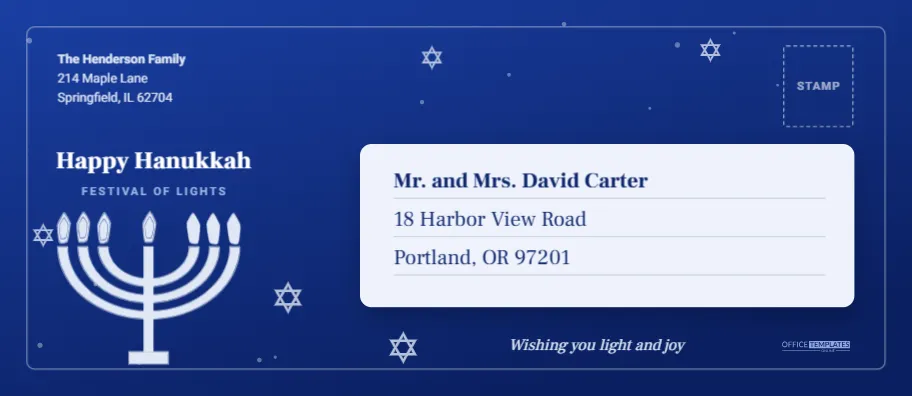
Hanukkah cards often travel further than people expect. They go to grandparents in another city, to cousins who have moved abroad and to friends from every background who want to share the festival of lights. An envelope that looks the part tells the recipient how much thought you gave to the greeting before they read a word. This blue and silver design is made for that moment: calm, luminous and easy to read.
Eight Details Worth Noticing
- The blue. The background is a royal blue gradient, brighter at the top left and deepening toward the lower right, like the sky just after sunset.
- The silver menorah. A large nine branch menorah in pale silver stands in the lower left. It is an outline drawing, so the blue shows through its arms, which keeps it light rather than heavy.
- The flames. Each candle ends in a small teardrop flame, with the taller shamash candle in the centre.
- The stars. Five six pointed stars of David in silver are scattered across the page, at different sizes and with a little transparency, so they read as shimmer rather than pattern.
- The hairline frame. A thin silver rounded line runs close to the edge, giving the envelope a finished border.
- The greeting. Happy Hanukkah appears in white, in Frank Ruhl Libre, a serif font designed for Hebrew and Latin text, with FESTIVAL OF LIGHTS in spaced pale blue capitals beneath it.
- The address panel. The recipient sits on a pale blue white rounded card in the centre right, with three lines in dark blue and thin rules.
- The sign off. A small italic line, Wishing you light and joy, runs along the bottom in silver.
Sizes and Layout Facts
The page is a #10 envelope, 9.5 by 4.125 inches, in landscape. The return address sits top left in white Heebo type, and a dashed stamp box sits in the top right corner. Because the card for the recipient is pale and the surrounding background is dark, the address can be read at a glance.
| Element | Colour | Where |
|---|---|---|
| Background | Royal blue gradient | Full page |
| Menorah | Silver | Lower left |
| Stars of David | Silver, partly transparent | Scattered |
| Address card | Pale blue white | Centre right |
| Greeting | White and light blue | Left, above the menorah |
Dates and Timing for Hanukkah Mail
Hanukkah follows the Hebrew calendar, so the dates move from year to year and usually fall between late November and late December. Check the exact dates for the year you are sending. Many people post their cards a week or two before the first candle, so that they arrive in time to be displayed. If your cards will cross the ocean, allow even more time. There is no need to mention a date on the envelope, but the inside card can carry one if you are inviting someone to light candles with you.
Editing the Greeting and the Names
Click the greeting to change the words. Some families prefer Chag Urim Sameach, a Hebrew greeting meaning a joyful festival of lights, or simply Happy Hanukkah and a family name. Type any greeting you like. The Frank Ruhl Libre font supports Hebrew characters, so you can replace the English words with Hebrew text if you have a keyboard layout for it. Edit the return address and the recipient lines in the same way.
Respectful Use of the Imagery
The menorah and the star of David are religious symbols, so use them with care. They are appropriate for a Hanukkah greeting. If you are sending mixed holiday cards to a wide group, this envelope is a thoughtful choice for the recipients who celebrate, and a separate design, such as the winter snowflake envelope, suits those who do not. Avoid pairing the menorah with Christmas symbols on the same page, and check the spelling of your greeting, since Hanukkah has several accepted spellings in English.
Printing Silver Without a Metallic Printer
A normal printer prints silver as a light grey, which looks quiet and elegant on this blue. If you want a real metallic shine, ask a print shop to apply silver foil to the menorah, stars and frame, since each is a separate object. For a home result, print the page, and add silver dots with a metallic pen around the stars. Choose a matte stock for the blue, since glossy paper shows fingerprints.
Hanukkah Envelope Questions From Senders
Can I change the blue to a darker navy?
Yes. Select the background shape, then edit its two gradient colours. A darker navy gives a more formal look.
Is the menorah a nine branch menorah?
Yes. It has eight branches and a central shamash holder, which is the traditional Hanukkah form.
Can I use it for a business greeting?
Yes, if the recipient celebrates Hanukkah. Replace the personal return address with your company details.
Does the template include a card?
No, this is an envelope front. A blue and silver card from the card section will match.
Can I add Hebrew text?
Yes. Type or paste Hebrew into any text box. The font used for the greeting supports Hebrew letters.
Pairing the Menorah Envelope With a Card and a Small Gift
A blue and silver envelope looks best with a card in the same family, a white card with a silver menorah or a pale blue card with a hand written note. If you are including chocolate gelt, remember that coins add weight and thickness, so seal them in a small flat bag and weigh the finished envelope before buying stamps. For families who exchange dreidels, a thin paper dreidel template tucked inside is light and fun. Keep photographs flat, and use a stiff card behind them so the envelope does not bend in the post.
Writing a Short, Warm Hanukkah Message
Many people stop at a printed greeting, but a line or two in your own words is what recipients keep. Mention a candle night you remember, a food you are looking forward to sharing, or simply that you are thinking of them. Keep it short enough to fit a small card, and sign with first names. If the recipient lives far away, add a line about when you hope to talk, which turns a seasonal card into a small appointment to connect.