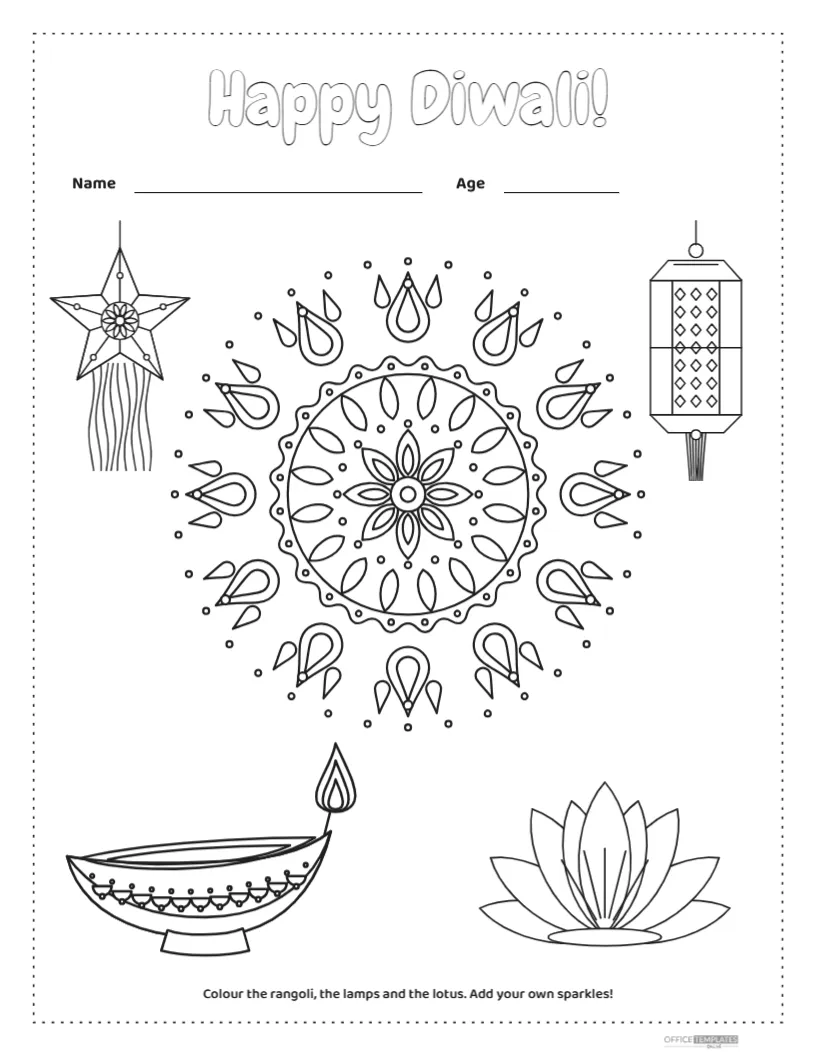
On the busy days before Diwali, while the grown-ups are cleaning, cooking, and decorating, children need something calm and festive to do. A colouring page is perfect: it keeps small hands busy, it teaches them the shapes and symbols of the festival, and the finished picture can go on the fridge or become a card for grandparents. This US Letter page gives children five Diwali designs to colour, drawn in clean, bold outlines that are easy for young hands to stay inside.
What Children Will Colour
- A large rangoli in the centre of the page, with a flower in the middle, rings of petals, a scalloped band, teardrop shapes, and dots. It is the biggest drawing, perfect for trying lots of colours.
- A star lantern (kandil) hanging from the top left, with a flower medallion and wavy paper streamers.
- A hanging lantern on the top right, with a diamond lattice to fill in.
- A diya at the bottom left, with a decorated bowl and a flame.
- A lotus at the bottom right, with layered petals.
At the top, the words Happy Diwali! are written in bubble letters with an outline, so children can colour the letters too. A line for the child’s name and a shorter line for their age sit under the title, and a dotted border frames the page.
Colouring Ideas by Age
| Age | What works well | Materials |
|---|---|---|
| 3 to 4 years | Colour the big shapes: lotus petals, the diya bowl, the lantern body | Chunky crayons |
| 5 to 6 years | Colour the rangoli rings in alternating colours | Crayons or washable markers |
| 7 to 9 years | Make the rangoli symmetrical, matching opposite petals | Coloured pencils or felt tips |
| 10 and up | Add shading, patterns inside petals and glitter details | Fine liners, gel pens, glitter glue |
Turning Colouring Into a Lesson
Each drawing is a small window into the festival. While children colour, talk about what they are drawing:
- The diya: families light clay lamps on Diwali night to celebrate light winning over darkness.
- The rangoli: patterns made at the doorstep with coloured powder, rice, or flowers to welcome guests and good fortune.
- The kandil: paper lanterns hung outside windows, especially in Maharashtra and Goa.
- The lotus: a flower linked with Goddess Lakshmi, who is welcomed into homes on Diwali.
Teachers can use the page in a lesson about festivals around the world, asking children to label each drawing or write one sentence about it on the back.
Creative Ways to Finish the Page
- Glue real glitter or sequins on the diya flame so it sparkles.
- Use real coloured rangoli powder or sand on the big rangoli; apply glue to one section at a time and sprinkle.
- Stick small paper circles or bindis on the dots around the rangoli.
- Cut out the finished lantern and kandil, punch a hole, and hang them as decorations.
- Fold the coloured page and use it as a handmade Diwali card for a grandparent.
Printing the Colouring Page
Download the page as a PDF and print at actual size on US Letter paper. Regular printer paper is fine for crayons and pencils. For markers, paint, or glitter glue, use heavier paper of 120 gsm or more so colours do not bleed through. Print in black only, or in grayscale, to save colour ink; the page is black line art on white. Print a few extra copies, because siblings always want their own.
Editing Before You Print
A few simple changes make the page personal or fit a classroom:
- Type a child’s name on the name line before printing for a personal gift.
- Change Happy Diwali! to Happy Deepavali! or Shubh Diwali!
- Delete a drawing for younger children who prefer fewer, larger shapes, and enlarge the rangoli.
- Change the instruction line at the bottom to a classroom task, such as Colour the rangoli and write one Diwali wish on the back.
The drawings are editable vector art, so you can resize, move, or delete them without losing quality.
For Classrooms and Community Events
Colouring pages are popular at Diwali melas, temple kids’ corners, and school festival days. Print a stack, put out crayons, and let children colour while adults enjoy the event. A colouring competition with small prizes adds excitement; the rangoli competition certificate in this collection can be adapted for colouring winners by changing the contest name.
Displaying the Finished Pictures
Create a Diwali gallery on the fridge, a classroom wall or a string across the room with clothes pegs. Add the date so the pictures become memories of each year’s Diwali; in 2026 the festival falls on Sunday, 8 November.
Colouring Page Questions
Can I print it on A4?
Yes. Choose fit to page or actual size; the drawings sit well inside the border on both paper sizes.
Are the outlines thick enough for young children?
Yes, the lines are bold, and the shapes are large. For very young children, delete the smaller lantern and diya patterns to keep things simple.
Can I make a two-page activity pack?
Use Add Page and copy the word search or quiz from this collection, or draw a second page with a large diya alone.
A Quiet Activity for Busy Festival Days
Diwali week is loud and full, and some children find the crowds, fireworks and late nights tiring. A colouring page gives them a calm corner to retreat to. Set up a small table away from the noise with the page, crayons and a cushion, and let children come and go as they please. Parents of younger children, and of children who are sensitive to noise, often appreciate a quiet activity being available at a party.
Teachers can also send the page home as a weekend activity, asking families to colour it together and bring it back for a classroom display on the Monday after Diwali.
Colour Your Way to Diwali
Print the page, set out the crayons, and let the children bring the festival to life in their own colours. The calm half hour it buys you before Diwali is a gift in itself.