Inclusive teaching asks a great deal. Special education teachers, SEN coordinators, learning support staff and inclusion leads adapt lessons for students with very different needs, write individual plans, work closely with families and therapists, and advocate for students who might otherwise be overlooked. Their successes are often quiet and personal: a student who can now read a menu, join a group activity, or stay calm through a fire drill. This award makes those successes visible.
A Heart of Many Colours
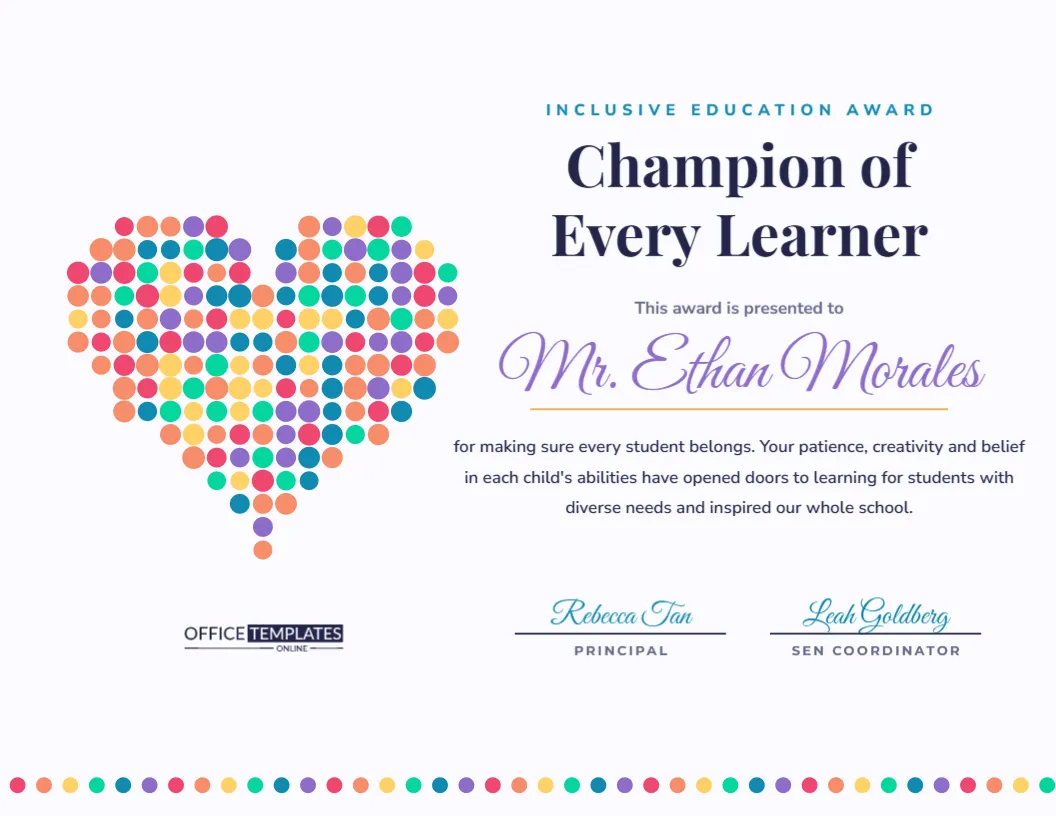
This US Letter landscape certificate (11 x 8.5 inches) is built around a single, gentle image. On the left, a large heart is made entirely of small round dots in six colours: coral pink, peach, sunflower yellow, mint, ocean blue and lavender. No two neighbouring dots are quite the same size or colour, and together they form one whole shape. It represents a classroom where every learner is different, and every learner belongs.
A line of the same coloured dots runs along the bottom of the page. On the right, Inclusive Education Award is set in blue capitals, followed by Champion of Every Learner in large Playfair Display, the recipient’s name in lavender script with a golden underline, a citation, and signature lines for the Principal and the SEN Coordinator. Our logo sits below the heart.
Language That Respects Every Learner
When writing the citation, the words we choose matter. Many educators prefer language that focuses on strengths and on the person first. This table offers some alternatives:
| Instead of | Consider |
|---|---|
| special needs children | students with diverse learning needs |
| despite their disabilities | building on each student’s strengths |
| low-ability students | students who needed extra support to access learning |
| dealing with difficult behaviour | helping students manage big feelings |
| normal classes | mainstream classes |
Preferences vary between communities and individuals, so follow your school’s policy and, where appropriate, the wishes of families.
What Inclusion Champions Do
Inclusive practice takes many forms. A strong citation might recognise:
- Designing lessons that all students in a mixed class can access and enjoy.
- Writing and reviewing individual education plans with care and ambition.
- Building trusting relationships with families, especially during difficult times.
- Training colleagues in strategies such as visual timetables or sensory breaks.
- Creating calm spaces, social groups or peer-mentoring schemes.
- Advocating for resources, adjustments and assessment arrangements.
Personalising the Award
- Type the recipient’s name and write a citation that reflects their specific contribution.
- Edit the signature lines; the second might be the Inclusion Lead, Learning Support Coordinator, or a parent representative.
- Change Champion of Every Learner if you prefer another title, such as Inclusion Champion or Learning Support Star.
- The dot heart is a single grouped object. Select it to change the palette, for example to your school colours, while keeping the mosaic effect.
- Download as PDF to print or PNG to share with the recipient’s permission.
Involving Students and Families
Some of the most powerful inclusion awards include the voices of students and families. Invite parents to share a sentence about the teacher’s impact, or ask students to contribute a drawing or a word. For students who communicate in different ways, a photograph of a favourite activity with the teacher can say as much as words. These additions can be presented alongside the certificate or printed on the back of it, making the award deeply personal.
Printing a Colourful Mosaic
The heart is made of many small coloured dots, so a good colour printer will give the best result. Use US Letter landscape at Actual size, or A4 with Fit to page, on bright white 250 gsm card to keep the colours clean against the pale background. The rest of the page is light, so ink use is moderate.
Writing About Progress Respectfully
Citations for inclusion awards often describe student progress, and they need care. Avoid naming individual students or describing their needs in detail; the certificate may be displayed or shared, and privacy matters. Instead, describe the teacher’s approach and its general effect: for creating a classroom where every student can take part in every lesson or for the individual plans that helped so many students grow in confidence and independence. If you want to mention a specific success, ask the family’s permission first and keep it anonymous. A respectful citation honours the teacher and protects the students at the same time.
When to Present the Award
Inclusion awards fit naturally into the end-of-year staff celebration, but other moments can be just as meaningful. Some schools present them during a week focused on disability awareness, neurodiversity, or anti-bullying, when inclusion is already on everyone’s mind. Others time it to coincide with a successful school event that the teacher made accessible, such as a sports day where every student competed or a school play with adapted roles. Presenting the award in front of colleagues also helps share good practice: invite the recipient to describe one strategy others could try.
Recognising Support Staff, Too
Inclusion is a team effort. Teaching assistants, learning support assistants, therapists, counsellors and one-to-one support workers are often closest to the students. Consider using this design to recognise them as well, changing the subtitle to Learning Support Award and adapting the citation. Recognising the whole team shows that inclusion is a shared value across the school, not the responsibility of one person.
Inclusive Education Award Questions
Is this suitable for mainstream teachers?
Yes. Any teacher who makes their classroom welcoming and accessible to all learners deserves this recognition.
Can I use it for a student?
Yes. Retitle it for a student who showed great kindness or helped include others, such as a Kindness Champion.
What size is it?
US Letter landscape, 11 x 8.5 inches.
Every Learner, Every Colour
An inclusive teacher sees each student as a unique part of the whole. Add their name, describe the difference they make, and honour them with a heart made of every colour.
Share their practice with colleagues too, so the award becomes a starting point for making every classroom in the school a little more inclusive.