A science fair project starts with a question and ends, weeks later, with a trifold board, a demonstration and a nervous student explaining results to a judge. In between, someone helped them design a fair test, find equipment, deal with experiments that failed, analyse data, and practise their explanation. That someone is usually a science teacher, and their mentoring is what turns curiosity into real scientific thinking. This award recognises them.
The Laboratory Look
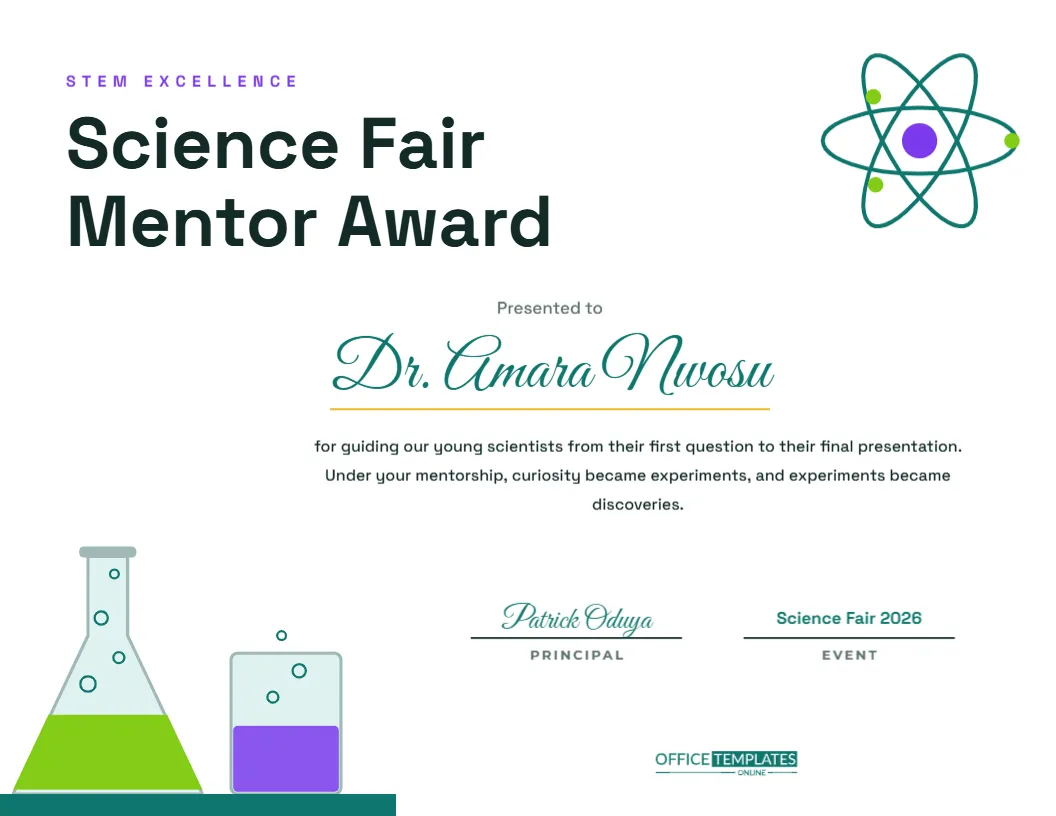
This US Letter landscape certificate (11 x 8.5 inches) is designed with a clean, modern STEM feel on a white background. In the bottom left corner sits a small laboratory bench: a teal counter strip, a conical flask filled with lime-green liquid and a beaker of purple liquid, both drawn as clear glassware with outline bubbles rising inside. In the top right corner, an atom emblem spins: three teal electron orbits around a purple nucleus, with lime-green electrons.
The heading STEM Excellence in purple capitals sits above the title Science Fair Mentor Award, set on two lines in bold Space Grotesk. Presented to introduces the mentor’s name in teal script with a gold underline, followed by a citation, signature lines for the Principal and the Event (Science Fair 2026), and our logo.
What Great Science Mentoring Looks Like
Mentoring a science fair project is different from teaching a lesson. The best mentors:
- Help students turn broad interests into testable questions.
- Teach fair testing: variables, controls, and repeated trials.
- Let students make mistakes and learn from failed experiments.
- Find equipment, space and time for experiments, often at lunch or after school.
- Coach students to explain their work clearly to judges and visitors.
- Encourage students who have never considered themselves science people.
Mentioning one or two of these in the citation shows that the school understands the real work involved.
A Sample Citation
Here is a fuller citation you could adapt:
For mentoring twelve Grade 7 students through their first science fair, from choosing questions about plant growth, water filters and paper aeroplanes to presenting their results with confidence. Three of your students went on to the regional fair, and every one of them now knows how to test an idea.
Specific numbers and topics make the certificate a meaningful record of the mentor’s contribution.
Judging Versus Mentoring
Science fairs involve two different kinds of adult help, and it is worth recognising both. Mentors work with students before the fair; judges evaluate projects on the day. This certificate is designed for mentors, but the same design with a changed title (Science Fair Judge) and citation works well to thank judges, especially visiting scientists, engineers and university staff who give up a day to help. Sending them a certificate afterwards is a courtesy that makes them far more likely to return next year.
Adapting the Certificate
- Type the mentor’s name and rewrite the citation.
- Change Science Fair 2026 to your event, such as STEM Week, Robotics Challenge, or Maths Olympiad.
- Replace STEM Excellence with your programme’s name if you have one.
- The glassware and the atom are separate grouped illustrations. Recolour the liquids to your school colours, or delete the atom and use the space for a school logo.
- Edit the principal’s name and add a second signatory, such as the Head of Science, if needed.
A Timeline of Mentoring
Science fair mentoring stretches over weeks, and each stage asks something different of the teacher. In the first week, mentors help students brainstorm questions and narrow them down to one they can actually test. Over the next fortnight, they approve plans, check safety, and help find materials. The experimental phase brings the most problems: seeds that do not sprout, equipment that breaks, results that make no sense. Here the mentor’s patience matters most. In the final week, attention shifts to analysing data, building display boards and rehearsing explanations. A citation that names even one of these stages, such as for your patience when half our experiments failed in week three, shows real understanding of the mentor’s journey alongside their students.
Beyond the Science Fair
The lab-themed design suits many STEM achievements: coaching a robotics team, running a coding club, leading a maths competition team, organising a school astronomy night or supervising student research projects. Simply change the title and citation. It also works for students, as a certificate for the best project, the most innovative experiment or outstanding scientific presentation.
Printing for a Crisp Lab Look
The design is mostly white with small areas of colour, so it prints economically on any colour printer. Use US Letter landscape at Actual size, or A4 with Fit to page, on bright white 200 to 250 gsm card to keep the glassware looking clean. The fine bubble outlines benefit from a high-quality print setting.
Presenting at the Awards Ceremony
Most science fairs end with an awards ceremony for students. Add the mentor certificates to the same ceremony: call each mentor up with their students and present the certificate in front of the young scientists they supported. It reminds everyone that behind every good project is a teacher who believed in it, and it models the value of mentorship for students who may one day mentor others.
Science Mentor Award Questions
Can parents who helped receive this certificate?
Yes. Many science fairs rely on parent volunteers; adjust the title to Science Fair Volunteer and the citation.
Can the atom be removed?
Yes. Select the atom group and delete it; the layout remains balanced.
What size is it?
US Letter landscape, 11 x 8.5 inches.
Recognise the Scientist Behind the Scientists
Every young scientist needs a mentor who asks How could you test that?. Add their name, describe their impact, and celebrate the teacher who helped curiosity become discovery.
Next year, show the certificate to the new cohort of mentors at the planning meeting. It sets expectations, celebrates what good mentoring looks like, and reminds everyone that the most important result of a science fair is not the prize, but the scientists it helps to grow.