Some teachers make a lesson on fractions feel like a cooking show, turn history into a courtroom drama, or transform the classroom into a rainforest for a week. Creativity in teaching is not only for art teachers; it is the ability to find a new way in when the usual one does not work. The Most Creative Teacher award recognises that talent, and this certificate is designed to look as lively as the teacher it celebrates.
Colour From Top to Bottom
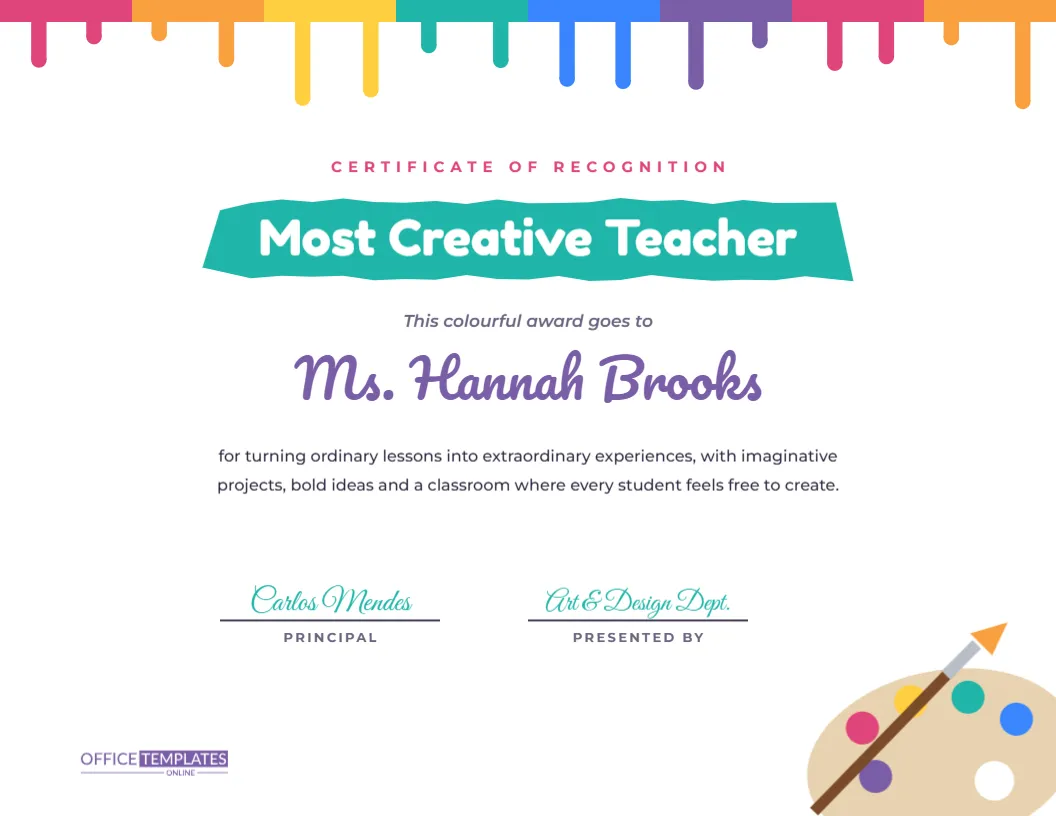
This US Letter landscape certificate (11 x 8.5 inches) starts with a band of paint running along the entire top edge in magenta, orange, yellow, teal, blue and purple, with drips of different lengths running down from it, as if someone had just painted the top of the page. In the centre, the title Most Creative Teacher is written in white Fredoka One on a wide teal brush stroke with rough, painterly ends.
Above the stroke, Certificate of Recognition appears in magenta capitals; below it, This colourful award goes to introduces the name in purple Pacifico script. A short citation and two signature lines (Principal and Art & Design Dept.) follow. In the bottom right corner sits an artist’s palette with a thumb hole, five dabs of paint and a brush resting across it; our logo is at the bottom left.
What Counts as Creative Teaching?
A strong citation names a specific creative achievement. Here are examples of what might earn this award, across different subjects:
- A maths teacher who ran a shop where pupils priced, sold and budgeted real items.
- An English teacher who staged a mock trial of a character from the class novel.
- A science teacher who built a school garden to teach plant biology.
- A languages teacher who organised a video exchange with a partner school abroad.
- A primary teacher who turned the classroom into a space station for a term-long topic.
- A PE teacher who invented a new game to include students with different abilities.
Choosing the Winner
Creativity is easy to see but hard to measure. Many schools let students nominate, since they notice the lessons that felt different. Others ask colleagues to nominate someone whose idea they borrowed. A small panel can then choose the winner based on impact on learning, originality, and willingness to share ideas. The award works well once a year, but it can also be given each term to spread the recognition across different departments.
Making the Award Your Own
- Click the name and type the teacher’s name; Pacifico suits most names, but shorten very long names or reduce the size slightly.
- Rewrite the citation to describe the creative achievement.
- Edit the signature lines. Art & Design Dept. is an example; use Student Council, Staff Committee, or a person’s name.
- The title sits on a separate teal brush stroke, so you can change its colour to match the palette dab you like best.
- The drips along the top form one grouped object; select it to move or recolour the whole band.
Print It Bright
This is one of the most colourful certificates in the collection, so print it on bright white 200 to 250 gsm card to keep the colours clean. Use US Letter landscape at Actual size, or A4 with “Fit to page”. If you print on an inkjet, choose a high-quality setting so the drips look crisp. A white frame lets the colours stand out on a classroom wall.
Creativity Awards for Students Too
The same design is perfect for students: the most creative project in a science fair, the best costume on Book Day, an imaginative story or an art competition winner. Change the title to Creative Star or Most Imaginative Project and adjust the citation. Using the same colourful design for teachers and students also shows that creativity is valued across the whole school.
Encouraging More Creative Teaching
An award is a signal. When a school publicly celebrates a creative lesson, other teachers feel permission to try something new. Leaders can build on the certificate by asking the winner to share their idea in a five-minute slot at a staff meeting, adding it to a shared ideas bank, or visiting their classroom with a colleague who wants to learn. Over time, recognising creativity creates a culture where experimentation is normal, which is exactly what keeps students engaged.
Writing a Colourful Citation
The citation on a creativity award should be as vivid as the teaching it celebrates. Rather than listing qualities, describe a scene: for the week our Year 3 classroom became an Egyptian tomb, complete with hieroglyphs, mummies and a very convincing sarcophagus. Mention the effect on students if you can: more questions, better writing, a shy pupil who took the lead. Keep it to two or three lines so it fits the space comfortably at the current font size. If the teacher’s creativity spans many projects, choose the one students remember most, and mention the others when you present the award aloud.
Keep the Evidence
Encourage the winner to photograph the project or lesson that earned the award and keep the photos with the certificate. Together they make a great addition to a teaching portfolio, and a reminder, on tougher days, of what creative teaching can achieve. Schools can also display the photos next to a copy of the certificate in a corridor, so students and visitors see the kind of learning the school is proud of. Parents often mention these displays at open evenings, and prospective families notice them too.
Questions About This Award
Is it only for art teachers?
No. The paint theme is a metaphor; the award suits creative teaching in any subject.
Can I tone down the colours?
Yes. Select the drip band and brush stroke and choose a softer palette, such as pastels.
What size is it?
US Letter landscape, 11 x 8.5 inches.
Paint Their Name in Colour
Creative teachers make learning unforgettable. Give them a certificate that is just as memorable, with their name, their idea, and a splash of every colour.