Here is a fact many students do not know: MLA style does not ask for a cover page at all. The MLA Handbook puts your name, your instructor’s name, the course, and the date in the top left corner of the first page of the essay. So why does this template exist? Because plenty of instructors still request one, especially for longer research essays, portfolios, and final papers. When they do, the safest choice is a page that repeats the MLA heading faithfully and then gives the title room to breathe. That is what this design does.
Read This Before You Add an MLA Cover
Check your assignment sheet. If it says follow MLA format and nothing about a title page, skip the cover and use the heading on page one. If it says include a title page or cover sheet, use this template. When the instructions are unclear, a short email to your instructor settles it in a minute and saves you a formatting deduction.
Cream Paper, a Red Swash and a Quill: The MLA Design
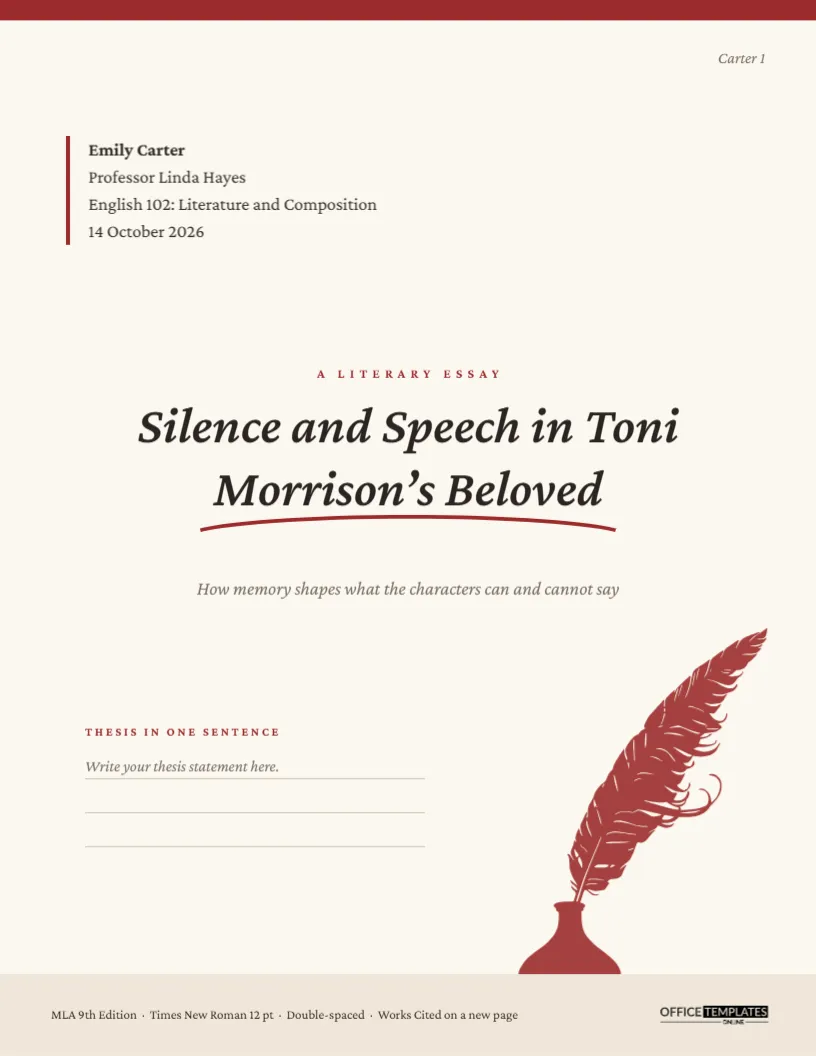
The background is a soft cream, like good writing paper. In the top right corner, a small header reads Carter 1, the surname and page number MLA puts on every page. In the top left sits the familiar four-line heading: student name, professor, course, and date, set in Crimson Pro. Lower down, a small red label says A Literary Essay, and the title appears in large italic type with a red swash curving beneath it. Under the title, an italic subtitle reads How memory shapes what the characters can and cannot say. Lower on the left, a Thesis in one sentence label sits above three faint ruled lines. A large quill dipping into an ink pot fills the lower right corner, and a sand-coloured footer band at the bottom repeats the core settings (MLA 9th Edition, Times New Roman 12 pt, double-spaced, Works Cited on a new page) beside the logo.
The MLA Heading, Line by Line
- Your full name, first name first: Emily Carter.
- Your instructor’s name with the title they use: Professor Linda Hayes.
- The course, with its number if your school uses one: English 102: Literature and Composition.
- The date in day-month-year order, without commas: 14 October 2026.
The day-first date is the detail most students miss. MLA prefers it, and instructors who grade style closely will notice.
Titles of Literary Works Inside Your Title
Your essay title often names a novel, play, or poem. MLA has clear rules here. Book-length works such as novels and plays go in italics; shorter works such as poems, short stories, and essays go in quotation marks. Since the whole title on this cover is already italic, a book title inside it should be set in roman (upright) type to stand out. For example: Silence and Speech in Toni Morrison’s Beloved. Select just the book title in the text box and turn italics off for that word.
The Thesis Line: A Small Feature That Helps You Write
The Thesis in one sentence label has three ruled lines and a grey prompt: Write your thesis statement here. You might not keep it on the final cover, but it is a useful drafting tool. Many writing centres recommend exactly this exercise: say the claim, the evidence, and the significance in one sentence before writing a paragraph of the essay. If you cannot write your argument in one sentence on this line, your essay probably needs a sharper focus. Fill it in while drafting, then either keep it as a subtitle or delete it before you submit.
Changing the Quill, Swash and Colours
The quill and ink pot are editable vector illustrations, not a flat picture. Select it and colour swatches appear, so you can turn the deep red into navy, forest green, or black. You can also ungroup it and remove the ink pot if you prefer a lone feather. The red swash under the title is a separate curved shape; change its colour to match the quill, or delete it for a quieter look. The cream page is the background and can be swapped for white if you print on standard paper.
Font Choices That Suit English Papers
Crimson Pro is a classic book face, which suits literary writing. MLA itself asks only for a legible font in which regular and italic look clearly different, at 11 to 13 points for body text. If your instructor prefers Times New Roman, pick a close serif from the font list and apply it to the heading block. Keep the title larger than the heading so the page still has a clear focus.
A Sample Cover Filled In
Here is how one student filled in this cover for a final essay. Name: Daniel Ortiz. Instructor: Dr. Rachel Kim. Course: ENGL 210 American Literature II. Date: 3 May 2027. Title: The Green Light and the Limits of Desire in The Great Gatsby. Subtitle line: Memory, money and the American past. Footer note: left as printed. Thesis: Gatsby’s dream fails not because it is too large but because it looks backward. Page header: Ortiz 1.
Printing on Cream or White Paper
The page is US Letter, 8.5 x 11 inches. If you print on white paper, the cream background prints as a light tint, which looks pleasant but uses some ink. To save ink, change the background to white before downloading. Use Download As PDF and print at actual size. For a portfolio, a slightly heavier paper, around 28 lb or 105 gsm, makes the cover feel substantial without being stiff.
Short Answers on MLA Covers
Should the page number appear on the cover?
If your instructor wants the cover counted as page 1, keep Carter 1. If not, remove it and start numbering on the essay itself.
Do I repeat the heading on the first page of the essay?
Many instructors say no when a cover is used. Follow their instructions.
Can I add my student ID?
Yes. Add it as a fifth line below the date or below your name; it does not break MLA rules when a cover page is requested.