Seating plans are usually associated with weddings, but anyone who has hosted Thanksgiving for twenty-five people knows the same problem: who sits next to whom, which grandparent needs the chair nearest the bathroom, and which cousins absolutely must not share a table. A seating chart decides it before the doorbell rings, and a nice poster by the entrance tells everyone where to go without the host having to direct traffic.
The Poster at a Glance
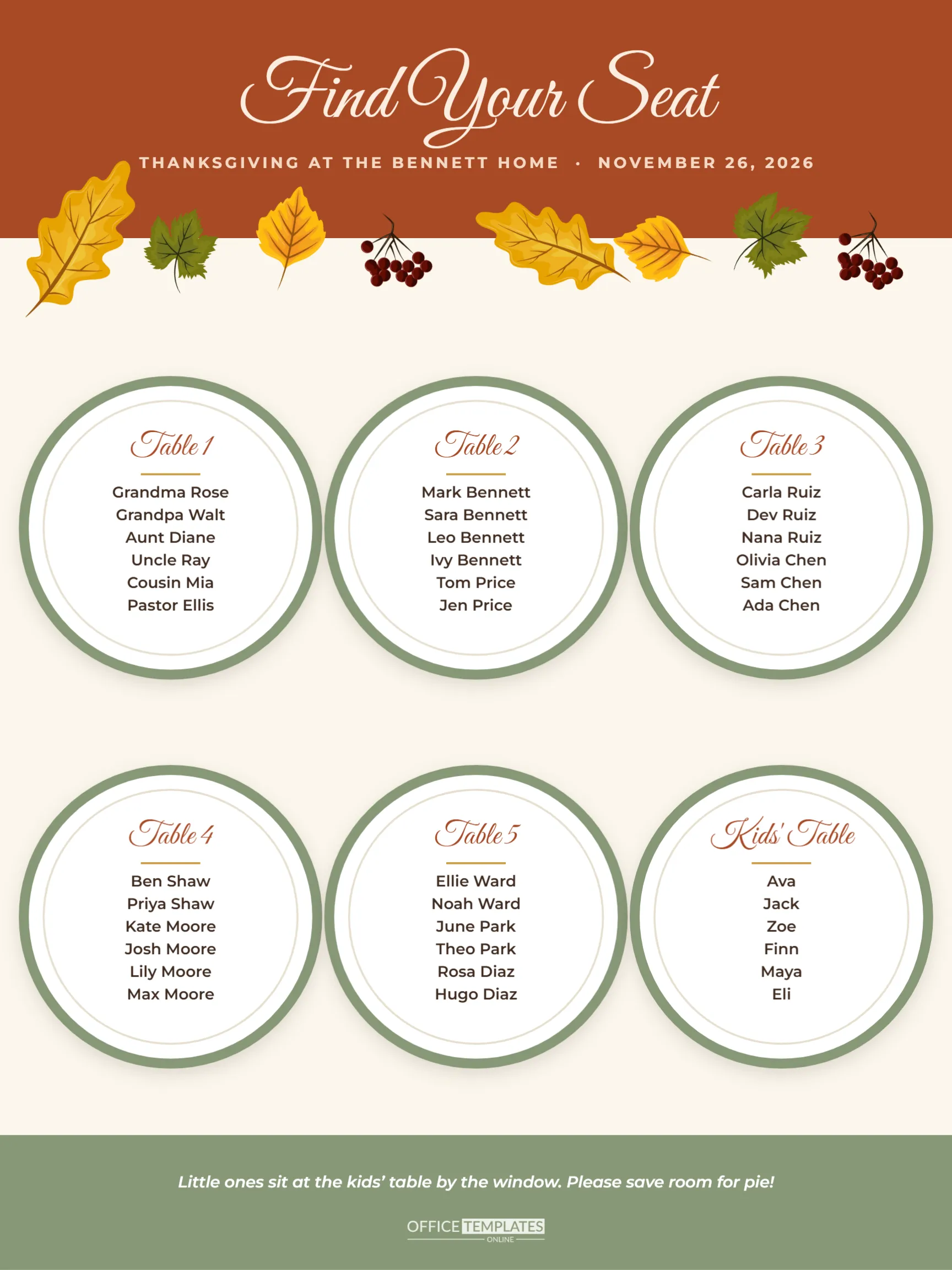
The chart is an 18 x 24 inch portrait poster, the standard size for easels and large frames. The top is a deep rust header with Find Your Seat in large cream Great Vibes script and a small line of spaced capitals underneath: THANKSGIVING AT THE BENNETT HOME · NOVEMBER 26, 2026. Along the lower edge of the header runs a garland of real autumn artwork: golden oak leaves, yellow leaves, green maple leaves, and clusters of dark red berries, laid edge to edge as if scattered on a table runner.
The main area is a warm cream with six white dinner plates arranged in two rows of three. Each plate has a thick sage-green rim and a thin inner ring, and holds a table name in rust script with a short gold rule under it, then six guest names in a neat stacked list. The sample tables are Table 1 to Table 5 and a Kids’ Table. A sage-green band across the bottom carries a friendly italic note and the brand mark.
Seating Rules That Keep the Peace
Before typing any names, it helps to plan. These guidelines come up again and again from experienced hosts.
Start with the people who need specific seats
Older guests near the door or the bathroom, people with mobility aids at the end of a table, parents of babies near the kitchen, guests with dietary needs close to their special dishes.
Mix families; do not split couples
Couples usually prefer to sit together. Families, on the other hand, enjoy each other more when they are mixed with the in-laws and friends they see less often.
Put a talker at every table
Every table needs one person who can keep a conversation going. Spread your natural hosts around.
Give teenagers their own table, near the adults
Teens hate the kids’ table and do not love being stuck beside great-aunts all evening. A teen table within earshot of the adults is a happy compromise.
Keep the kids’ table visible
The sample puts the kids’ table by the window. Wherever it is, make sure a parent can see it from their seat.
Separate the debaters
If two relatives always argue, they should not share a table. That is the main reason seating charts exist.
Filling In the Plates
Each plate has two text boxes: the table name and the guest list. Click the list and type the names, one per line. Six names fit comfortably at the default size; for eight guests, reduce the font size slightly. For a long table that seats twelve, use two plates and call them Long Table, Left and Long Table, Right.
The table names can be anything you like: numbers to match table cards, pie flavours, family branches (The Ruiz Clan), or simply Head Table. Keep them short, because the script is large.
Changing the Number of Tables
Six plates suit most large family gatherings. For four tables, delete the two plates in the bottom row and move the remaining four into a two-by-two grid, enlarging them a little. For eight or nine tables, reduce each plate’s size and add a third row by copying an existing plate together with its two text boxes. Keep the plates evenly spaced; the visual rhythm is what makes the chart easy to scan.
Customizing Colours and the Garland
The header colour, the plate rims and the bottom band are separate shapes. Change the rust header to burgundy or navy and the sage rims to gold for a more formal look. The garland pieces are editable vector artwork; select any leaf or berry cluster to recolour it from its swatches, rotate it, or remove it. If you prefer a clean header, delete the garland entirely.
Printing and Displaying the Seating Chart
Download the PDF and send it to a print shop or an online poster printer at 18 x 24 inches. Matte poster paper or a foam-board mount looks best and does not reflect the room lights. Stand it on an easel near the front door or the entrance to the dining room, at about eye height.
For a smaller gathering, print the same file at 11 x 17 or even on Letter paper and pin it to a corkboard or fridge. Because the layout is proportional, it scales down cleanly; just check that the guest names are still large enough to read.
Pair It with Place Cards
A seating chart tells guests which table; place cards tell them which chair. Using both is the smoothest option for a large dinner. Match the table names on the chart to the table number cards, and the guest names to the place cards, letter for letter.
Updating the Seating Chart When Plans Change
Thanksgiving guest lists change right up to the day: a cousin brings a new partner, a flight is cancelled, a neighbour gets invited at the last minute. Keep the chart editable until the morning of the dinner and only print it when you are sure. If a change happens after printing, write the new name on a small kraft label and stick it neatly over the old one; on a poster this size, nobody will notice. For big gatherings, keep a pen and two blank labels in your pocket during arrivals.
Seating Chart Questions
Can I list guests alphabetically instead of by table?
For very large events, an alphabetical list with table numbers is easier to scan. Replace the six plates with text columns of Name, Table pairs.
Will it work for a Friendsgiving or office party?
Yes. Change the header line to your event and the table names to teams or departments.
A little planning before the holiday saves a lot of hovering in the doorway. Fill in your tables, print your poster, and greet every guest with a seat already waiting.