Turn Animal Names into an Easy and Enjoyable Matching Activity
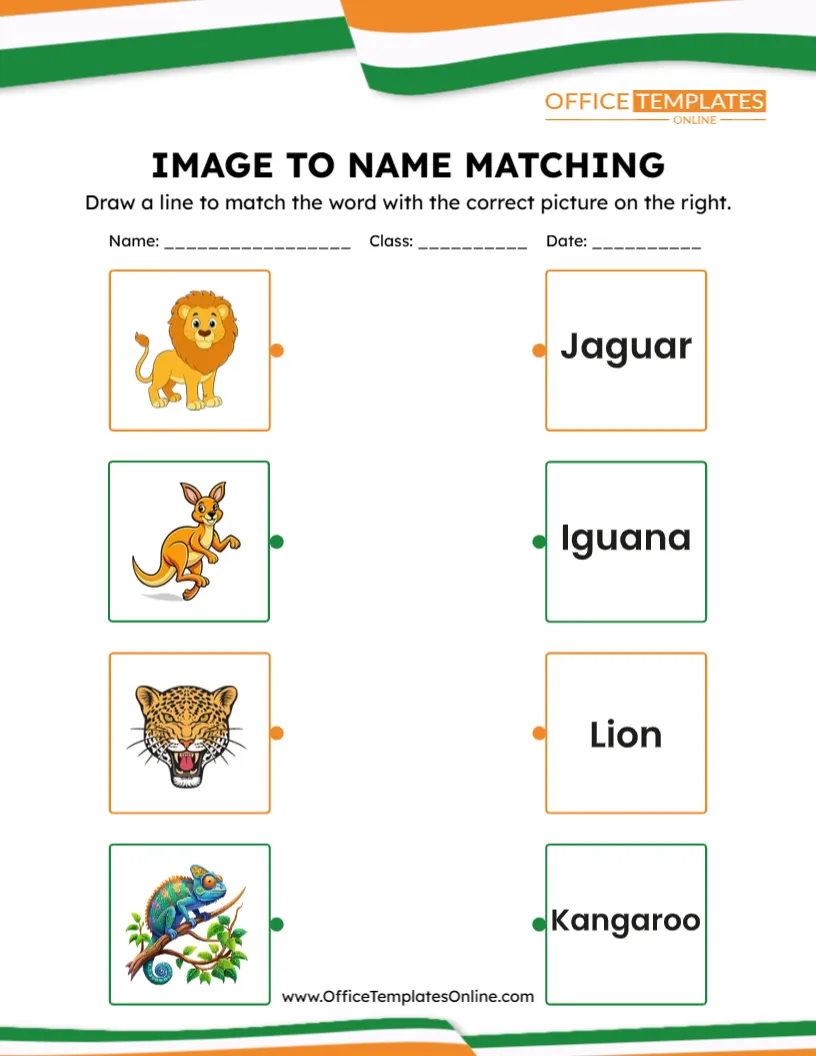
Make vocabulary practice more visual and engaging with this Image to Name Matching Student Activity Worksheet. Created for young learners, this worksheet asks students to look at animal pictures, read the animal names, and draw lines to connect each picture with the correct word.
The activity uses a straightforward format that children can quickly understand. Animal illustrations appear on one side of the page, while names are placed separately on the other side. Students have to identify each animal and find its matching name rather than simply reading a word placed directly underneath a picture.
The included examples feature animals such as a lion, kangaroo, jaguar, and iguana, providing a useful starting point for an animal vocabulary or word-recognition exercise.
Better still, this is not a fixed worksheet that you have to use exactly as shown. You can customize the template online in your browser without logging in, adapt the activity to your students, and download your finished worksheet as a PDF, PNG, or JPG.
What Students Do on This Worksheet
The instruction at the top of the worksheet is simple: draw a line to match the word with the correct picture.
Students look carefully at the pictures in the left column and compare them with the animal names in the right column. They then draw a line between each correct pair.
Picture-and-word matching activities are commonly used with early learners to support vocabulary, word recognition, visual matching, and early reading practice. Drawing connecting lines can also add a simple fine-motor element to the exercise.
Because the task itself is easy to explain, teachers can spend less time giving instructions and more time helping students understand unfamiliar words.
A Clean Layout Made for Young Learners
One of the strengths of this student matching worksheet template is its uncluttered layout. The page does not overwhelm students with long instructions or large amounts of text.
The worksheet includes:
- A clear “Image to Name Matching” activity title
- A short instruction explaining what students need to do
- Spaces for Name, Class, and Date
- Four colourful animal illustrations
- Four animal names displayed in large, easy-to-read text
- Clearly marked connection points beside the pictures and words
- Plenty of open space for students to draw their matching lines
- Saffron, white, and green decorative details around the page
- A neat, classroom-friendly worksheet format
The combination of pictures, large words, and open space helps keep attention on the actual learning task.
Useful for Building Animal Vocabulary
This particular version focuses on animal names, making it useful when introducing or reviewing animal vocabulary.
Students can look at each illustration, say the animal name aloud, find the corresponding written word, and then make the match. This creates a connection between the visual object and its written name.
Word-and-picture matching exercises are often used to strengthen vocabulary and early word recognition because learners must associate printed words with their meanings rather than view the two separately.
Teachers can extend the activity by asking students to pronounce each animal name after completing the worksheet or use the animal names in simple sentences.
Not Limited to the Animals Shown Here
The lion, kangaroo, jaguar, and iguana provide a ready-made activity, but the editable nature of the template gives you more possibilities.
You can personalize the worksheet online to create an activity that better matches your lesson. For example, you might adapt the content for a particular vocabulary set or student level.
The same matching concept can be useful for topics such as:
- Animals and their names
- Fruits and vegetables
- Classroom objects
- Common household items
- Food vocabulary
- Transportation
- Shapes
- Everyday objects
- Nature vocabulary
- Other picture-based learning topics
This makes the template much more flexible than a single-use printable worksheet.
Customize It Online Without a Login
Want to make changes before giving the worksheet to your students? You can do so directly through the online editor.
There is no login required, and you do not need complicated desktop design software just to prepare a customized classroom activity.
Depending on your lesson, you can personalize the worksheet with different text or other suitable details. You might add a class name, adjust the activity wording, or prepare a variation for another group of students.
For teachers who regularly create classroom resources, starting with an editable design can save time compared with building the entire worksheet layout from a blank page.
Suitable for Classroom Practice, Homework and More
The worksheet can fit naturally into different parts of a lesson. It does not have to be used only as a full classroom assignment.
For example, a teacher could hand it out after introducing animal vocabulary and use it as a quick check to see which words students recognize. It could also become an independent activity while the teacher works with another group.
Other possible uses include:
- Early literacy lessons
- Animal vocabulary practice
- Classroom activity time
- Independent student work
- Homework assignments
- Vocabulary revision
- Homeschool lessons
- Tutoring sessions
- Early reading exercises
- Morning work
- Learning stations
- Extra practice for young learners
Similar picture-to-word worksheets are used in classroom, home-learning, literacy, and independent-work settings because the format is simple and adaptable.
An Easy Way to Check Word Recognition
Matching activities can also provide teachers and parents with a quick way to observe whether a learner can connect a familiar picture with its written name.
If a student recognizes the picture of a lion but cannot identify the word “Lion,” for example, that may indicate that the animal itself is familiar while the written vocabulary needs more practice.
Once students finish, an adult can review the connections with them and discuss any incorrect matches. This turns a short worksheet into an opportunity for additional vocabulary practice.
Make the Activity More Interactive
You can get more learning value from the page by using it as the beginning of a short discussion rather than ending the activity as soon as all four lines are drawn.
After students complete the matches, try asking simple questions such as:
Which animal has a mane?
Which animal can hop?
Which animals have you seen before?
Can you say each animal name aloud?
Can you spell one of the animal names?
For older or more confident learners, you can ask them to write a short sentence using one or more of the words.
These small follow-up activities allow you to adapt one worksheet for students with different levels of ability.
Download as PDF, PNG or JPG
Once you have finished customizing the student activity worksheet, you can download your completed design in PDF, PNG, or JPG format.
PDF is a practical choice when you plan to print the worksheet or keep it as a classroom document. PNG provides a useful high-quality image version, while JPG is a convenient and widely supported image format.
You can choose whichever format works best for the way you intend to distribute, print, save, or share the activity.
A Ready-to-Use Activity with Room to Make It Your Own
Creating a worksheet from scratch means arranging pictures, typing vocabulary words, spacing the matching columns, adding student information fields, and making sure everything fits neatly on the page. This template already gives you that structure.
Use the existing animal activity as it is, or customize it to better suit your lesson.
With its picture-to-word matching format, student information fields, colourful illustrations, editable design, no-login online editor, and multiple download options, this Student Activity Worksheet offers a convenient starting point for teachers, parents, tutors, and other educators.
Open the template online, personalize the activity, and download the finished worksheet as a PDF, PNG, or JPG for your next learning session.