A school trip looks simple on the day: a bus, a museum, a packed lunch and a lot of excited students. Behind it lie weeks of planning. Someone chose the destination, wrote the risk assessment, booked transport, collected permission slips and payments, organised supervisors, checked allergies and medications, planned activities that link to the curriculum, and counted every student, again and again. This certificate thanks the teacher who led the way.
A Map of the Journey
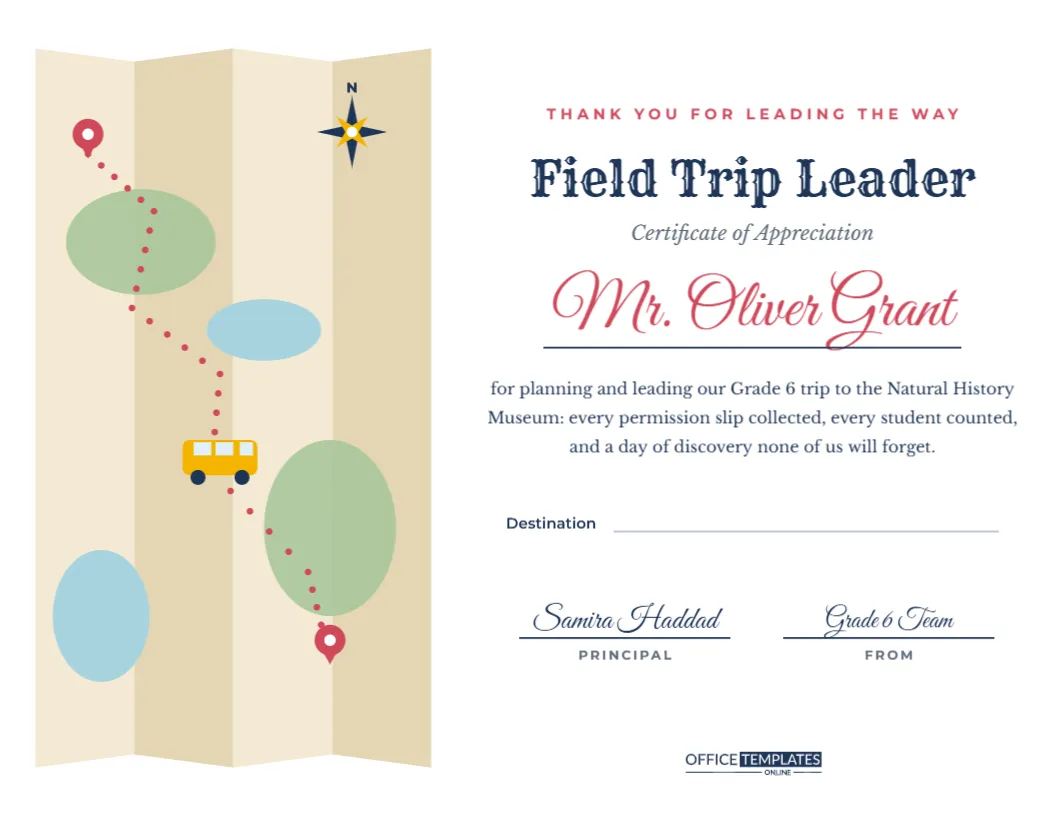
This US Letter landscape certificate (11 x 8.5 inches) has a folded paper map on its left side, with four panels alternating between cream and slightly darker tan, like a real map opened out on a table. Green patches of park and blue patches of water dot the map. A red dotted route winds from a map pin at the top left, past a small yellow school bus, to a second pin at the bottom right. In the top corner of the map, a navy and gold compass star points north.
On the right, Thank you for leading the way in red capitals sits above the title Field Trip Leader, set in the Rye typeface with the feel of an old travel poster. Certificate of Appreciation follows in italic, then the leader’s name in red script over a navy rule, a citation, a Destination line, and signature lines for the Principal and the grade team. Our logo sits at the foot of the page.
The Work Behind a School Trip
Mentioning the planning in the citation helps everyone appreciate the effort. A trip leader typically handles:
| Before the trip | On the day | After the trip |
|---|---|---|
| Choosing a destination linked to learning | Registers and headcounts at every stop | Follow-up lessons and reflection |
| Risk assessment and approvals | Managing groups and supervisors | Thank-you letters to hosts |
| Transport, tickets and budget | First aid and medical needs | Collecting feedback |
| Permission slips and payments | Keeping to the timetable | Sharing photos with families |
| Briefing students and parents | Handling the unexpected calmly | Reporting on the visit |
Filling In the Destination
The Destination line is a nice touch that makes every certificate specific. Fill it in with the place and date, such as Natural History Museum, 12 March 2026 or Outdoor Education Centre, three-day residential. For longer trips, you might mention the number of students and days in the citation: for leading 54 students on a three-day geography field course without a single lost bag.
Adapting the Map
- Type the leader’s name and edit the citation to describe the trip.
- Complete the Destination line, or delete it if the destination is already in the citation.
- Change the second signature from Grade 6 Team to the group that went on the trip.
- The map, route, pins, bus, and compass form one grouped illustration. Recolour the route or the bus, or change the map tones to suit a seaside, mountain or city trip.
- Replace Field Trip Leader with Trip Coordinator, Expedition Leader, or Residential Trip Leader if you prefer.
Thanking Every Adult on the Trip
Trips need many adults: teachers, teaching assistants, parent volunteers, coach drivers, and guides. While the leader deserves special recognition, the same design works for everyone who helped supervise. Change the title to Trip Helper or Thank You for Joining Us and the citation accordingly. Parent volunteers in particular often give up a day’s work to help, and a certificate is a lovely way to acknowledge it.
Trips Worth Recognising
Every trip involves work, but some stand out: a first overnight residential for young students, an international exchange, a trip that included students who had never left their town, or a visit that went smoothly despite a cancelled coach or a sudden storm. Day trips to museums, theatres, farms, science centres, historic sites and nature reserves all qualify too. The certificate’s wording is flexible enough for any of them. If the leader has run the same popular trip for many years, mention that as well; long-running traditions take just as much effort to keep going as brand-new ventures.
Timing the Thank-You
Present the certificate soon after the trip, while memories are fresh. A good moment is during the follow-up lesson, when students share what they learned; ask a student to hand over the certificate and say one thing they will remember. Photos from the trip displayed on the classroom screen make the moment even better, especially if students choose the pictures and tell the stories behind them.
Printing the Folded Map
The map uses soft cream, tan, green and blue, so it prints nicely on a standard colour printer. Print without scaling on US Letter, or fit the page to A4. A cream or natural card suits the travel-poster feel. Because the design leaves plenty of white space on the right, the certificate is light on ink and easy to print for several helpers at once.
A Keepsake of the Journey
Trip leaders often keep souvenirs from memorable trips. Suggest attaching the certificate to a page of trip photos, students’ thank-you notes, or a copy of the itinerary. Together, they make a lovely record of the journey, and a reminder that all that planning was worth it.
Field Trip Certificate Questions
Can students receive this certificate?
Yes. It works as a Great Explorer or Trip Journal award for students who contributed brilliantly on a trip.
Can I show a real map?
The map is decorative. For a real location, you could add a screenshot of a map as an image in place of the illustration, keeping map copyright rules in mind.
What size is it?
US Letter landscape, 11 x 8.5 inches.
Thanks for Leading the Way
Every great school trip has a leader who planned the route and brought everyone home safely. Mark the destination, add the leader’s name, and say thank you for the journey.
A leader who feels appreciated is far more likely to volunteer for next year’s trip, and students benefit most of all when experienced teachers keep taking them beyond the classroom walls to learn in the real world.