Examinations run on the quiet work of the adults in the room. Invigilators check identity, hand out papers, keep time, watch for malpractice and manage every small emergency, from a missing calculator to a fainting candidate. In many education systems, particularly for board and national examinations, teachers are formally appointed to these duties and need a certificate afterwards, either for their records, for payment claims, or as evidence of experience when applying for senior examination roles. This template provides a clear, official-looking certificate for exactly that purpose.
An Official, Security-Style Design
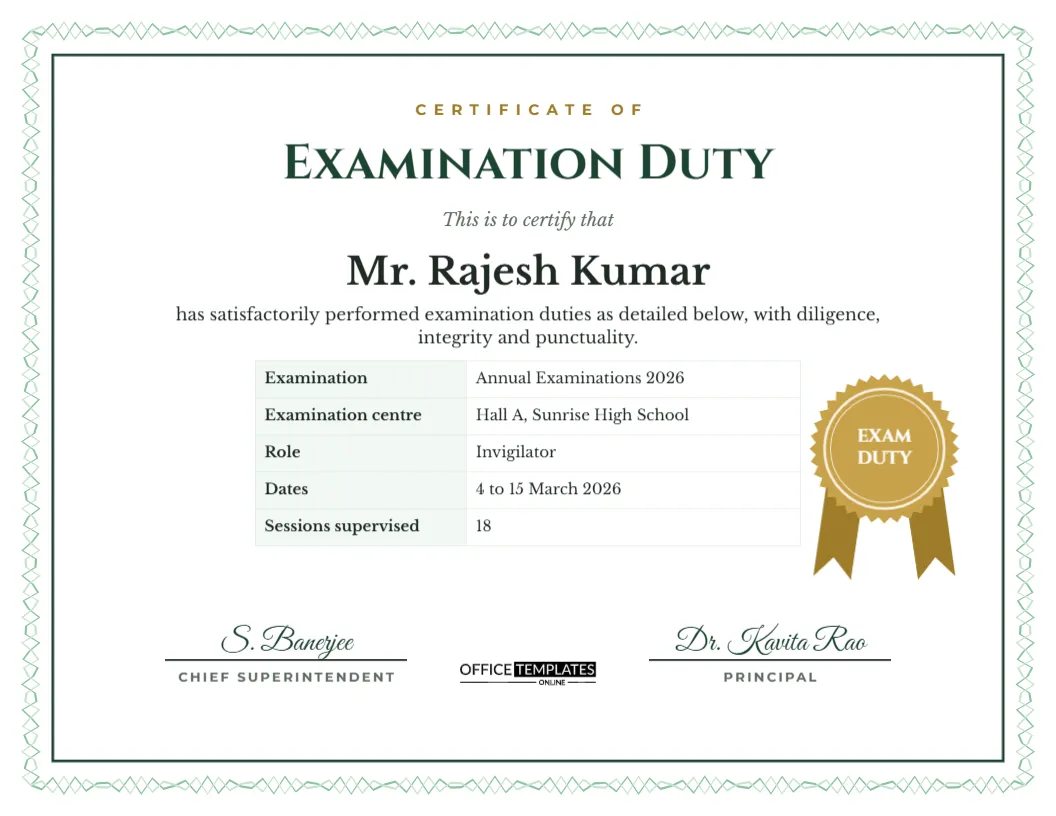
This certificate is US Letter landscape (11 x 8.5 inches). Its border borrows from the look of banknotes and official documents: two intertwined wavy lines, one in mid green and one in pale green, run all the way around the page, creating a delicate guilloche-style pattern. Inside, a single dark green rule frames the content.
The wording is formal. Certificate of appears in small gold capitals above Examination Duty in Cinzel, followed by This is to certify that, the teacher’s name in bold Libre Baskerville, and a statement that they performed examination duties with diligence, integrity, and punctuality. The key facts appear in a two-column table, a gold rosette seal with ribbons reads EXAM DUTY, and signature lines for the Chief Superintendent and the Principal sit either side of our logo.
The Duty Details Table
The table holds five rows, each easy to verify:
- Examination: the name of the exam series, for example Annual Examinations 2026 or Grade 12 Board Examinations.
- Examination centre: the hall or school where duty was performed.
- Role: invigilator, relief invigilator, hall supervisor, and so on.
- Dates: the full period of duty.
- Sessions supervised: the total number of sessions.
Double-click the table to open Edit Table Data. Add rows with + Add Row for details such as appointment order number, subjects, or remuneration reference if your authority requires them.
A Glossary of Examination Roles
Terminology varies between countries and exam boards. These are common roles you might enter in the Role row or the signature labels:
- Invigilator: Supervises candidates in the exam room, checks identity and ensures the rules are followed.
- Chief invigilator/Chief superintendent: Leads the examination at a centre, manages papers and staff, and signs off records.
- Deputy superintendent: Supports the chief superintendent and takes charge in their absence.
- Relief invigilator: Covers breaks and emergencies so no room is ever unsupervised.
- Exams officer: Coordinates entries, timetables, papers and results for a school.
Completing the Duty Record
- Type the teacher’s full name exactly as it appears on the duty appointment letter.
- Complete the table with the exam, centre, role, dates and number of sessions.
- Edit the signature names and roles to match the officials who will sign.
- The seal text is separate from the seal shape, so you can change EXAM DUTY to BOARD EXAM or your exam board’s initials.
- Download a PDF, print, sign and stamp.
Keeping Proper Records
Examination certificates are only as reliable as the records behind them. Before issuing, check each teacher’s duty against the invigilation rota and sign-in sheets, especially the number of sessions, which is often linked to payment. Give each certificate a reference number if your centre keeps a register, and file a copy. Teachers should keep their certificates too: many examination boards appoint senior invigilators and superintendents based on documented experience.
Issuing Certificates to Many Invigilators
A large examination centre may appoint dozens of invigilators each series. To issue certificates efficiently, fill in everything that is common to all of them first: the examination name, the centre, the dates and the signatories. Save that version as the centre’s master. Then, for each person, change only the name, role, and number of sessions, and download a separate file. Name each file with the invigilator’s surname and the exam series, for example, Kumar_Annual2026.pdf, so they are easy to email and archive. The whole batch can be printed together, signed in one sitting by the chief superintendent and principal, and distributed on the last day of the examination period.
Why the Formal Look Matters
Unlike appreciation certificates, this one may be presented to an authority as proof of service. The guilloche border, formal typography, table of facts, and seal all signal that it is an official record rather than a thank-you card. For the same reason, our logo appears in plain black rather than a colour, and the layout leaves generous space for real signatures and an ink stamp. Resist the urge to decorate it further; clarity is its strength.
Signing, Stamping and Filing
Print on US Letter landscape at Actual size, or on A4 with Fit to page. The fine border lines reproduce best on a laser printer. Use a good 120 to 160 gsm paper that takes ink signatures and stamps without smudging. The gold seal can be printed in colour, or you can print in greyscale and apply the centre’s embossed or ink seal on top of it.
Thanking Invigilators, Too
Although this is a formal record, a line of thanks does no harm. The template’s statement already mentions diligence, integrity and punctuality. Some centres add a sentence such as: The centre is grateful for your careful and calm supervision throughout the examination period. Exam duty is long, repetitive and demanding, and acknowledging it helps centres recruit reliable invigilators for the next series.
Exam Duty Certificate FAQs
Can non-teaching staff receive this certificate?
Yes. Many centres use support staff or external invigilators; change the role accordingly.
Can I use it for practical or oral examinations?
Yes. Enter Practical examiner or Oral examination supervisor in the Role row.
What size is it?
US Letter landscape, 11 x 8.5 inches.
A Clear Record of Careful Work
Examination duty is serious, responsible work. Record it properly with a certificate that looks official, states the facts plainly, and carries the signatures that matter. Teachers who build up a file of these certificates over several years will find them invaluable when applying for senior examination roles.