An Italian menu tells a story in courses. Guests expect to start with something to share, move on to pasta, then a main, and finish with coffee and dessert. That rhythm is part of the pleasure of eating Italian food. This Italian Restaurant Menu Template follows the traditional order, antipasti, primi, secondi, contorni, and dolci, and wraps it in the warm, understated style of a family trattoria: cream paper, fine serif type, and a flash of the Italian flag down the side.
Parchment, Tricolore and an Oval Portrait
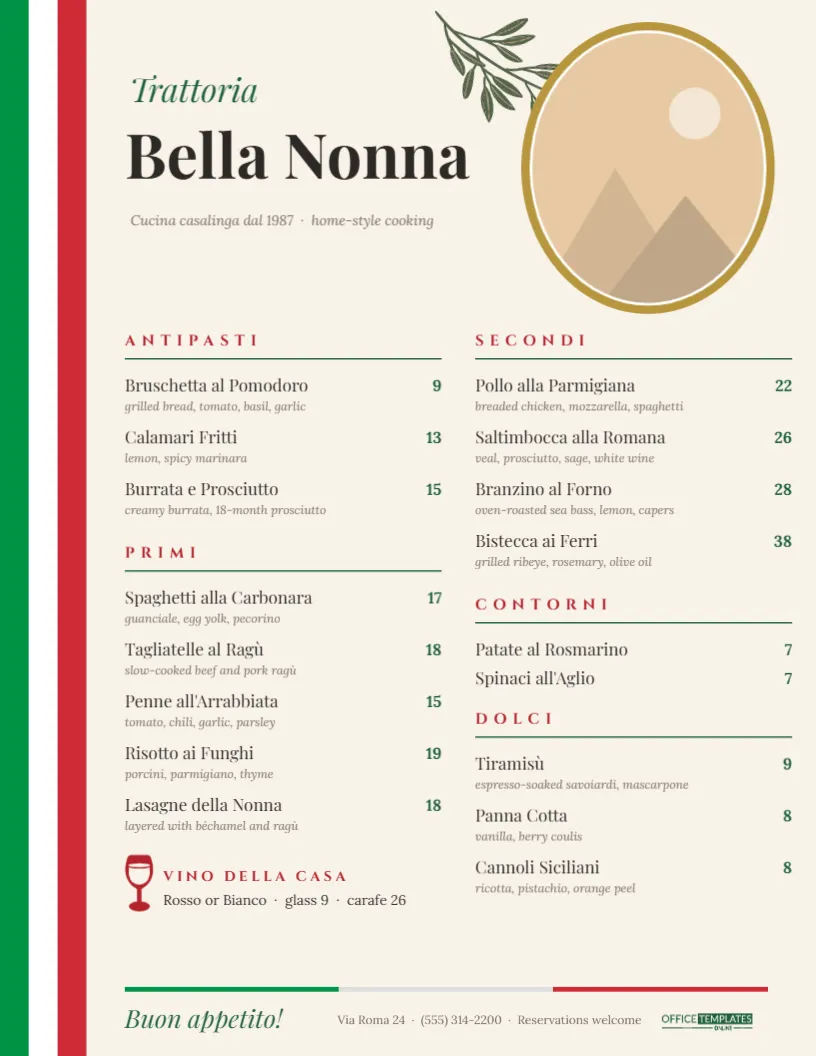
The menu is US Letter, 8.5 x 11 inches, portrait, on a soft parchment background. A slim vertical tricolore of green, white, and red runs the full height of the left edge, like the ribbon on a bottle of Chianti. At the top, a small green italic Trattoria sits above Bella Nonna in bold Playfair Display, with the line Cucina casalinga dal 1987 · home-style cooking in grey italics beneath.
To the right of the name is a tall oval photo frame on a gold ring, with a sprig of olive leaves reaching out from behind its upper-left edge. The oval suits a portrait-shaped photo: a steaming plate of pasta, your nonna in the kitchen, or the restaurant’s front door.
The menu runs in two columns. Each course name is set in widely spaced red Cinzel capitals over a thin green rule:
- Left column: ANTIPASTI (bruschetta, calamari, burrata with prosciutto) and PRIMI (carbonara, tagliatelle al ragù, penne all’arrabbiata, mushroom risotto and lasagne), then a VINO DELLA CASA line with a red wine-glass icon and the glass and carafe prices.
- Right column: SECONDI (chicken parmigiana, saltimbocca, oven-roasted sea bass and grilled ribeye), CONTORNI (rosemary potatoes and garlic spinach) and DOLCI (tiramisù, panna cotta and cannoli).
Dish names are in Playfair Display with green prices on the right, and each has a short English description in italic Lora, so the Italian names stay authentic and every guest knows what’s in them. At the foot, a three-colour rule echoes the tricolore strip, with Buon appetito! in green italics, the address and reservation line, and our logo.
The Italian Meal, Course by Course
If you are new to Italian menu structure, or want to explain it to your staff, here is what each course means and how guests usually order:
- Antipasti: Starters meant for sharing: cured meats, cheeses, bruschetta, and fried seafood. Guests often order one or two for the table.
- Primi: The first course, usually pasta, risotto, or soup. In Italy, it is a modest portion before the main. Many restaurants abroad serve it as a main, so say so if your portions are large.
- Secondi: The main course of meat or fish, typically served simply, without a heap of sides on the plate.
- Contorni: Side dishes ordered separately to go with the secondi: vegetables, potatoes, salads.
- Dolci: Desserts, followed by espresso and sometimes a digestivo such as limoncello or amaro.
Nobody is expected to order every course. A good Italian menu simply makes it easy to build a meal, which is exactly what the two-column layout does.
Customizing Your Trattoria Menu
- Name and tagline: double-click Bella Nonna and Trattoria. You could use Ristorante, Osteria, or Pizzeria instead, and write your own year in the tagline.
- Photo: click the oval and choose Replace Image. The photo fills the oval, and the gold ring stays in place.
- Dishes: each dish has three editable parts: the Italian name, the price, and the English description. Keep descriptions to three or four ingredients.
- House wine: change the glass and carafe prices, or rewrite the line for a featured bottle, such as Chianti Classico · bottle 42.
- Olive sprig and wine glass: both are editable vectors. Recolour them from their colour swatches, or ungroup the olive sprig to move individual leaves.
- Tricolore: the strip is three simple rectangles. Delete them for a more neutral look, or recolour them to match your brand.
Writing Italian Dish Names Correctly
Guests notice spelling, and so do Italian-speaking customers. A few habits help:
- Use accents where they belong: tiramisù, ragù, caffè, Bolognese (no accent).
- Keep alla when it means in the style of: Saltimbocca alla Romana, Penne all’Arrabbiata.
- Plural pasta names are normal: spaghetti, tagliatelle and cannoli are already plural in Italian.
- Pair the Italian name with an English description rather than translating it. Carbonara sells better than coal-miner’s pasta.
Specials, Seasons and the Daily Pasta
Trattorias live by the seasons: asparagus risotto in spring, tomato and burrata in summer, porcini and truffle in autumn, slow braises in winter. Because every dish line is plain editable text, a seasonal change takes minutes. Many restaurants keep one line in the PRIMI section as a rotating Pasta del giorno and write the day’s choice on a chalkboard, so the printed menu never goes out of date. Others print a fresh copy each season and keep the old versions in the editor for next year.
Printing for the Dining Room
This design looks best printed on textured or natural cream stock, such as 100 lb linen or felt-finish cover, which echoes the parchment background. For a traditional feel, clip menus to a wooden board with a leather strap, or slide them into a simple kraft cover. For daily specials, print the menu without the secondi prices and write them in by hand each night. Download a PDF for the print shop and a JPG for your website and reservation listings.
Frequently Asked by Restaurateurs
Can I add pizza to this menu?
Replace CONTORNI with PIZZE and list three or four pizzas, or add a second page with Add Page for a full pizza and wine list.
Is it suitable for an Italian-themed dinner party?
Definitely. Remove the prices, change Trattoria Bella Nonna to Cena da Marco or similar, and print one per place setting.
Can I make the menu one column?
For a short set menu, delete the right column and centre the left one. The oval photo and masthead still balance the page.
How do I mark vegetarian dishes?
Add a small green (V) after the dish name, and a key such as (V) vegetarian next to the address at the bottom.
A Tavola!
Set out your antipasti, fill in your pasta and mains, and add the photo that best captures your kitchen. Print it on good paper, lay it on the table, and let your menu invite guests to slow down and enjoy every course.