Lent is forty days of preparation for Easter, traditionally marked by prayer, fasting, and giving. Many people begin with good intentions on Ash Wednesday and lose track by the second week. A calendar on the wall, with one simple practice for each day, helps the whole season hold together. This page walks through each feature of the 2027 Lent calendar and how to use it at home, in church, or in school.
Lent 2027 Key Dates
| Day | Date in 2027 | Meaning |
|---|---|---|
| Ash Wednesday | February 10 | Lent begins |
| Palm Sunday | March 21 | Holy Week begins |
| Holy Thursday | March 25 | The Last Supper |
| Good Friday | March 26 | The Crucifixion |
| Holy Saturday | March 27 | Waiting and vigil |
| Easter Sunday | March 28 | The Resurrection |
These dates follow the Western church calendar. Orthodox churches calculate Easter differently, so adjust the notes if your community follows the Orthodox date.
Stained-Glass Windows Across the Top
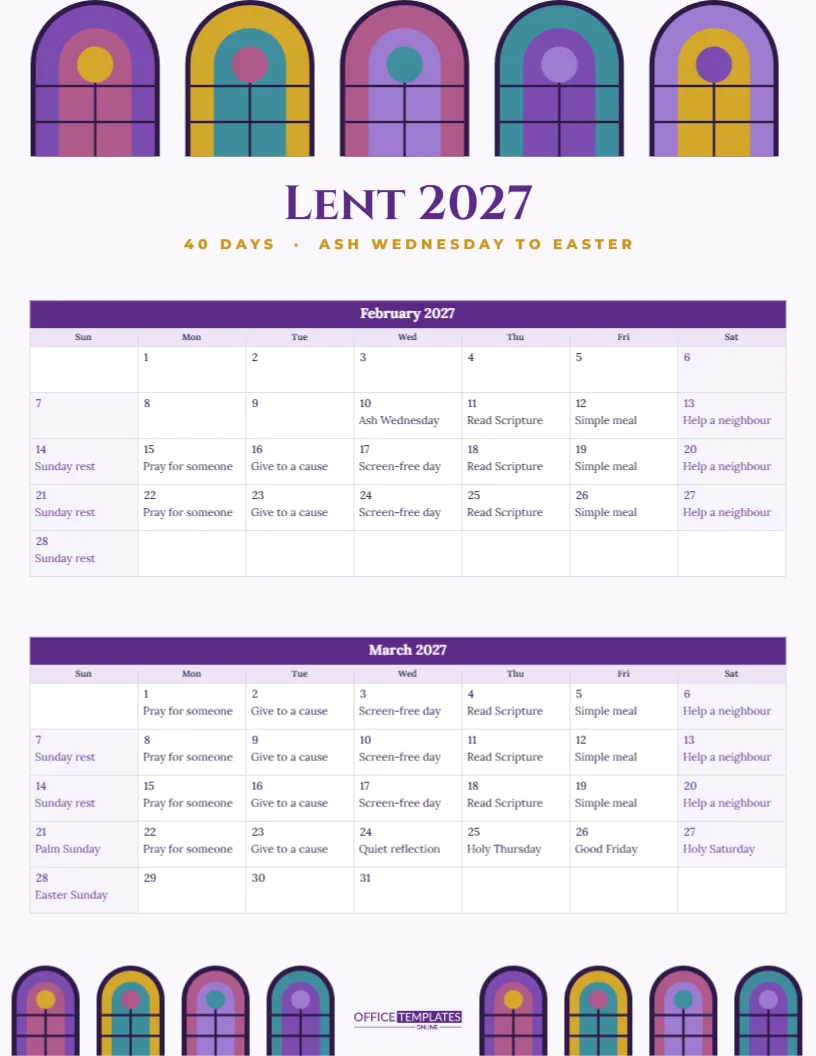
The page is US Letter portrait on a very pale lilac background. Across the top, five arched stained-glass windows stand side by side, each with a dark leaded outline, panes of violet, gold, rose and teal, a round rosette near the top and fine lead lines dividing the glass. Below them, Lent 2027 is set in deep purple Cinzel, a classical serif inspired by Roman inscriptions, with 40 DAYS · ASH WEDNESDAY TO EASTER in gold capitals underneath. A smaller row of eight windows lines the bottom of the page, four on each side of the logo, so the design is framed like a church nave.
February and March With a Practice Every Day
The centre of the page holds two Task Calendars, February 2027 above and March 2027 below, each with a purple title row, a lilac weekday row and the season’s notes written into the dates in Lora, a gentle book serif. February 10 reads Ash Wednesday. From the next day, each date carries a simple practice that rotates through the week:
- Sunday: Sunday rest (Sundays are traditionally not counted among the forty days).
- Monday: Pray for someone.
- Tuesday: Give to a cause.
- Wednesday: Screen-free day.
- Thursday: Read Scripture.
- Friday: Simple meal.
- Saturday: Help a neighbour.
Holy Week is marked separately, from Palm Sunday on March 21 through Holy Thursday, Good Friday, and Holy Saturday to Easter Sunday on March 28, with Quiet reflection on the Wednesday of Holy Week.
Why a Weekly Rhythm Works
The traditional pillars of Lent are prayer, fasting and almsgiving. Spreading them across the week means each one gets regular attention, and nobody has to decide each morning what to do. The rhythm also suits families with children, who quickly learn that Tuesday is giving day and Friday is a simple meal. Over six weeks, small repeated acts add up to something meaningful.
Changing the Daily Practices
Every note can be edited. Select either calendar, open Calendar Options, and click Manage Notes/Tasks to change the practice for any date. You might replace Screen-free day with No sweets, add a specific Scripture reading for each day, or note your parish’s Stations of the Cross on Fridays. Keep notes short, around fifteen characters, so they fit neatly on one line inside the date box.
Using the Calendar in a Parish or School
Parishes can print the calendar for every family at the Ash Wednesday service, with the church’s service times added to the dates. Catholic and Christian schools can display a large copy in the classroom, letting a different pupil read out the day’s practice each morning. Youth groups can use the Give to a Cause days to collect for a local charity and add up the total at Easter.
Lent With Children
For younger children, simplify the practices into things they can do themselves: share a toy, say a prayer for grandma, help set the table, give up one treat. Let them colour in each date once the practice is done. Seeing the purple dates fill up towards the bright Easter Sunday at the end makes the waiting feel purposeful.
Recolouring the Stained Glass
Purple is the liturgical colour of Lent, which is why it leads the palette, with gold and rose as accents. The window bands are grouped shapes, so you can recolour the panes or the leading in one place. Change the calendar colours in Calendar Options, and to reuse the design in another year, change the months and years and update the Ash Wednesday and Holy Week notes for the new dates. Fonts are Cinzel, Lora and Montserrat, all Google Fonts.
Keeping a Lenten Journal Alongside the Calendar
Many people find it helpful to write a line or two each evening about the day’s practice: who they prayed for, what they gave, what they noticed when the screens were off. A small notebook kept beside the calendar is enough. By Holy Week, those notes show how the season has shaped your thoughts and habits, and they make a meaningful read on Easter Sunday. For families, a shared notebook where each person adds one sentence at dinner works beautifully and helps children put their experience into words.
When a Day Is Missed
Lent is not about a perfect score. If a practice is missed, there is no need to make it up twice the next day; simply continue with the next date. Some people mark missed days with a small dot rather than leaving them blank, as a gentle reminder rather than a failure. What matters is returning to the rhythm, which is itself part of the spirit of the season. A missed Tuesday of giving can simply become a slightly more generous Saturday of helping a neighbour.
Printing the Lent Calendar for Home
Print the PDF on bright white letter paper so the stained-glass colours look rich. Hang it near the dinner table, where the family can read the day’s practice together at a meal, or keep it with your prayer books. A copy printed on card lasts the full six weeks without curling.
Forty days, one practice at a time, all the way to Easter morning.