Summer holidays start with endless possibilities and, by week three, often turn into I’m bored. A summer calendar with a bucket list keeps the fun going all the way to the first day of school. Here are ten ways this printable makes summer better for kids and parents.
1. All Three Summer Months on One Page
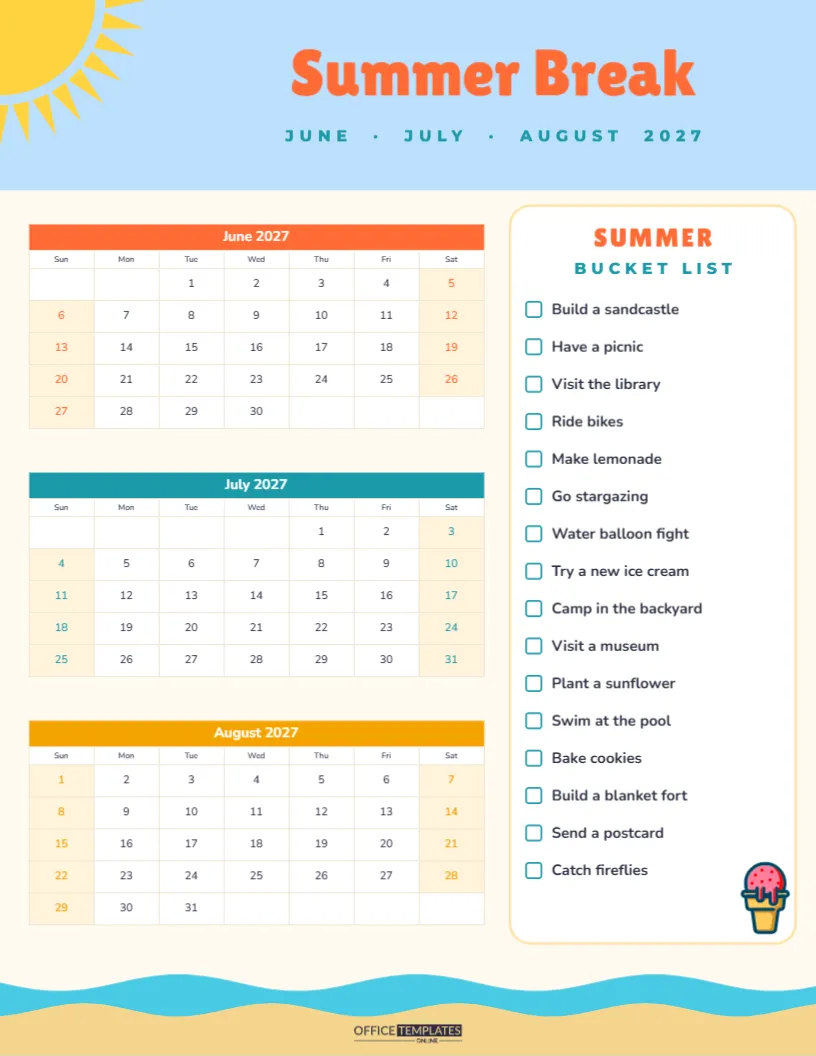
The page is US Letter portrait. Down the left side, June, July and August 2027 are stacked one above the other, each with its own coloured title row: tangerine for June, teal for July and golden yellow for August. Weekends are tinted a warm sand colour. Seeing the whole summer at once helps children understand how long the holiday really is, and helps parents spot clashes between camps, trips and visitors.
2. A Big Sun to Start the Day
A bright yellow sun sits in the top-left corner of the page, cut off by the edge so it looks as if it is rising into the picture, with sharp rays fanning out across a pale blue sky. Summer Break is written in chunky orange Lilita One, a fun, rounded display font, with JUNE · JULY · AUGUST 2027 in teal capitals underneath. It is cheerful without being cluttered.
3. Waves and Sand at the Bottom
At the foot of the page, a turquoise wave rolls across with a sandy wave in front of it, like the edge of a beach. The OTO logo sits on the sand. Sky at the top and sea at the bottom make the page feel like one complete summer scene.
4. A 16-Item Summer Bucket List
On the right side, a white card with rounded corners holds the SUMMER BUCKET LIST, with sixteen tick boxes:
- Build a sandcastle
- Have a picnic
- Visit the library
- Ride bikes
- Make lemonade
- Go stargazing
- Water balloon fight
- Try a new ice cream
- Camp in the backyard
- Visit a museum
- Plant a sunflower
- Swim at the pool
- Bake cookies
- Build a blanket fort
- Send a postcard
- Catch fireflies
A small ice cream cone illustration sits at the bottom of the card. Most of the ideas are free or cheap, and every one of them is editable text, so you can replace them with your family’s own plans.
5. Kids Can Help Write the List
The bucket list works best when children choose some of the items. Sit down together on the first day of the holiday, read the list, and swap in their ideas: a trip to the zoo, learning to dive, a sleepover with a cousin. When children write the plan, they are much more excited to make it happen.
6. Planning Big Days Around the Calendar
Write the big events into the dates: camp weeks, holidays, family visits, swimming lessons, and the first day back at school. Then choose quiet days for the bucket-list activities. A simple rule many families use is one bucket-list item per week, which spreads the fun across the whole summer instead of cramming it into the first fortnight.
| Week | Example plan | Bucket-list pick |
|---|---|---|
| Week 1 | Settle in, library card | Visit the library |
| Week 2 | Day camp | Make lemonade |
| Week 3 | Grandparents visit | Have a picnic |
| Week 4 | Beach trip | Build a sandcastle |
| Week 5 | Quiet week at home | Camp in the backyard |
7. A Countdown That Works Both Ways
At the start of summer, children love counting down to holidays and birthdays. Near the end, the calendar softens the return to school: they can see the first day coming and prepare. Colour each day as it passes, or put a sticker on days when a bucket-list item was ticked off.
8. Easy to Change the Months
School holidays do not start on the same day everywhere. The three calendars are the editor’s Calendar objects, so open Calendar Options on any of them to change the month or year. For a southern-hemisphere summer, set them to December, January and February. The same panel switches the summer weeks to start on Monday and recolours each month’s title row.
9. Restyle It for Your Family
Add your child’s name to the title (Ava’s Summer Break) and change the colours of the title rows and the sun to match their favourite colours. The ice cream is an editable vector illustration; recolour it from its colour swatches, or replace it with another icon from the editor. Fonts are Lilita One and Nunito, both Google Fonts, chosen because they are easy for young readers.
10. Simple to Print and Display
Download the PDF and print on letter paper or light card. Put it on the fridge or a bedroom door where children see it every morning, with a pen tied beside it. Print one copy per child if siblings want their own bucket lists. At the end of summer, keep the page as a record of everything you did together.
Bonus: Rainy Day Back-Up Ideas
Summer weather does not always cooperate. Keep a few indoor ideas ready for wet days: a board game tournament, a home cinema afternoon with popcorn, a baking challenge, a treasure hunt around the house, or a craft project. Write them on the back of the page so they are ready when the clouds roll in. A rainy day can even become a bucket-list day if you swap in an indoor adventure, such as a living-room campout with torches and stories.
Bonus: Keep a Little Summer Journal
Pair the calendar with a simple summer journal. Each time a bucket-list item is ticked off, children can draw a picture or write two sentences about it in a notebook, and stick in a ticket, a pressed flower or a photo. Writing a little every week also keeps reading and writing skills ticking over during the long break, which teachers always appreciate in September. By the end of the holiday, the calendar shows what you did and the journal shows how it felt. Together they make a lovely end-of-summer keepsake to share with grandparents.
Three months, sixteen adventures, and a lot of sunshine. Here’s to the best summer yet.