Exams rarely go wrong because students are not clever enough. They go wrong because revision starts too late, one subject gets all the attention, or the last week turns into panic. A revision calendar fixes the timing. Below is a countdown plan for the weeks before exams, showing how to use this printable at each stage.
The Revision Calendar at a Glance
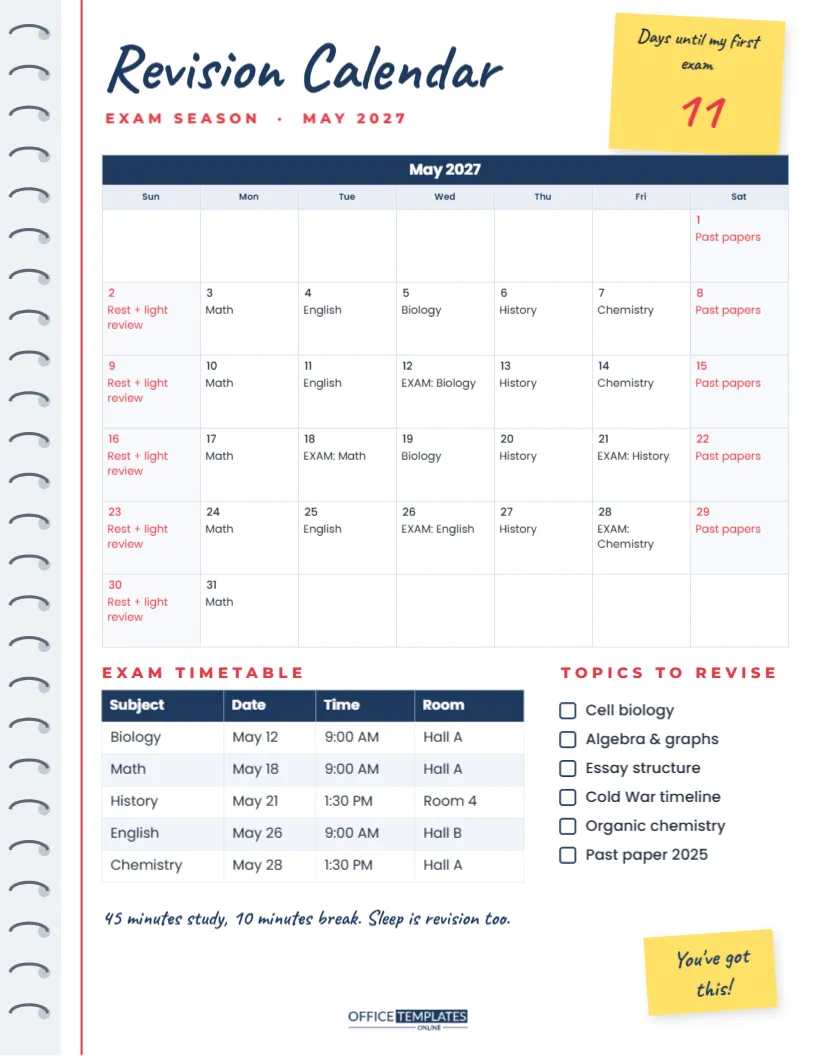
The page is US Letter portrait and looks like a page torn from a spiral notebook. A grey binding strip with spiral coils runs down the left edge, and a red margin line runs the full height of the page. Revision Calendar is written in Caveat, a natural handwriting font, in navy, with EXAM SEASON · MAY 2027 in red capitals underneath. In the top-right corner, a yellow sticky note, slightly tilted, reads Days until my first exam with a big red number.
Below, a May 2027 Task Calendar has a subject written into every date, with exam days marked EXAM:. Under the calendar, an exam timetable table and a TOPICS TO REVISE checklist sit side by side, followed by a handwritten tip and a second sticky note saying You’ve got this! near the OTO logo.
Six Weeks Before: Build the Revision Plan
Start by writing every exam into the timetable table. The sample lists five:
| Subject | Date | Time | Room |
|---|---|---|---|
| Biology | May 12 | 9:00 AM | Hall A |
| Math | May 18 | 9:00 AM | Hall A |
| History | May 21 | 1:30 PM | Room 4 |
| English | May 26 | 9:00 AM | Hall B |
| Chemistry | May 28 | 1:30 PM | Hall A |
Then list the topics for each subject and decide which are weakest. Put the hardest topics in the TOPICS TO REVISE checklist so they get attention first. The table is the editor’s Table object, so add rows for more exams or a column for the exam board or paper number.
Four Weeks Before: Rotate Through Every Subject
The calendar uses a simple weekly rotation so every subject gets regular attention: Monday is Math, Tuesday is English, Wednesday is Biology, Thursday is History, Friday is Chemistry, Saturday is for past papers, and Sunday is a lighter day of rest and gentle review. A rotation stops you from revising only your favourite subject and forgetting the others until the night before.
Use the Saturday past-paper sessions seriously: time yourself, work in silence, and mark the paper afterwards. Past papers show exactly what examiners expect, and mistakes made at home are mistakes you will not make in the exam.
Two Weeks Before: Shift to the Earliest Exams
As exams get close, give more time to the subjects that come first. In the sample, Biology is on May 12, so the days before it should lean towards Biology even if the rotation says something else. Edit the calendar notes to reflect this: select the calendar, open Calendar Options, click Manage Notes/Tasks, and change the subject for any date. Update the sticky note countdown too, so you can see the days ticking down.
Exam Weeks: Revise Between Papers
Once exams begin, use the days between them for the next subject. After Biology on Wednesday the 12th, the focus moves to Math for the following Tuesday. Keep sessions shorter and sharper during exam weeks: review summary notes, practise key questions, and get enough sleep. The handwritten tip on the page sums it up: 45 minutes study, 10 minutes break. Sleep is revision too.
The Night Before Each Exam
- Check the timetable for the time and room, and set an alarm.
- Pack pens, pencils, a calculator, a clear bottle of water, and your ID.
- Read through your summary notes once, then stop.
- Go to bed at a normal time; late-night cramming hurts more than it helps.
Changing the Calendar to Your Exam Season
The calendar is set to May 2027, but exams happen at different times around the world. Open Calendar Options to change the month and year, then update the notes for the new dates. You can also start the week on Monday and change the colours. The notebook binding, margin line, and sticky notes are ordinary shapes and text, so you can recolour or move them. Fonts are Caveat for the handwritten parts and Poppins for the rest, both Google Fonts.
For Parents and Teachers
Parents can use the calendar to understand when the pressure points are and plan quiet evenings and good meals around them. Teachers can fill in the timetable for a class and share the template, letting each student adjust the rotation and topics to their own needs. A shared plan helps students see that revision is manageable when it is broken into days.
Printing the Revision Planner
Download the PDF and print on letter paper. Pin it above your desk, where you see it every time you sit down to study, and tick topics off the checklist as you go. Some students print two copies: one for the wall and one for their revision folder.
Making Revision Sessions Count
Time spent at a desk is not the same as time spent learning. Active methods work better than re-reading: test yourself with flashcards, explain a topic out loud as if teaching it, draw a mind map from memory and then check what you missed, or answer exam questions under timed conditions. Mix topics within a session rather than spending three hours on one, and come back to difficult material a few days later. These habits fit neatly into the daily subject slots on the calendar.
Look after the basics too. Regular meals, water, fresh air and a short walk each day all help concentration. Put your phone in another room during study blocks; even a silent phone on the desk pulls attention away from the work.
Finally, be kind to yourself. Some days revision will go badly, and that is normal. Close the books, rest, and start again with the next subject on the calendar the following day. Steady effort over several weeks beats a few heroic all-nighters every time, and the calendar is there to make that steady effort easy to follow.
Plan the weeks, rotate the subjects, and walk into every exam prepared. You’ve got this.