Churches, food banks, community centres and civic groups host Thanksgiving dinners for people who would otherwise eat alone or go without. These events need a different kind of invitation from a family card: it must welcome strangers, explain that the meal is free, and recruit volunteers at the same time. Everything below is written as questions and answers, because those are exactly what organisers ask when they plan this flyer.
What Does the Community Dinner Invitation Look Like?
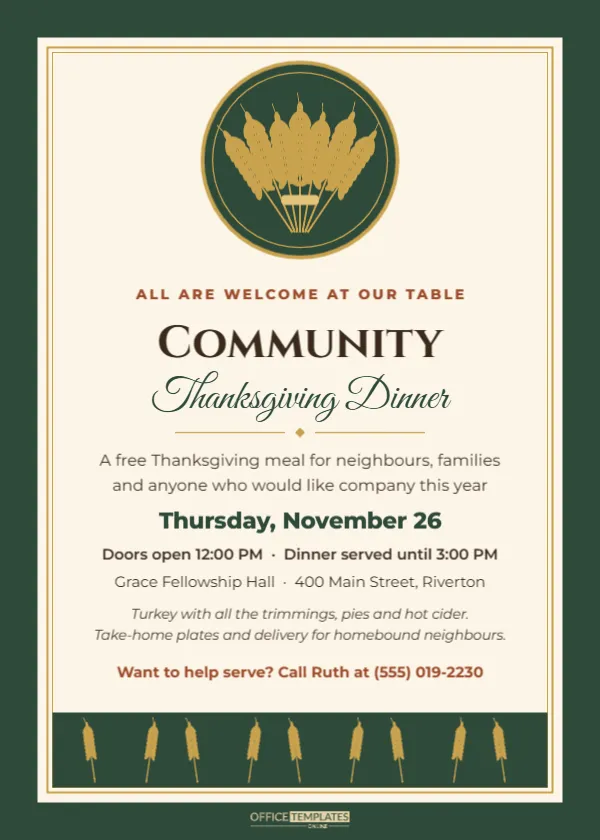
It is a 5 x 7 inch portrait card with a deep forest-green background and a cream panel set inside it, leaving a generous green margin all round. Inside the panel are two thin gold rules, one slightly inside the other, which give the page the feel of a printed programme or a certificate. At the top of the panel sits a round green medallion with a gold ring. Inside the medallion is a hand-drawn sheaf of golden wheat: seven stalks fanning out from a single tied bundle, with a pale gold band where the stalks are bound together.
Below the medallion, ALL ARE WELCOME AT OUR TABLE runs in spaced rust capitals. Community follows in Cinzel, a classical serif with Roman proportions, and Thanksgiving Dinner sits under it in flowing green script. At the bottom of the panel, a solid green band holds a row of nine small wheat stalks, echoing the sheaf at the top, and the brand mark sits in pale gold on the green margin below.
Why a Wheat Sheaf Instead of a Turkey?
Wheat is the oldest harvest symbol there is, and it carries a sense of sharing bread rather than a feast. That suits a public meal, especially one hosted by a faith community or charity, without tying the card to any single tradition. It also looks dignified. A free dinner invitation should never look cheap or pitying, and a gold sheaf on forest green reads as a proper event.
What Information Should the Card Include?
The sample text covers what people actually need to decide whether to come:
- A plain statement that the meal is free and who it is for: A free Thanksgiving meal for neighbours, families, and anyone who would like company this year.
- The day in bold green: Thursday, November 26.
- When doors open and how long food is served: 12:00 PM to 3:00 PM.
- The venue name and street: Grace Fellowship Hall, 400 Main Street, Riverton.
- What is on offer, in italics: turkey with all the trimmings, pies and hot cider, plus take-home plates and delivery for homebound neighbours.
- A volunteer call in rust: Want to help serve? Call Ruth at (555) 019-2230.
Replace every sample name, address and phone number with your own before printing.
Should We Say “Free” on the Invitation?
Yes, clearly and early. People who could most use the meal will often not come if they are unsure whether it costs money or whether they qualify. The word free in the first sentence removes that doubt. If donations are welcome, say so in a separate, low-key line (Donations welcome but never expected) rather than near the headline.
How Do We Reach Guests Who Are Not Online?
This is where a printed card earns its place. Print a stack on card stock and leave them at the library, laundromats, bus shelters, the post office counter, senior centres, pharmacies and food pantries. Ask local grocers if they will put one beside the register. Give a few to home-care nurses and meal delivery drivers, who know who is likely to be alone on the holiday.
For online sharing, download a PNG and post it to neighbourhood groups and your organisation’s page. A JPG works for printing in a bulletin or newsletter.
Can the Same Card Recruit Volunteers?
It already does. The rust volunteer line is deliberately the last line of text, set in a stronger colour so it stands out. For a volunteer-only version, change ALL ARE WELCOME AT OUR TABLE to VOLUNTEERS NEEDED, keep the rest, and swap the italic line for the shifts you need covered: setting up tables, cooking, serving, washing up, driving plates to homebound guests.
How Do We Customize the Colours?
The green background is the page colour, and the cream panel, gold frames and green foot band are separate shapes, so each can be recoloured on its own. The wheat sheaf and the row of stalks at the foot are each a single grouped object; select one to change its gold to a warmer copper, or ungroup it to shorten individual stalks. A burgundy background with cream and gold works well if your organisation uses those colours; navy and gold suits civic groups.
What Paper and Size Work Best?
At 5 x 7 inches, two cards fit on a Letter sheet. Use a heavy matte stock so they survive being pinned to corkboards. For noticeboards and church doors, scale the PDF up to a full Letter page when printing; the layout is proportional, so it simply gets bigger. A light card stock in ivory helps the cream panel blend into the paper, which hides small trimming errors.
Can We Add a Map or a QR Code?
Yes. There is a little space between the italic menu line and the volunteer line. Add a QR code from the editor’s QR tool, set it to a map link or a sign-up page, and keep it at least three-quarters of an inch wide so phones can read it.
Is This Only for Churches?
Not at all. The wording is neutral, and the wheat sheaf has no religious meaning. Food banks, mutual-aid groups, veterans’ halls, schools, restaurants donating their dining room for a day, and apartment associations all use invitations like this. Change Grace Fellowship Hall to your venue and the card fits.
When Should We Start Handing Them Out?
Three weeks before the dinner is ideal. That gives guests time to plan transport and gives you time to count likely numbers. Hand out a second round the week of the meal, because many people decide late.
A meal shared with neighbours is one of the oldest ways to give thanks. Personalise the details, print a stack, and make sure the people who need an invitation most actually receive one.